


How To Promote Your Restaurant on Instagram: Complete Guide
Instagram has over 2 billion monthly active users, and a huge chunk of them use the platform to discover where to eat. If you're a restaurant owner wondering how to promote your restaurant on Instagram, you're asking the right question, because your future customers are already scrolling, searching, and saving food content every single day. The opportunity to turn followers into paying guests has never been more accessible.
But here's where most restaurants get it wrong: they post a few photos, slap on some hashtags, and wait. That approach doesn't work. What does work is a clear strategy that combines great visuals, smart use of Instagram's features, and a direct path from someone's feed to an actual order. That last part matters more than you think. Driving engagement is only half the battle, you need a system that converts that attention into revenue without handing over 30% in commission fees to third-party apps.
That's exactly why we built The Foody Gram: to give restaurants their own branded online ordering website where customers can order directly from you. Pair that with a strong Instagram presence, and you've got a marketing engine that actually puts money back in your pocket. This guide breaks down everything, from optimizing your profile and creating scroll-stopping content to using Reels, Stories, and hashtags strategically. Whether you run a single pizzeria or manage multiple locations, these are proven tactics you can start using today.
Why Instagram works for restaurants right now
Instagram's format is a natural fit for restaurants. Food is one of the most searched and saved content categories on the platform, and Instagram's algorithm actively surfaces content to people who have already shown interest in dining and local businesses. When you understand why the platform performs so well for food businesses, you can make smarter decisions about how to promote your restaurant on Instagram, instead of just posting and hoping for the best.
Food is the most visual category on the internet
People eat with their eyes first. A well-lit photo of a perfectly plated dish or a slow-motion video of melted cheese triggers something immediate in the viewer. Instagram is built around visual content, and that puts restaurants at a natural advantage over almost every other type of business on the platform. A plumber or an accountant has to work hard to make their service look appealing. You just have to show the food.
The data backs this up. Food and beverage content consistently ranks among the highest engagement categories on Instagram, meaning likes, saves, shares, and comments happen more naturally here than in most other niches. Saves matter especially, because when someone saves a post, it signals intent to return to it, which often means they're planning a visit or placing an order soon.
Saves are one of Instagram's strongest engagement signals, and food content earns more saves per post than nearly any other category on the platform.
Instagram's features are built for local discovery
Instagram gives you tools that are directly relevant to restaurants: location tags, local search, geofenced Stories, and a searchable Explore page. When someone nearby searches "best tacos" or browses posts tagged at a neighborhood spot, your content can appear in those results organically. That kind of local discovery is difficult to replicate on most other platforms without paying for ads.
Beyond organic search, Instagram's algorithm rewards content that generates fast engagement from nearby users. A Reel that gets watched and reshared in your city signals local relevance to the algorithm, and the platform will push it further within that geographic area. That's why the way you post, not just what you post, directly impacts how many new local customers actually see your content each week.
Your potential customers are already making dining decisions here
Instagram functions as both a discovery platform and a decision-making tool at the same time. People browse it when they're bored and hungry, when they're planning a dinner out, or when a friend sends them a video of something that looks good. According to Meta's own research, a significant share of users report discovering new businesses through Instagram, and restaurants are consistently among the most searched business categories on the platform.
This matters because your competitors are likely already active on Instagram, and if you're not posting consistently, you're simply not in the consideration set when someone nearby decides where to eat tonight. Customers compare options visually. They look at your feed before they look at your menu. If your Instagram presence is thin or inactive, you lose that first impression before anyone walks through the door or places an order. The good news is that getting this right does not require a big production budget. It requires a consistent strategy and a clear understanding of what actually moves people from scrolling to ordering.
Set up an Instagram profile that drives orders
Before you post a single photo, your profile needs to work for you. Most restaurants lose potential customers in the first five seconds because their bio is vague, their link is broken, or their account is set up as personal instead of business. Getting the foundation right means every piece of content you create actually points people toward an order, not a dead end. This is the part of learning how to promote your restaurant on Instagram that most owners skip, and then wonder why their posts do not convert.
Switch to a Business account and pick the right category
A Business account unlocks features that a personal account simply does not have: Instagram Insights, contact buttons, category labels, and the ability to run ads. Go to your settings, tap "Account," and switch to Professional. Then select "Business" and choose a category like Restaurant, Pizza Place, or the option that best matches your concept. This label appears under your name in search results and on your profile, which helps Instagram surface your account when nearby users browse for dining options.
Your account category directly influences how Instagram classifies your content and who it shows your profile to in local search results.
Write a bio that tells people exactly what to do next
Your bio has 150 characters to communicate who you are, what you serve, and where you are located. Do not waste that space on vague phrases. Lead with your cuisine type and city, then include one clear call to action that directs people to order or visit. Below is a format that works well:
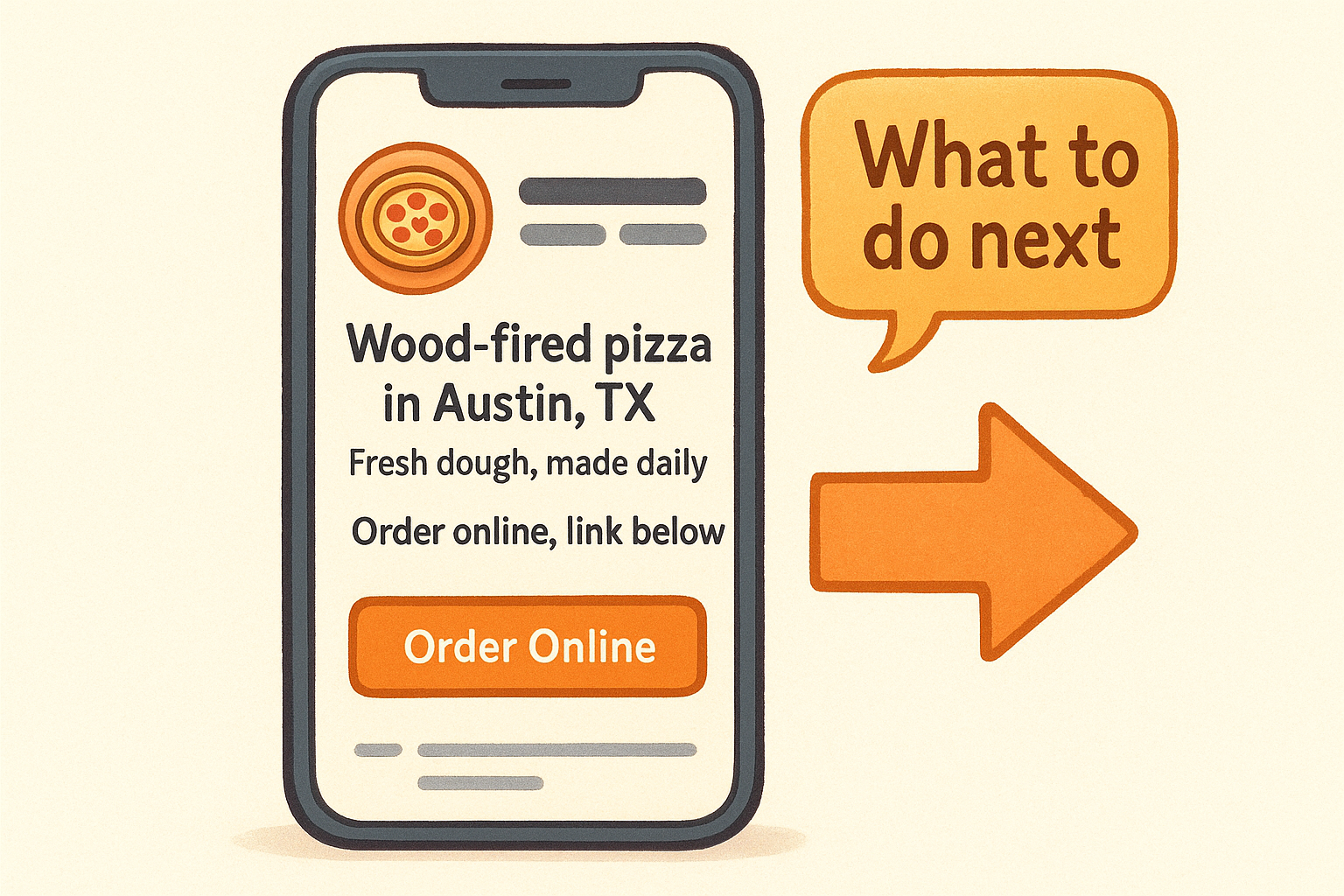
- Line 1: What you serve and where ("Wood-fired pizza in Austin, TX")
- Line 2: A short value statement ("Fresh dough, made daily")
- Line 3: A direct call to action ("Order online, link below")
Your profile photo should be your logo at a minimum size of 320x320 pixels so it stays sharp at every display size. A blurry or cropped logo signals an unmanaged account and reduces trust immediately.
Point your link to your own ordering page
Instagram gives you one clickable link in your bio, and most restaurants waste it by linking to a general website homepage with no clear path to order. Instead, link directly to your online ordering page. If you use The Foody Gram, that means sending customers to your branded ordering site where they place orders and the revenue goes straight to you, with no commission taken out. A direct ordering link in your bio can turn casual profile visitors into paying customers without them ever having to call, search elsewhere, or open a third-party app.
Define your audience, positioning, and content pillars
Random posting is one of the most common reasons restaurants stall on Instagram. If you do not know who you are talking to and what makes your restaurant worth following, your content will feel scattered and your audience will not grow. Defining your audience, your positioning, and your content pillars before you start creating is the strategic work that makes everything else easier and more effective.
Know who your best customer actually is
Think about the customers who come back most often and spend the most. What do they have in common, where do they live, and why do they choose you over other options nearby? Those answers define your target audience on Instagram. A sports bar attracting weekend game-day crowds will post and speak differently than a family-run Vietnamese spot drawing in weeknight regulars. Neither approach is wrong, but mixing both in one account without intention creates confusion.
Once you have a clear picture of your ideal customer, every caption, visual choice, and offer you create should speak directly to that person. If you serve working professionals who order lunch during the week, your content should emphasize speed, quality, and easy online ordering. If your audience is families looking for a reliable Friday-night dinner, lean into portions, value, and atmosphere. Clarity here sharpens every decision you make afterward.
The more specifically you define your audience, the easier it becomes to create content they actually respond to.
Position your restaurant with a clear angle
Positioning means choosing one thing that makes your restaurant memorable and leading with that angle consistently across all your content. It could be your grandmother's recipe, the only wood-fired oven in your zip code, or the fact that you source everything locally. You do not need to reinvent your restaurant, you just need to choose what to lead with and repeat it.
When you figure out how to promote your restaurant on Instagram effectively, your positioning becomes the thread that ties your content together. Without it, your feed looks like a generic collection of food photos that could belong to any restaurant.
Build three content pillars and stick to them
Content pillars are the repeating categories your posts fall into. Three pillars is the right number because it gives you variety without making your strategy too complex to maintain. A practical set of pillars for most restaurants looks like this:
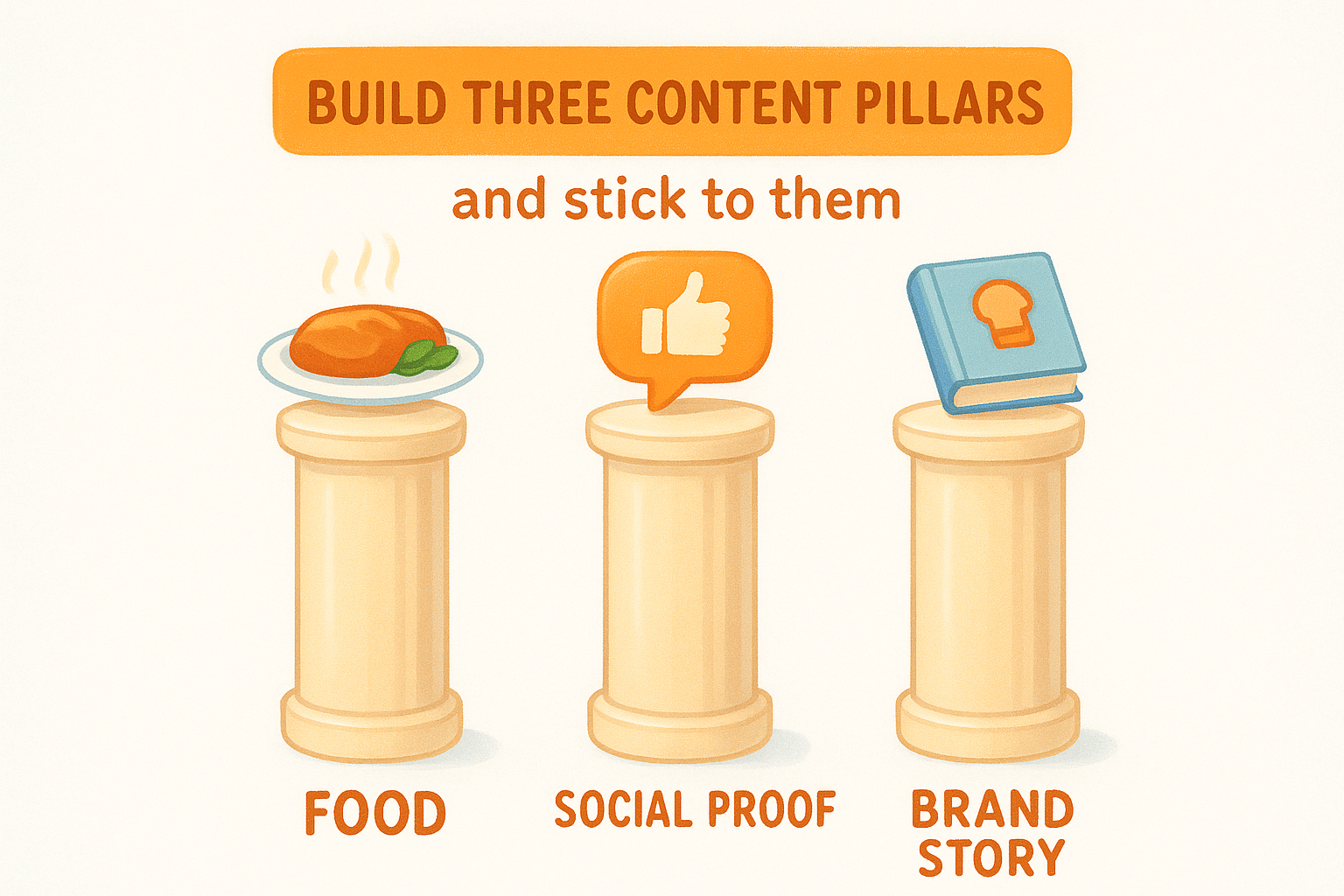
- Food content: Your menu items, specials, and behind-the-scenes preparation
- Social proof: Customer reactions, reviews, and community moments
- Brand story: Your team, your values, and what makes your restaurant worth visiting
Rotating through these three pillars keeps your feed consistent and gives followers a reason to keep coming back to see what you post next.
Create a weekly posting plan you can actually maintain
Consistency beats frequency every time on Instagram. Posting three times a week without fail will outperform posting seven times one week and going dark for the next two. The algorithm rewards accounts that show up regularly because consistent activity signals to Instagram that your account is active and worth distributing. Before you figure out how to promote your restaurant on Instagram effectively, you need a realistic schedule you can actually follow through on, not an ambitious one you abandon after two weeks.
Choose a posting frequency that fits your operation
Most restaurant owners run lean teams where social media is nobody's full-time job. Three to four feed posts per week, combined with daily Stories, is the sweet spot for most independent restaurants. That volume is enough to stay visible in your followers' feeds and keep the algorithm working in your favor without burning out whoever manages the account. If three posts a week still feels like too much, start with two and build from there. Showing up consistently at a lower frequency is always better than sporadic bursts followed by long silences.
Consistency is the single most reliable predictor of Instagram account growth, more than post quality, hashtags, or posting time.
Build your week around a repeatable structure
A predictable content structure removes the daily guesswork that causes most restaurant owners to fall behind on posting. Assign a content type to each posting day so you always know what you are creating before you sit down to create it. A simple weekly structure could look like this:
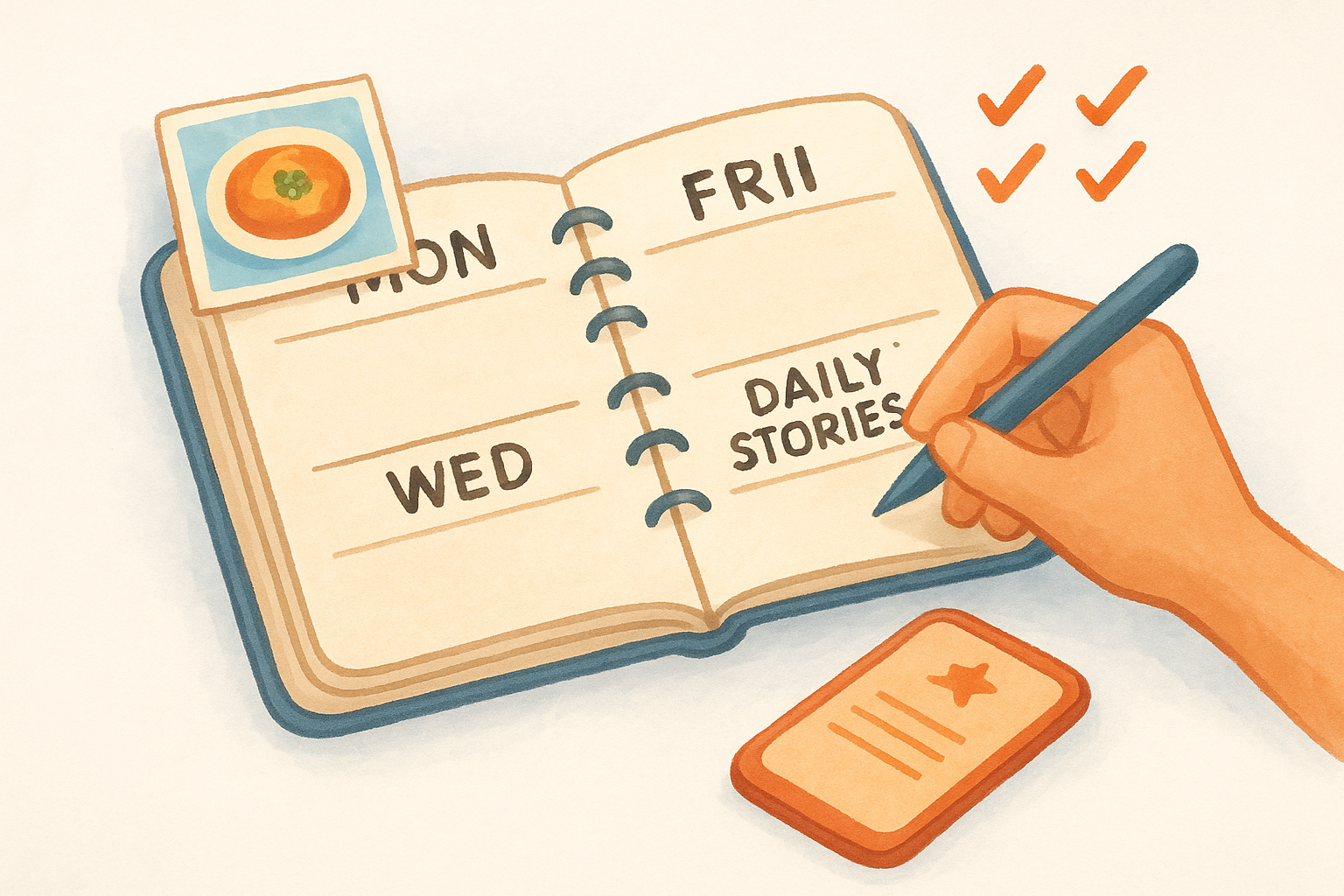
- Monday: A menu item photo or video to start the week with something appetizing
- Wednesday: A behind-the-scenes clip or team moment to build brand personality
- Friday: A promotional post highlighting a weekend special or an online ordering call to action
- Daily Stories: Quick updates like today's special, a kitchen moment, or a customer shoutout
Batch your content in one session per week
Set aside one dedicated hour each week to shoot and schedule your content rather than scrambling to post something every single day. Most smartphone cameras produce more than enough quality for Instagram when you shoot in good natural light. Capture multiple dishes, angles, and short clips in a single session, then schedule the posts using Instagram's built-in scheduling tool inside Creator Studio so they go live automatically. Batching removes the daily friction that causes inconsistent posting and frees you to focus on running your restaurant instead of chasing content ideas at the last minute.
Use Reels to reach locals and new customers
Reels are the fastest way to reach people who have never heard of your restaurant. Unlike feed posts, which are primarily shown to your existing followers, Reels get distributed to non-followers through Instagram's Explore page and the Reels feed. That means every Reel you publish has the potential to land in front of a local customer who has no idea your restaurant exists yet. If you are serious about learning how to promote your restaurant on Instagram beyond your current audience, Reels need to be part of your weekly plan.
Why Reels outperform static posts for restaurant discovery
Instagram's algorithm favors video content because video keeps users on the platform longer, and more time on the platform means more ad inventory for Instagram to sell. That business incentive directly benefits you as a restaurant, because the algorithm actively pushes Reels to new audiences in ways that static photos simply do not get. A well-performing Reel can generate thousands of views from local accounts in your city within 24 to 48 hours of posting, something that rarely happens with a photo post regardless of how good it looks.
Reels consistently deliver three to five times the organic reach of static feed posts for small business accounts, making them the highest-leverage content format on Instagram.
The local reach component matters most for restaurants. Instagram distributes Reels based on viewer location and interest signals, which means a local who watches food content regularly is highly likely to see your Reel if it performs well in the first hour after posting. That window immediately after publishing is critical, so posting when your local audience is most active, typically between 11am and 1pm or 6pm and 8pm, gives your content the best chance to gain early traction and get pushed further.
What to film and how to keep it simple
You do not need professional equipment or a video crew. Your phone, a window with natural light, and a steady hand are enough to create Reels that perform well. The best-performing restaurant Reels fall into a few repeatable categories: a satisfying food prep clip, a cheese pull or sauce pour, an order being packed for pickup, or a quick tour of a new menu item. Keep your Reels between 15 and 30 seconds for maximum completion rates, because viewers who watch the full video signal strong engagement to the algorithm, which triggers further distribution.
Build a simple rotation of Reel types so you are not reinventing the concept each week:
- A weekly "menu spotlight" showing one dish being prepared or plated
- A behind-the-scenes clip of your kitchen or team during service
- A customer reaction or pickup moment that feels authentic and unscripted
- A quick "what we made today" update tied to a daily special
Use Stories to convert followers into repeat buyers
Stories live at the top of the Instagram app, which means they are the first thing your followers see when they open the platform. While Reels are built for discovery and reaching new people, Stories are where you build the relationship that turns a first-time visitor into a regular. If you want to understand how to promote your restaurant on Instagram in a way that creates loyalty and not just awareness, Stories are the tool that does the heavy lifting after someone already follows you.
Stories disappear after 24 hours, which creates natural urgency that no other Instagram format replicates as effectively.
Post Stories that create urgency and drive action
Daily specials and limited-time offers belong in Stories, not your main feed. Because Stories expire within 24 hours, customers know they need to act now if they want that deal. A simple photo or short clip showing today's special with a caption like "Available today only, order at the link in our bio" is enough to push a follower who is already thinking about lunch into placing an actual order. You do not need fancy graphics or editing tools. A clear photo, a readable text overlay, and a call to action are all it takes to drive meaningful traffic to your ordering page.
Build a repeatable daily rhythm for your Stories. Post one Story in the morning to announce the day's special, one around midday to show the kitchen in action, and one in the evening to highlight a dish or remind followers that online ordering is open. This rhythm keeps your restaurant at the top of your followers' feeds throughout the day without requiring a major time investment.
Use interactive features to build loyalty over time
Instagram gives you several built-in interactive tools inside Stories, including polls, question stickers, and emoji sliders, and each one serves a purpose beyond entertainment. A poll asking "Which should we bring back: the truffle fries or the loaded nachos?" gives followers a stake in your menu and signals to your regulars that their opinion matters. Question stickers let customers ask about ingredients, hours, or daily specials, and answering those questions publicly builds trust faster than any caption you could write.
Use these interactions consistently and you create a feedback loop. Customers feel heard, they engage more, and your Stories reach more of your followers because Instagram prioritizes accounts with high Story engagement. Over time, the followers who interact with your Stories regularly become the ones placing repeat orders and recommending your restaurant to others.
Get discovered with hashtags, geotags, and search
Every post you create is a discovery opportunity, but only if Instagram can connect it to people actively looking for what you serve. Hashtags, geotags, and Instagram's search function are the three tools that make your content findable beyond your current followers. Understanding how each one works is a critical part of learning how to promote your restaurant on Instagram in a way that consistently brings in new local customers rather than just entertaining the audience you already have.
Use hashtags with purpose, not volume
Instagram allows up to 30 hashtags per post, but using all 30 does not improve your reach and can actually signal low-quality content to the algorithm. A focused set of 5 to 10 hashtags that directly match your cuisine, location, and content type performs better every time. Think in three layers: broad food hashtags that describe the dish, location-specific hashtags that include your city or neighborhood, and niche hashtags that match your restaurant's concept.
A small set of highly relevant hashtags consistently outperforms a large pile of generic ones because Instagram's algorithm measures engagement rate per hashtag, not total hashtag count.
Here is a practical breakdown of how to structure your hashtag mix:
- Broad category tags (2-3): #ItalianFood, #PizzaLovers, #TacoTuesday
- City and neighborhood tags (3-4): #ChicagoEats, #WickerParkFood, #ChicagoRestaurants
- Concept-specific tags (2-3): #WoodFiredPizza, #FarmToTable, #LocallySourced
Geotags turn your posts into local search results
Tagging your restaurant's location on every post and Reel is one of the simplest actions you can take to improve local discoverability. When someone taps a location tag, they see every public post tagged at that spot. That makes your content visible to people who are physically nearby or actively researching a specific neighborhood to eat in. Set up your location as a dedicated place on Facebook's location tool, which feeds directly into Instagram, so your exact restaurant name appears as a tag option rather than a vague city-level tag.
Stories that include a location sticker get surfaced in local Story clusters that anyone in the area can browse. This is free organic visibility that most restaurants leave on the table simply by forgetting to add the sticker before posting.
Optimize for Instagram's search function
Instagram's search bar now returns results based on keywords in your captions and profile text, not just hashtags. That shift means writing captions that describe your food in natural, searchable language directly improves how often your posts appear when someone nearby searches a term like "wood-fired pizza" or "late night burgers." Include your city name and cuisine type in your captions regularly, and make sure both appear in your profile bio as well, since your bio text is indexed by Instagram's search algorithm and influences how your account ranks for local food searches.
Turn engagement into sales with offers and links
Getting likes and follows feels good, but none of that pays the bills unless you convert that attention into actual orders. Engagement is a means to an end, and the restaurants that win on Instagram are the ones that build a clear, repeatable path from follower to paying customer. Figuring out how to promote your restaurant on Instagram without that conversion step means you are essentially running a free advertising campaign for someone else's benefit.
Create offers that push followers to act
A well-timed offer gives people a reason to stop scrolling and actually do something. Exclusive Instagram-only discounts, limited-time bundles, and loyalty rewards work especially well because they reward your followers for paying attention and create urgency that a standard menu post never achieves. Keep your offers simple: a specific dollar amount off, a free item with a minimum order, or a weekend special that disappears Sunday night. The simpler the offer, the faster someone can decide to take you up on it.
The best-performing Instagram offers are specific, time-limited, and tied directly to a single action like clicking the link in your bio.
Post your offers in both your feed and your Stories. Stories are ideal for flash deals that expire within 24 hours, while feed posts work better for weekly specials you want customers to find later through search or your profile. When you announce an offer, always pair it with explicit instructions: tell followers exactly what to do next, whether that is tapping the link in your bio, showing the post at the counter, or using a specific code at checkout.
Make your link do the work for you
Your bio link is the only clickable exit point Instagram gives you, and most restaurants send that traffic to a homepage that buries the ordering option three clicks deep. That friction kills conversions. Instead, point your link directly to your online ordering page so that anyone who taps it lands somewhere they can complete a purchase in under a minute. With The Foody Gram, your ordering page is your own branded site, which means every order that comes through goes straight to you without a commission cut taken off the top.
Update your bio link every time you run a new promotion so it points to the most relevant page at that moment. If you are running a weekend special, link to that item or category directly. If you are promoting catering, send people to that page. Matching your link to your active promotion removes hesitation and shortens the path from interest to order in a way that a static homepage link never will.
Measure what matters and improve every week
Posting consistently is only half the job. Reviewing what actually worked and what did not is what separates restaurants that grow on Instagram from ones that stay flat for months. If you want to understand how to promote your restaurant on Instagram in a way that keeps improving, you need to look at your numbers every week and make one concrete adjustment based on what you find.
Track the metrics that actually tell you something
Instagram Insights gives you data on every post, Reel, and Story, but not all metrics carry the same weight. Vanity numbers like total follower count feel satisfying but tell you very little about whether your content is driving orders. Focus on the metrics that connect directly to business outcomes.
Reach, saves, and profile visits are the three Instagram metrics that most reliably predict whether your content is moving people toward an order.
Here are the four numbers worth tracking each week:
- Reach: How many unique accounts saw your content, which tells you whether your Reels and hashtag strategy are working
- Saves: How many people bookmarked your post, which signals strong purchase intent and content value
- Profile visits: How many viewers clicked through to your profile after seeing a post, which indicates your content is generating genuine curiosity
- Link taps: How many people clicked the link in your bio, which is the closest Instagram gets to a direct conversion metric
Review your numbers and adjust once a week
Set aside 15 minutes every Monday to pull your previous week's data inside Instagram Insights. Look at which posts drove the most reach, which ones earned the most saves, and which format, Reel, Story, or feed post, generated the most profile visits. You are not looking for perfection, you are looking for a pattern that tells you what to do more of this week.
When you spot a post that outperformed everything else, identify the specific reason it worked: the dish, the format, the time of day, or the caption style. Then replicate that variable in your next post rather than reinventing the whole approach. If your Tuesday lunch Reel consistently drives more link taps than any other content, shift your weekly schedule to publish more content in that same slot. Small, data-driven adjustments compound quickly and produce measurably better results within four to six weeks without requiring you to completely overhaul what you are already doing.
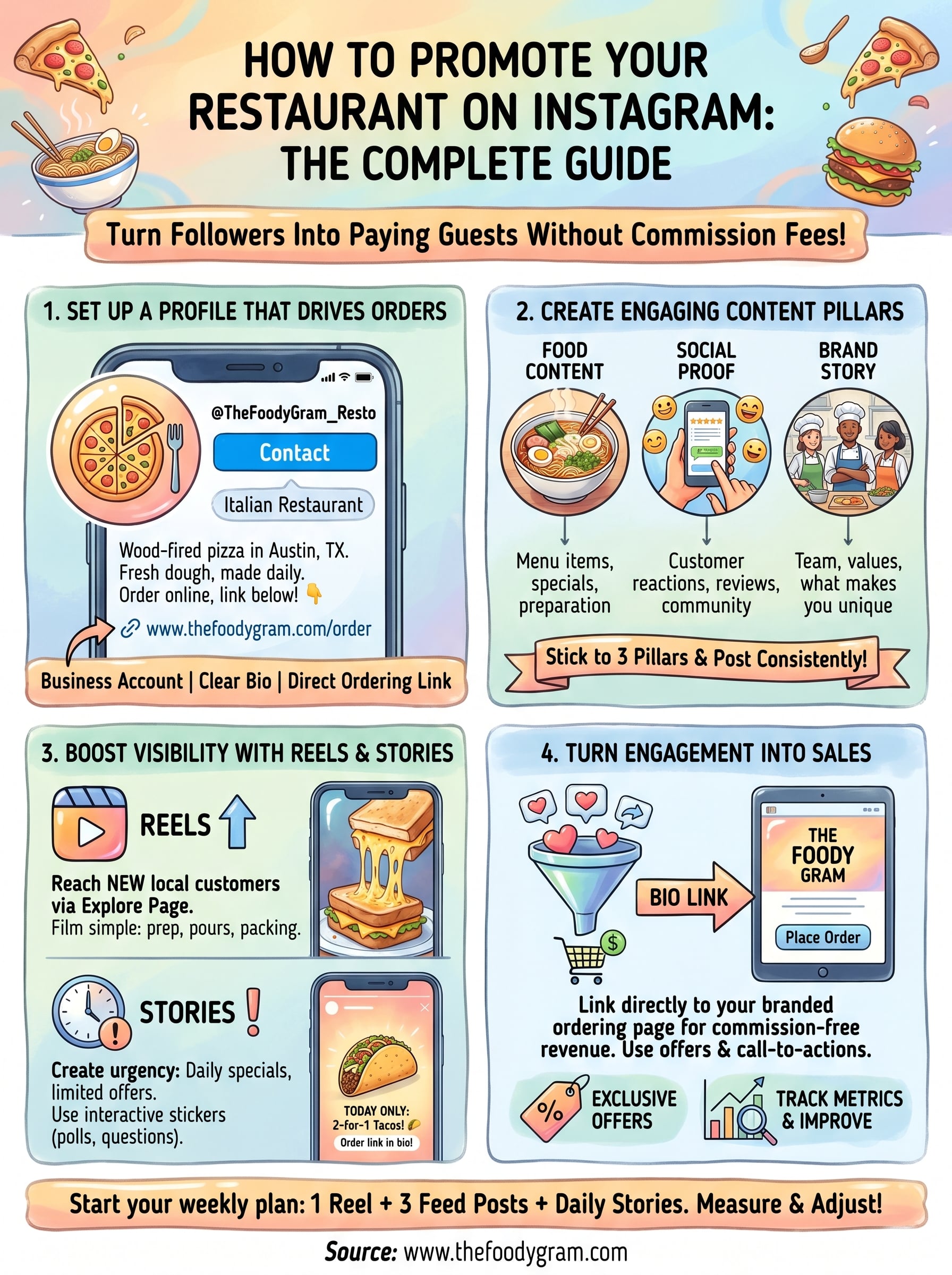
A simple plan to start this week
You now have everything you need to know about how to promote your restaurant on Instagram and turn that effort into real revenue. Start small and build from there. This week, switch to a Business account, rewrite your bio with a clear call to action, and point your link directly to your ordering page. Shoot one Reel and three feed posts using the content pillars you defined, post a daily Story announcing your specials, and add a location tag to every single piece of content you publish.
Next week, check your Insights and identify which post drove the most reach and saves. Repeat that format and build on it. The strategy compounds quickly when you stay consistent. If you want to make sure every order you drive through Instagram goes directly to you without commission fees eating into your margins, see what The Foody Gram offers and get your branded ordering site live within 48 hours.