


Text Message Marketing for Restaurants: Step-by-Step Guide
Most restaurants spend thousands on social media ads that get buried by algorithms. Meanwhile, text message marketing for restaurants sits right there with a 98% open rate, and most restaurant owners still aren't using it. That's a massive missed opportunity when your customers already have their phones in hand while deciding what to eat.
SMS marketing lets you send promotions, order updates, and limited-time offers straight to your customers' lock screens. No competing with influencers. No paying for reach. Just a direct line to the people who already love your food. When you pair that with a commission-free online ordering system like The Foody Gram, where every order goes through your own branded website instead of a third-party app, those text messages become a direct revenue driver you fully control.
This guide breaks down exactly how to build a restaurant SMS marketing strategy from scratch. You'll learn how to collect phone numbers, write messages that actually get clicks, stay compliant with regulations, and pick the right platform for your budget. Whether you run a single pizzeria or manage multiple locations, every step here is built for real-world restaurant operations.
What SMS marketing is and when to use it
SMS marketing is the practice of sending promotional or transactional text messages to customers who have opted in to receive them. For restaurants, that means reaching people with limited-time deals, new menu items, and order confirmations directly through their default messaging app. No app download is required, and no inbox algorithm decides whether your message gets seen. Your text lands on the customer's lock screen within seconds of you hitting send.
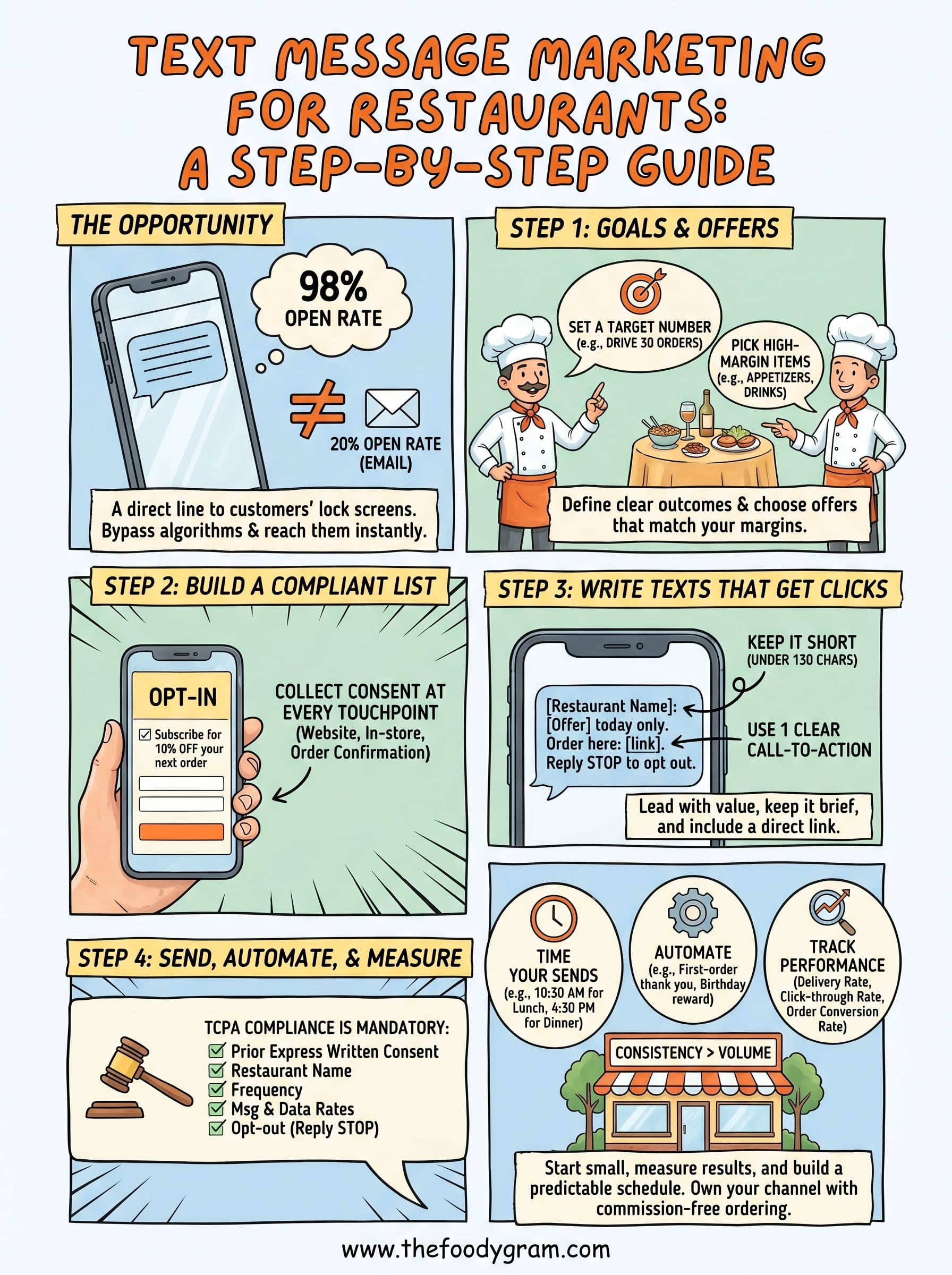
A text message carries a 98% open rate compared to roughly 20% for email, which makes it one of the most direct marketing channels available to independent restaurant owners.
How SMS differs from email and social media
Email is great for newsletters and longer promotions, but most emails get skimmed or deleted within the first few hours of arrival. Social media posts depend on platform algorithms to decide how many of your followers actually see what you share. SMS bypasses both of those problems. When you send a text, nearly every subscriber reads it, usually within three minutes of delivery. That speed and directness is what makes text message marketing for restaurants especially effective for time-sensitive offers like a lunch special that ends at 2 PM.
The tradeoff is that SMS carries a higher expectation from subscribers than email does. People guard their phone numbers more carefully than their email addresses, so you need to deliver real value with every message you send. One irrelevant text can cause a subscriber to opt out immediately, which is why content and timing matter more than send volume.
When to use SMS (and when not to)
Text messages work best when the goal is time-sensitive, action-driven, and personally relevant to the customer. SMS is not the right channel for long announcements, general updates, or anything that takes more than a few sentences to explain. Use it when you need someone to act within a specific window of time.
Here are the moments when an SMS performs well for restaurants:
- Flash promotions: "20% off online orders today only, ends at 8 PM"
- Loyalty rewards: notifying a customer they have a reward ready to redeem
- Pre-order reminders: confirming a reservation or scheduled pickup time
- Slow period boosts: a Tuesday afternoon deal to drive traffic during a quiet shift
- New menu launches: a short teaser with a direct link to order online
- Holiday specials: early access to a holiday menu for existing customers
Step 1. Set goals, offers, and your SMS budget
Before you write a single text, you need to know what you want the message to accomplish and what you're willing to spend to get there. Skipping this step is the fastest way to burn through your list with promotions that don't move the needle. Every SMS campaign should start with a clear purpose tied to a specific, measurable outcome for your restaurant.
Define what success looks like
Your goal determines everything else in the campaign, from the offer you write to the time you send. A good SMS goal is specific: "drive 30 online orders this Tuesday between 11 AM and 2 PM" is useful. "Get more customers" is not. Set a target number for orders, redemptions, or revenue before you schedule anything, so you can judge whether the campaign actually worked.
Restaurants that define a clear outcome before sending see higher redemption rates because the offer, the call-to-action, and the timing all point toward the same result.
Choose offers that match your margins
Not every deal belongs in an SMS. High-margin items like appetizers, drinks, and upsell bundles make better SMS offers than already-discounted entrees. A flat dollar discount tends to outperform a percentage discount for lower price points because it feels more concrete to the customer.
Here are offer types that work well in text message marketing for restaurants:
- Free item with minimum order (example: free garlic bread on orders over $30)
- Limited-time bundle (example: pizza and wings deal, available online only)
- Loyalty reward notification (example: your $5 reward is ready to use today)
Budget for SMS the right way
Most SMS platforms charge between $0.01 and $0.05 per message sent, or bundle a set number of messages into a monthly plan. Start by estimating your list size and send frequency, then multiply that by the per-message rate to set a realistic monthly ceiling before you commit to a platform.
Step 2. Build a compliant SMS list you own
Your SMS list is only as valuable as the trust behind it. Federal law requires written consent before you send any marketing text, and that consent must come from the customer directly. The Telephone Consumer Protection Act (TCPA) governs how businesses collect and use phone numbers for marketing, so building your list the right way protects both your subscribers and your restaurant from serious legal and financial risk.
Collect opt-ins at every customer touchpoint
You have several practical ways to grow your subscriber list without being pushy. The key is to make the sign-up visible and the value obvious at the moment a customer is already engaged with your brand. Text message marketing for restaurants only works when the people receiving your messages actually want them.
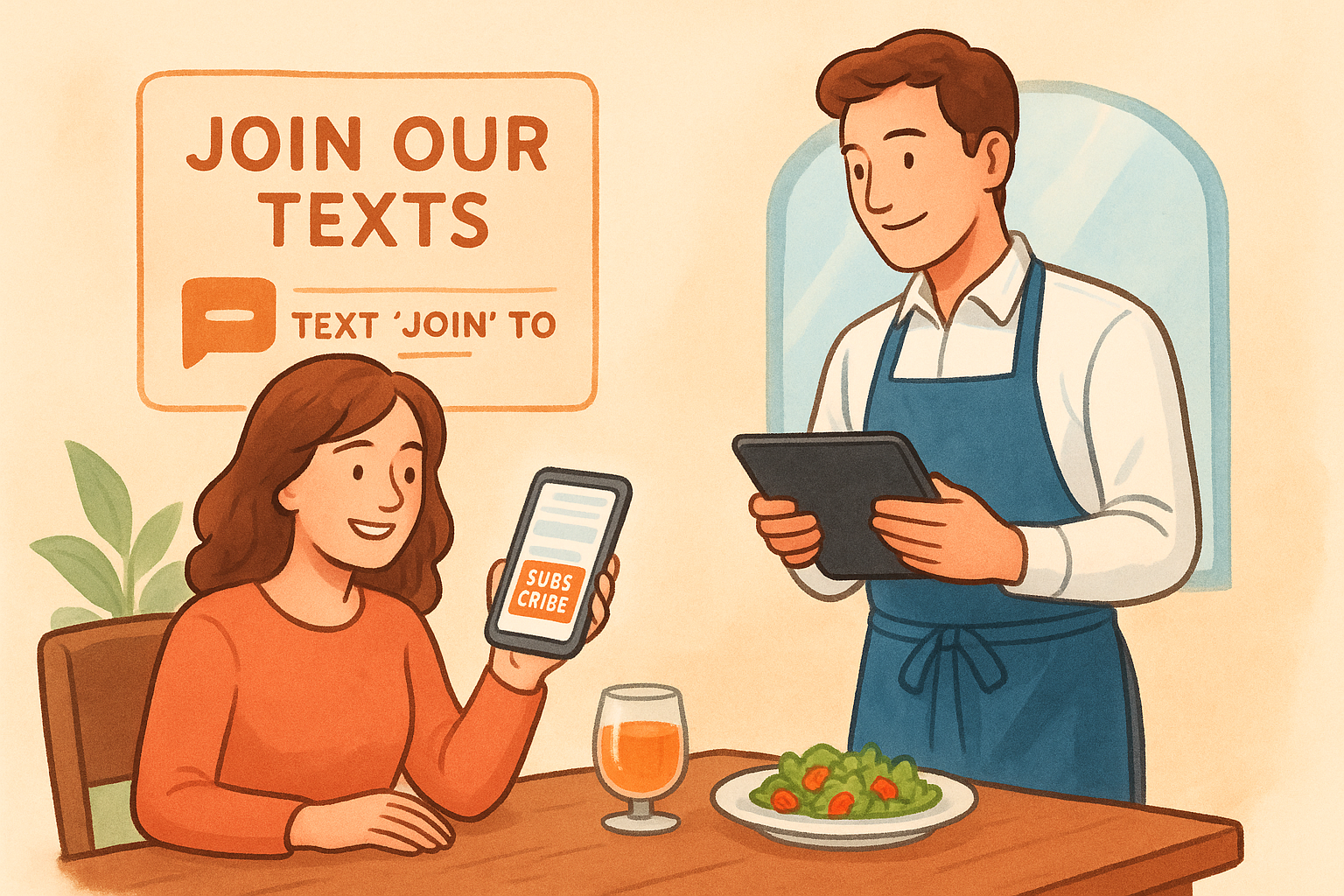
Here are proven opt-in methods for restaurants:
- Website ordering page: Add a checkbox or short form with an incentive, such as "Subscribe for 10% off your next order"
- In-store table cards or receipts: Print a keyword and shortcode so dine-in guests can opt in on the spot
- Order confirmation page: Ask customers to subscribe for future deals right after they place an online order
What TCPA compliance actually requires
Compliance is not optional, and not knowing the rules does not protect you from fines. Under TCPA guidelines, every subscriber must give prior express written consent before you send them any promotional message.
Every opt-in prompt should state the message frequency, confirm that message and data rates may apply, and explain how to opt out by replying STOP.
Your opt-in form or keyword prompt must include all of the following before a customer subscribes:
- Your restaurant name
- A clear description of the message type (promotions, order updates)
- Estimated send frequency per month
- "Msg & data rates may apply"
- Opt-out instructions (reply STOP to unsubscribe)
Step 3. Write texts that get clicks and orders
The words you choose inside a text message determine whether a customer places an order or ignores it. SMS messages cap at 160 characters for a single segment, so you have almost no room to waste. Every word needs to move the customer toward a specific action, which means you should write your call-to-action first and build the offer around it.
Keep it short and lead with value
Your subscriber decides whether to act within seconds of reading your message. Put the offer in the first line, not buried after a greeting. Start with what the customer gets, then give them a reason to act now, and end with a direct link. Text message marketing for restaurants works best when the message reads like a tip from someone who knows the customer, not a broadcast from a marketing department.
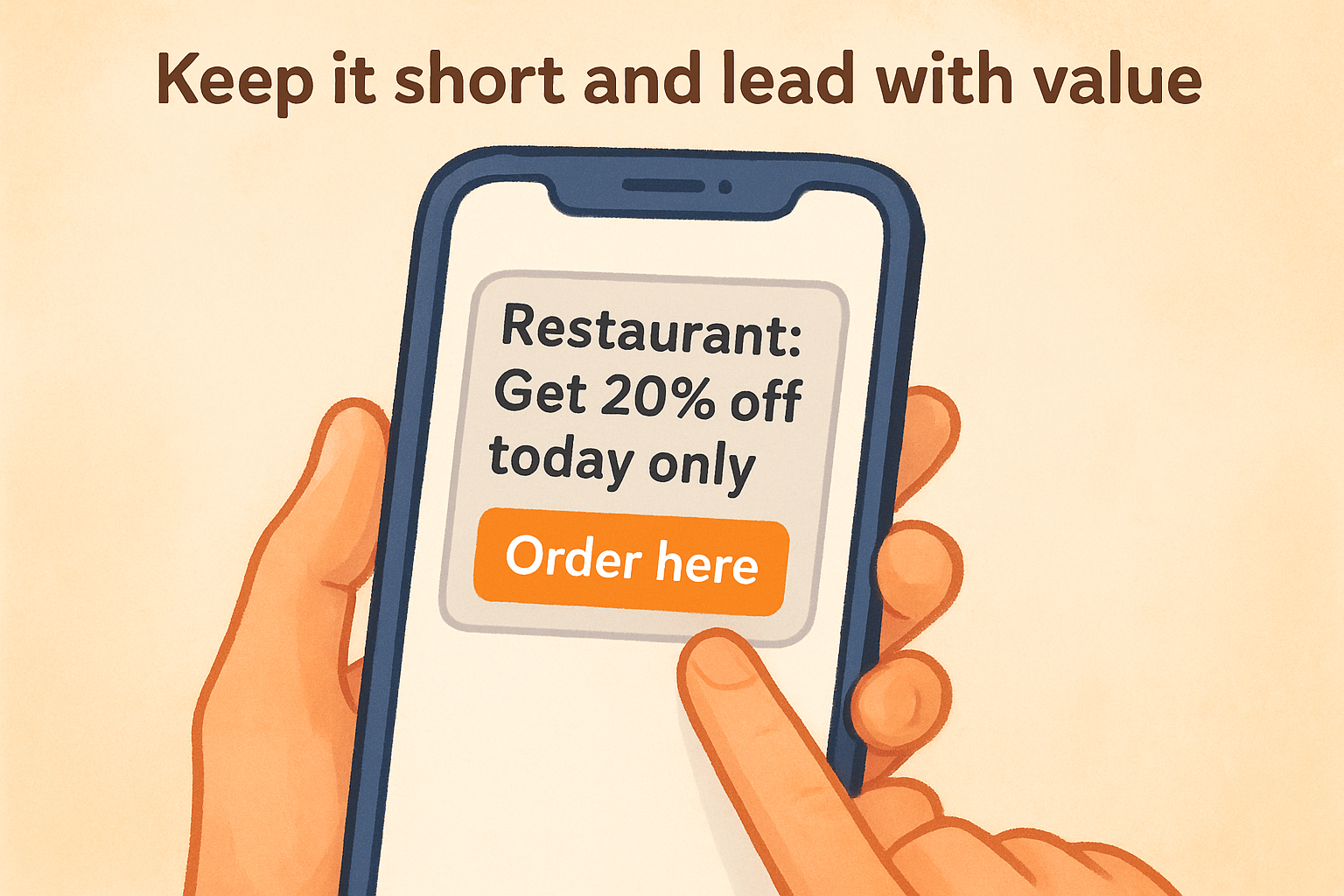
A message under 130 characters with a clear discount and a direct link consistently outperforms longer texts with multiple offers.
Use this template as a starting point for promotional texts:
[Restaurant name]: [Offer] today only. Order here: [link]
Reply STOP to opt out.
Example:
Marco's Pizza: Free cheesy bread on orders $25+. Today only.
Order: foodygram.com/marcos
Reply STOP to opt out.
Use a clear call-to-action every time
Every message needs one action, not two or three. Asking a customer to visit your website, follow your social account, and use a promo code in the same text splits their attention and reduces conversions. Pick the single action you want them to take, then make that link or instruction impossible to miss at the end of the message. If you send customers to your online ordering page, confirm the link works on mobile before you hit send.
Step 4. Send, automate, and measure performance
Sending a well-written text at the wrong time wastes the effort you put into the offer. Timing and automation separate restaurants that see consistent results from those that send one campaign and give up. Once your system is running, tracking the right metrics tells you exactly what to improve next.
Time your sends for maximum impact
Send your promotional messages 60 to 90 minutes before your peak ordering window so customers have enough time to decide and place an order. For lunch promotions, that means sending around 10:30 to 11:00 AM. For dinner, send between 4:00 and 5:00 PM. Sending too early loses urgency, and sending too late cuts off the window for action entirely.
Avoid sending texts after 8 PM or before 10 AM. The FCC's TCPA guidelines restrict contact during quiet hours, and most reputable SMS platforms enforce these windows automatically.
Automate messages based on customer behavior
Most SMS platforms let you set up trigger-based messages that send automatically when a customer takes a specific action. You do not need a large staff to run these. Set up automation for a first-order thank-you with a return discount, a loyalty milestone reward, or a re-engagement message to subscribers who have not ordered in 30 days.
Track the numbers that matter
Text message marketing for restaurants only improves when you review performance after every send. Focus on these three core metrics to diagnose what is working and what needs adjustment:
| Metric | What it tells you |
|---|---|
| Delivery rate | Whether your list is clean and active |
| Click-through rate | Whether your offer and link are compelling |
| Order conversion rate | Whether the landing page closes the sale |
Adjust your offer, timing, or call-to-action based on these numbers before scheduling the next campaign.
Keep it simple and stay consistent
Text message marketing for restaurants does not require a large team or a complex tech stack to produce real results. Start with one campaign, measure what happens, adjust one variable, and repeat. Most restaurant owners who quit SMS marketing do so because they overcomplicate it before they have any data to work from. Build the habit of sending first, then optimize from there.
Consistency matters more than volume. A predictable send schedule, even just two messages per month, keeps your restaurant visible to customers without overwhelming your list. Every message you send should offer something worth reading, link directly to your ordering page, and respect your subscribers' time. When you own your online ordering channel and keep your customers' attention through direct communication, you stop depending on third-party platforms to grow your revenue. Check out The Foody Gram's commission-free ordering plans to see how it pairs with your SMS strategy.