


Restaurant Social Media Strategy: Get More Orders In 2026
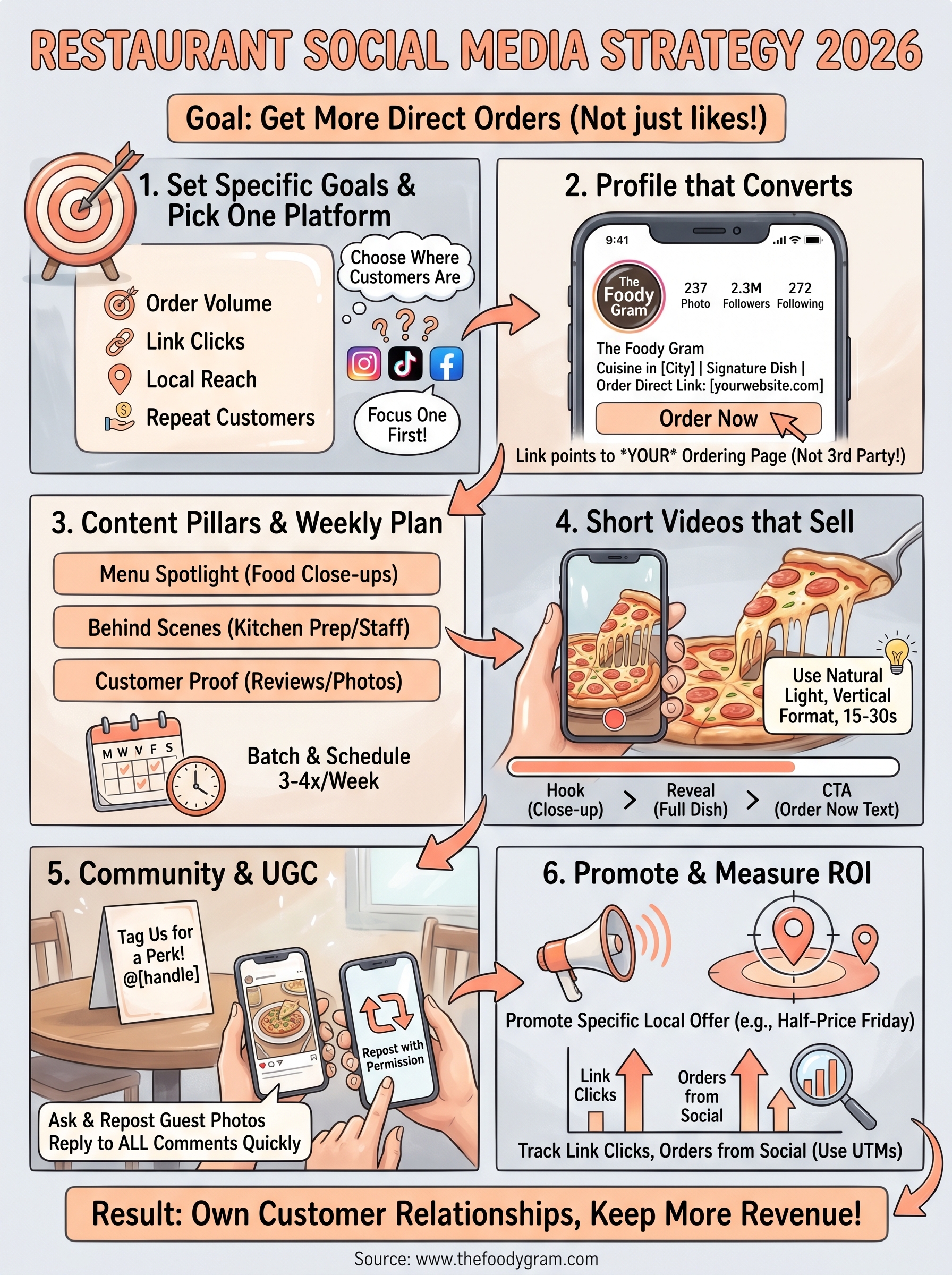
A strong restaurant social media strategy does more than rack up likes and followers. It drives real orders, builds a loyal customer base, and gives your restaurant a direct line to the people most likely to walk through your door, or place an order online. Yet most restaurant owners either post randomly with no plan or copy what chains are doing without adapting it to their own brand.
This guide breaks that cycle. You'll get a step-by-step framework for choosing the right platforms, creating content that actually converts, and measuring what matters, not vanity metrics, but orders and revenue. Every tactic here is built around one goal: getting more customers to order directly from you, not through a third-party app that takes 30% of your profit.
That's exactly why we built The Foody Gram, to give restaurants their own commission-free online ordering website where social media traffic converts into direct orders you fully control. A great social media strategy paired with your own branded ordering system means you keep more money and own your customer relationships. Let's build that strategy from the ground up.
What a restaurant social media strategy includes
A restaurant social media strategy is a written plan that connects your content, your platforms, and your business goals into one coherent system. Most restaurants treat social media as an afterthought, posting a photo here, sharing a promotion there, with no clear direction. A real strategy defines what you post, when you post, and why, so every piece of content moves a potential customer closer to placing an order rather than just scrolling past it.
The six building blocks of a restaurant strategy
Think of your strategy as a six-part framework. Each block supports the others, and skipping one creates a gap that weakens the whole system. Here is what a complete restaurant social media strategy covers:
- Goals and KPIs: Specific targets like online order volume, follower growth rate, or website click-throughs from your social profiles
- Platform selection: Choosing one or two platforms where your actual customers spend time, rather than trying to maintain a presence everywhere at once
- Content pillars: Three to five repeatable content themes, such as menu features, behind-the-scenes clips, and customer reviews, that make planning faster and more consistent
- Posting schedule: A weekly or bi-weekly calendar that sets realistic publishing frequency and keeps your profile active without burning you out
- Community and UGC: A system for responding to comments, reposting customer photos, and building the kind of local loyalty that drives repeat orders
- Paid promotion: A small, targeted ad budget that amplifies your best-performing content to people within your delivery or pickup radius
A strategy without a defined goal is just a content calendar. Tie every post back to a measurable outcome, and you will know exactly whether your effort is working.
Why restaurants need a different approach than other businesses
Generic social media advice tells you to post consistently and engage with your audience. That is sound advice, but restaurants operate under constraints that most other businesses do not face. Your content competes with professional food photographers, large chains with dedicated marketing teams, and third-party apps that spend millions running ads directly against your restaurant's name on those same platforms.
Your strategy needs to prioritize local targeting, meaning your content should reach people who can actually order from you, not a broad national audience that will never walk through your door. It also needs to account for time sensitivity. A Tuesday lunch special promoted on Monday morning performs very differently than the same post pushed out on Thursday afternoon. Understanding these nuances and building them into your plan is what separates a restaurant-specific approach from a generic one.
What this guide covers
This guide walks you through seven concrete steps, from setting goals and optimizing your profile to shooting short-form video and running local ads. Each step builds on the previous one, so you will end up with a complete, working strategy rather than a loose collection of unrelated tactics. You will also find specific templates and real examples you can adapt to your restaurant right away, without needing to hire an agency or spend weeks figuring out the basics from scratch.
Step 1. Set goals and pick your main platform
Every effective restaurant social media strategy starts with two decisions made before you ever touch a camera or write a caption: what you are trying to achieve, and where you will focus your energy. Without these anchors, you will waste hours producing content that feels busy but drives nothing measurable.
Define goals that tie directly to orders
Your goals need to connect to revenue, not reach. Follower counts and post impressions feel good but do not pay your food costs. Set specific, time-bound targets that link social activity to actual business outcomes. A useful starting format is: "Generate X online orders per week from social media traffic within 90 days."
Use this simple goal-setting template to get started:
| Goal type | Example target | How to track |
|---|---|---|
| Online orders | 25 orders/week from social links | UTM links on your ordering page |
| Profile clicks | 500 link-in-bio clicks per month | Platform analytics |
| Local reach | 10,000 accounts reached in ZIP code | Instagram or Facebook insights |
| Repeat customers | 30% of orders from returning guests | Your ordering system dashboard |
Pick one primary goal for your first 90 days and ignore everything else. Chasing multiple metrics at once splits your focus and makes it nearly impossible to know what is actually working.
Choose one platform and commit to it
Spreading yourself across Instagram, TikTok, Facebook, and X simultaneously guarantees mediocre results on all of them. Instead, pick one platform based on where your customers already spend time, and build there first.
Here is a quick way to decide. If your food is highly visual and your customers skew under 45, start with Instagram or TikTok. If you serve a neighborhood with a strong local Facebook community or run a family-style restaurant, Facebook Business is often the better starting point. You can always expand later once your first channel runs consistently.
To confirm your choice, spend 20 minutes searching your restaurant's neighborhood on each platform. Notice where local food content gets the most engagement, who is posting it, and how active the comments are. That signal tells you more than any industry report.
Step 2. Build a profile that converts to orders
Your social media profile is the first page a potential customer sees before they decide whether to keep scrolling or tap your ordering link. Most restaurant profiles waste this space with vague descriptions and broken links. Treat your profile like a landing page, because that is exactly what it is.
Write a bio that does the work for you
Your bio has one job: tell someone who you are, what you serve, and where to order, in three lines or fewer. Skip the generic "fresh ingredients, made with love" copy. Instead, state your cuisine type, your location, and a direct action the visitor should take. Here is a simple template you can adapt right now:
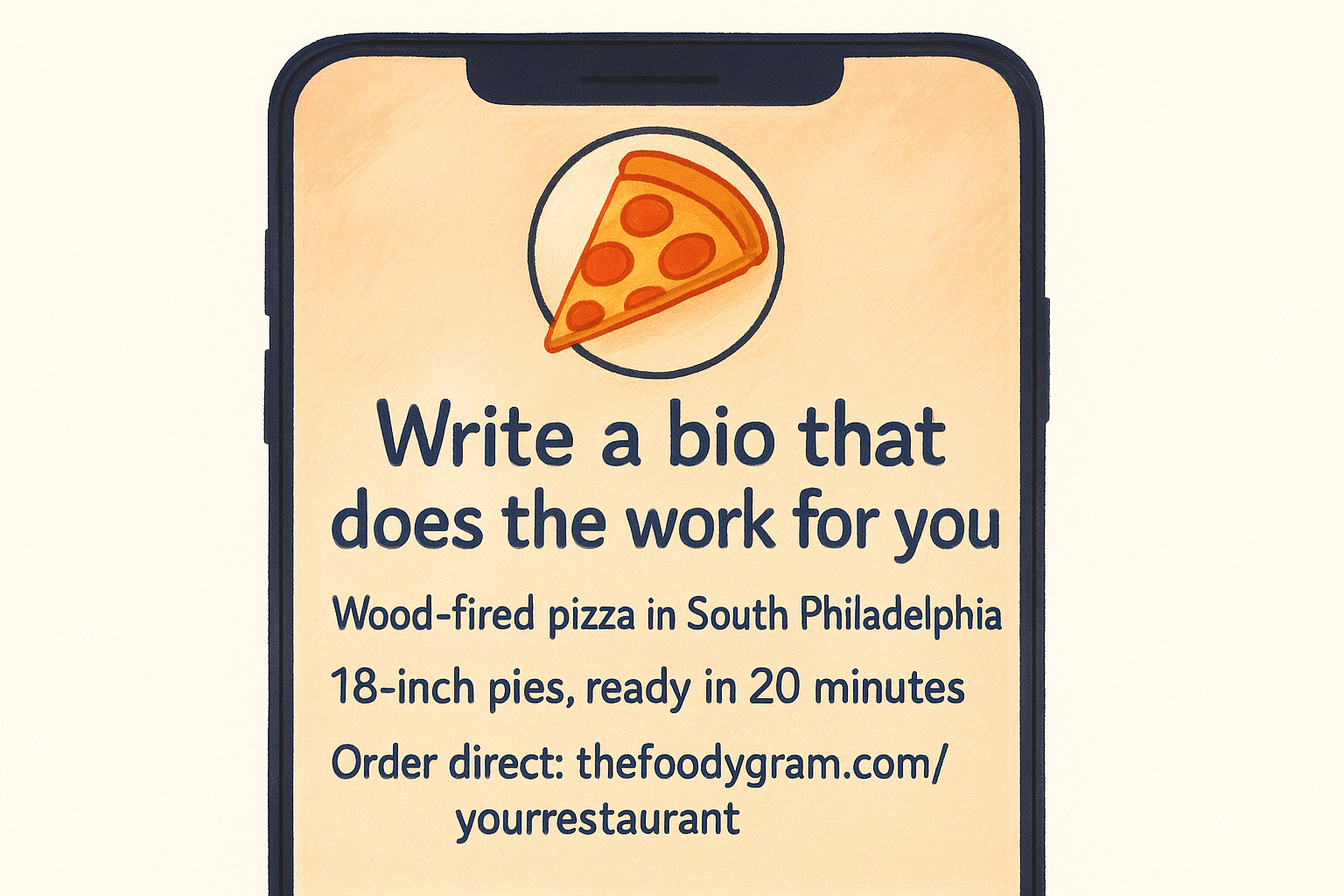
[Cuisine type] in [City/Neighborhood]
[Your signature dish or unique angle]
Order direct: [your ordering link]
Example using that template:
Wood-fired pizza in South Philadelphia
18-inch pies, ready in 20 minutes
Order direct: thefoodygram.com/yourrestaurant
The link in your bio is the most valuable real estate on your entire profile. Point it directly to your own ordering page, not your homepage, so visitors land one tap away from placing an order.
Use a consistent profile photo and cover image
Your profile photo should be your logo, not a food shot. Food photos work well in your feed, but your logo builds brand recognition across every comment, reply, and tagged post. Keep it high resolution and centered, since most platforms crop profile images into a circle. Your cover image (on Facebook) or story highlights (on Instagram) should reinforce your menu, your hours, and any active promotions.
On Instagram, create at least three story highlights using these labels as a starting point: Menu, Hours, and Order Now. Pin your most recent promotion or popular dish to the Order Now highlight and update it weekly.
Fill every optional field your platform offers
Restaurants often leave their hours, phone number, address, and category fields blank. Filling these fields increases your visibility in local search results within the platform itself. On Facebook, complete your "About" section, add your price range, and enable the booking or order button that links directly to your commission-free ordering page. Each completed field is one more signal that tells the platform, and your customers, that your restaurant is active and worth visiting.
Step 3. Create content pillars and a weekly plan
Content pillars solve the "what do I post today?" problem that kills most restaurant social media strategies before they gain traction. A content pillar is a repeatable content theme that ties directly to your restaurant's identity and your customers' interests. Instead of brainstorming from scratch every week, you draw from a short list of proven categories that your audience already responds to, which makes content creation faster and far more consistent.
Define your three to five content pillars
Your pillars should reflect what makes your restaurant worth following, not just worth visiting once. Most independent restaurant owners perform best with pillars that mix food, people, and social proof. Here are five pillars you can adapt to your own brand right now:
- Menu spotlight: Close-up photos or short clips of your best-selling or seasonal dishes
- Behind the scenes: Prep work, kitchen moments, and staff introductions that show the people behind the food
- Customer proof: Reposted guest photos, reviews, and shoutouts that build credibility with new visitors
- Local connection: Posts about your neighborhood, nearby events, or community involvement that reinforce your roots
- Offer and order: Direct promotion of a special, limited-time item, or a clear link to place an order online
Stick to pillars you can produce consistently without burning out, because content published regularly at good quality will always outperform content published perfectly once a month.
Build a repeatable weekly posting schedule
Once your pillars are set, map them onto a weekly posting schedule so you never make a creative decision under pressure. Three to four posts per week is a realistic starting point for most independent restaurants managing social without a dedicated team. Use this template to build your first week:
| Day | Pillar | Format |
|---|---|---|
| Monday | Offer and order | Static photo + ordering link |
| Wednesday | Menu spotlight | Short video or carousel |
| Friday | Customer proof | Reposted guest photo or review screenshot |
| Saturday | Behind the scenes | Short clip from the kitchen or prep |
Batch your content creation on one day each week, ideally Sunday or Monday morning, so you publish throughout the week instead of scrambling to shoot and post in the same rushed hour. This single habit reduces decision fatigue and keeps your profile active without pulling you away from running your restaurant during peak service hours.
Step 4. Shoot short videos that sell the food
Short-form video is the highest-reach format available to restaurants on every major platform right now. Reels, TikToks, and YouTube Shorts consistently get pushed to new audiences without requiring you to spend money on ads, which makes video the most cost-efficient content type in your entire restaurant social media strategy. The good news is you do not need expensive equipment or a film crew to produce videos that drive real orders.
Set up your shot in under two minutes
Natural light is your best tool, and it costs nothing. Position your food near a window during the day, with the light source to the side rather than directly behind the dish. This setup creates depth and makes colors pop without any editing. Your smartphone camera set to portrait mode or 1080p video will handle everything else.
Use this quick setup checklist before every shoot:
- Place the dish on a clean, neutral surface (a wooden board or dark slate works well)
- Shoot from directly above (flat lay) or at a 45-degree angle to show height and texture
- Keep the background uncluttered so the food stays the focal point
- Record in vertical format (9:16 ratio) so the video fills the full screen on mobile
Follow a simple three-part video structure
Every high-performing food video follows the same basic arc: hook, reveal, and call to action. Start with a close-up shot of the food being plated or cut in the first two seconds, because that is what stops someone mid-scroll. Then pull back to show the full dish, ideally with steam rising or cheese pulling. Close with a direct text overlay that tells the viewer exactly what to do next.
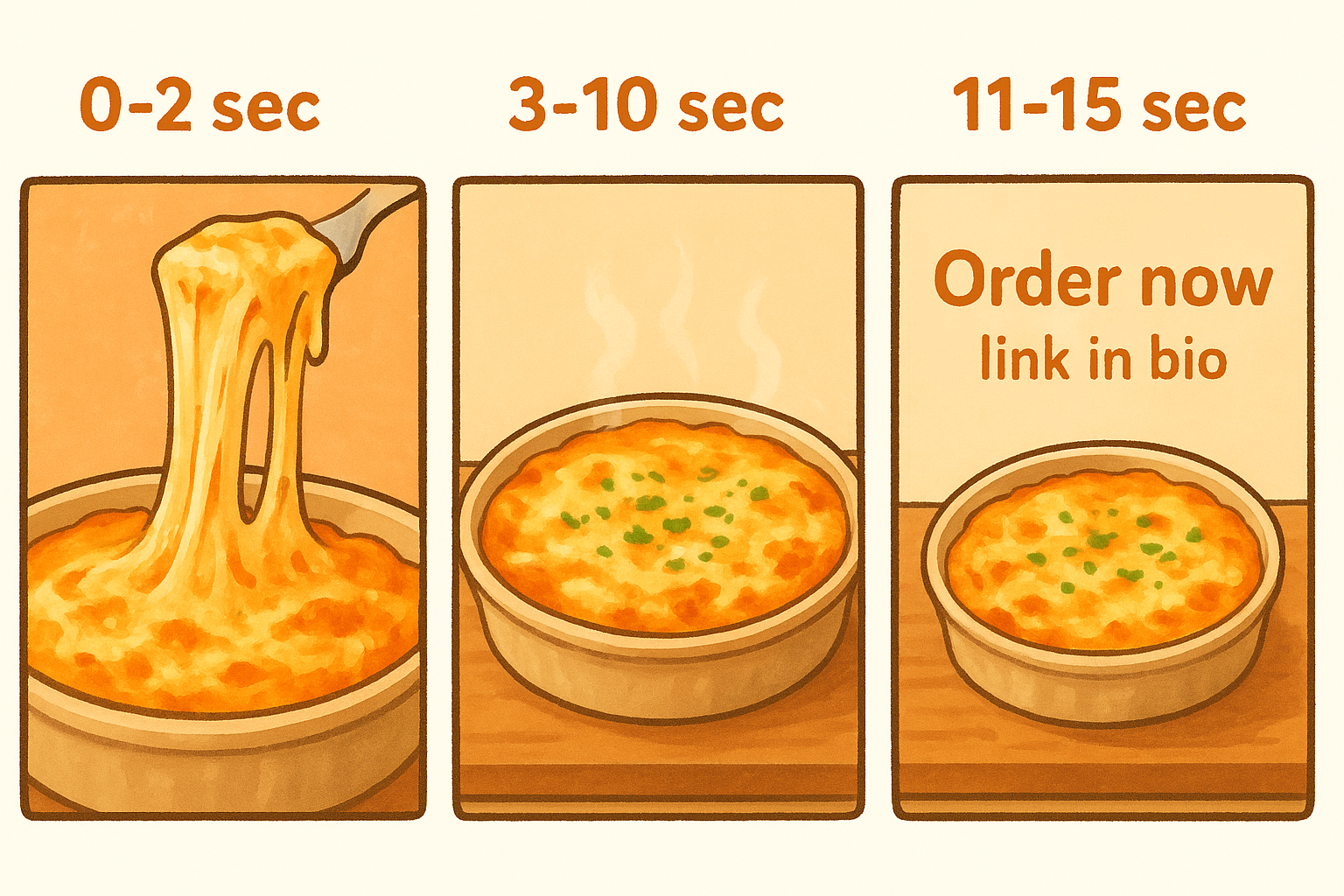
The first two seconds of your video determine whether someone watches the rest. Start with the most visually compelling moment, not an introduction or a logo.
Here is a three-part script template you can follow for every video:
[0-2 sec]  Tight close-up: cheese pull, sauce pour, or knife cut
[3-10 sec] Full dish reveal with your restaurant name in the corner
[11-15 sec] Text overlay: "Order now - link in bio" + dish name + price
Keep your videos between 15 and 30 seconds for maximum viewer completion rates across Reels and TikTok.
Step 5. Turn guests into community and UGC
User-generated content (UGC) is the most credible marketing your restaurant can produce, because it comes from real customers rather than your own brand account. When someone posts a photo of your food and tags you, that single post reaches their entire local network without you spending a dollar. Building a deliberate system to encourage, collect, and reshare guest content turns your happiest customers into a consistent, free content engine that strengthens every other part of your restaurant social media strategy.
Ask for content at the right moment
The easiest way to increase UGC volume is to ask for it at the moment when a guest is already engaged. That moment is when the food lands on the table or when the order is picked up. Train your staff to mention your social handle and tell guests they might get featured. Print your Instagram or TikTok handle directly on your packaging, receipts, and table cards so the ask is always visible without requiring a verbal reminder.
Use this simple three-line table-card script as a starting point:
Tag us @[yourhandle] for a chance to be featured.
Show this post at your next visit for [small perk - free drink, discount].
We reshare our favorites every week.
The small perk does not need to be expensive. A free soft drink or a 10% discount on the next order is enough to motivate a guest who was already happy with the meal.
Build a fast repost workflow
Collecting UGC only works if you actually use it. Set aside 15 minutes each week to search your handle and any tagged posts, save the ones worth resharing, and queue them into your content calendar under your customer proof pillar. Always ask for permission before reposting, even when a guest has tagged you directly. A simple comment reply like "Love this! Mind if we share it on our page?" takes ten seconds and protects you from any awkward situations.
Respond to every comment and DM within 24 hours
Responding quickly signals to both the platform algorithm and your followers that your restaurant is active and worth engaging with. Keep replies specific rather than generic. Reference the dish they ordered or the detail they mentioned, because personalized responses build genuine loyalty and encourage the same guest to post again after their next visit.
Step 6. Promote specials and run local ads
Organic content builds your audience over time, but paid promotion accelerates results when you have a specific offer worth pushing. Running even a small local ad budget as part of your restaurant social media strategy lets you place your best content directly in front of people who live within your delivery or pickup radius and have never heard of your restaurant before. The key is to promote something concrete, not your brand in general, because a specific offer gives people a reason to act immediately.
Build a special around one clear offer
Before you spend a dollar on promotion, you need an offer worth promoting. The strongest specials are time-limited and single-item focused, because they create urgency without requiring the customer to think too hard. Pick one dish that photographs well, set a clear expiration window, and attach a direct link to your ordering page. Vague promotions like "great food at great prices" get ignored. A specific one like "Half-price birria tacos this Friday only" gives someone a concrete reason to tap your link right now.
Use this template to structure every promoted special before you publish it:
Offer:    [Specific dish or bundle]
Discount: [Dollar amount off or percentage]
Window:   [Day and time the offer starts and ends]
Action:   [Order now at yourorderinglink.com]
Run a local ad that targets the right radius
Both Meta Ads Manager and Google Ads let you set a geographic radius around your restaurant's address so your budget reaches only the people who can realistically order from you. Start with a $5 to $10 daily budget and target a 5-mile radius around your location. Select "Traffic" as your campaign objective and point the destination URL directly to your ordering page, not your social profile.
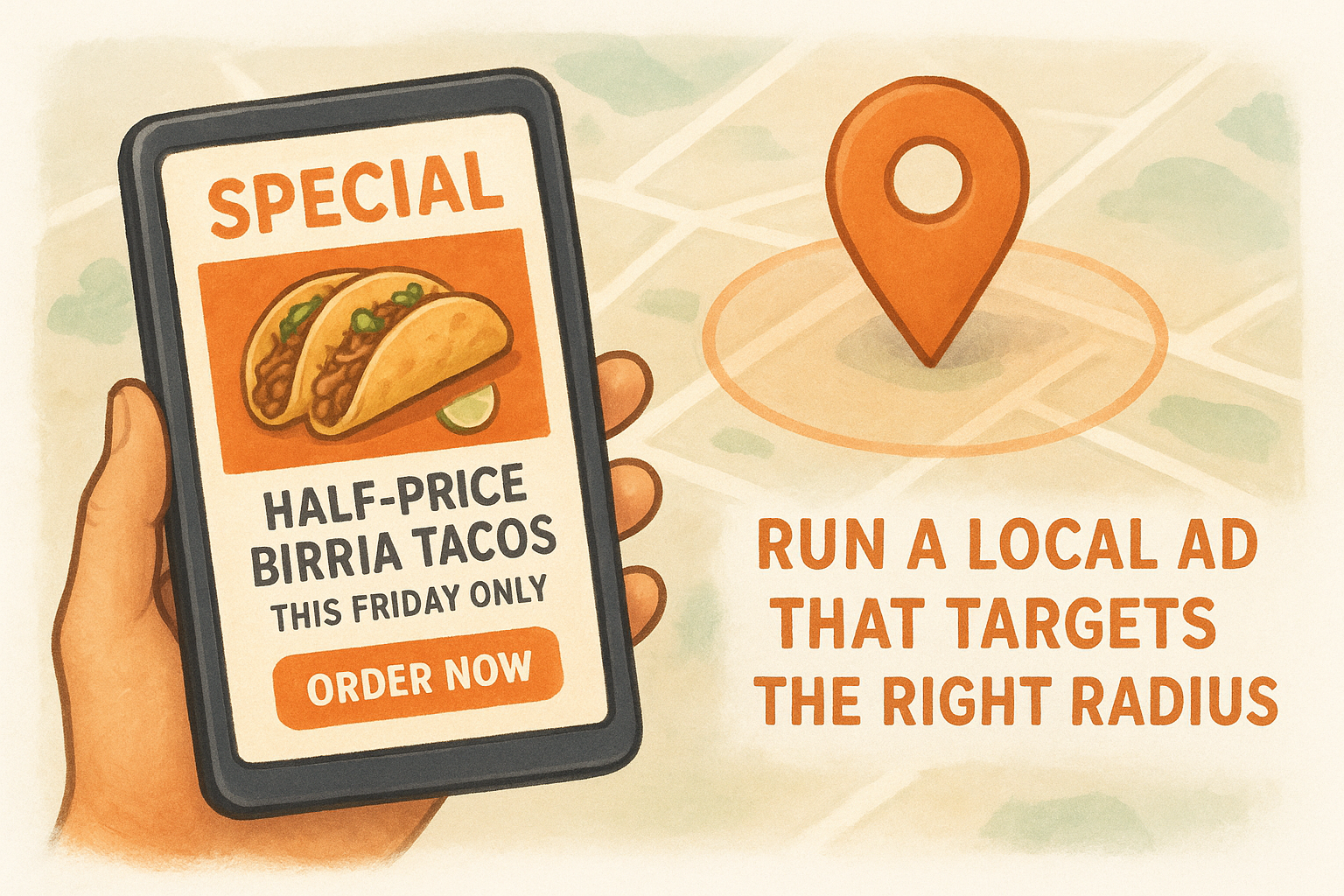
You do not need a large budget to see real results. A $50 weekly spend on a well-targeted local ad consistently outperforms a $500 national campaign with no geographic focus.
Boost your highest-performing organic post from the week rather than creating a separate ad from scratch. This approach saves production time and gives you a head start, because the post already proved it resonates with the people who follow you.
Step 7. Measure ROI and refine your strategy
Posting consistently is only half the job. The other half is reviewing what your content actually produced so you can double down on what works and cut what does not. Most restaurant owners skip this step entirely, which means they repeat the same low-performing tactics month after month without realizing it. Building a simple monthly review into your restaurant social media strategy takes less than an hour and pays for itself immediately.
Track the metrics that connect to orders
Your platform analytics will show you dozens of numbers, but most of them do not connect to revenue. Focus on the small set of metrics that tell you whether social content is actually driving orders. Add UTM parameters to your ordering link so you can see in your ordering dashboard exactly how many sales came from each platform. Use a format like ?utm_source=instagram&utm_medium=bio_link appended to your ordering URL and check it weekly.
Measuring reach or impressions without tying them to clicks and orders is the same as counting foot traffic without tracking how many people bought something.
Use this tracking table to review your results each month:
| Metric | Where to find it | What it tells you |
|---|---|---|
| Link-in-bio clicks | Platform analytics | How often your profile converts to intent |
| Orders from social | UTM data in your ordering dashboard | Direct revenue tied to social activity |
| Top-performing post | Reach + saves in platform insights | Which content type to repeat |
| Video completion rate | Reels or TikTok analytics | Whether your hook is strong enough |
| DM and comment volume | Platform notifications | How engaged your local audience is |
Review and adjust monthly
Set a recurring calendar block on the last Monday of each month to sit down with your metrics and answer three questions: which posts drove the most clicks to your ordering page, which content format produced the highest engagement rate, and which days or times generated the most reach? Those three answers tell you exactly what to do more of next month.
After two or three monthly reviews, clear patterns will emerge in your data. If Friday short videos consistently outperform Monday photo posts, shift more of your production effort toward video. If a specific dish drives three times more link clicks than everything else, feature it again as a promoted special. Let the numbers make the creative decisions for you rather than guessing.
Next steps
You now have a complete restaurant social media strategy built around one outcome: more direct orders from customers you own, not third-party platforms that take a cut of every sale. You have the goal-setting framework, the content pillars, the video structure, the UGC system, the ad approach, and the monthly review process. The only thing left is to start.
Pick the single step that feels most actionable today, whether that is rewriting your bio, shooting your first short video, or setting up UTM tracking on your ordering link. Do that one thing before you move to the next. Momentum comes from small actions completed, not from planning everything perfectly before you begin.
When you are ready to pair your social strategy with a commission-free ordering system that keeps 100% of your revenue in your pocket, check out The Foody Gram's pricing plans and see which tier fits your restaurant.