


How Restaurants Make Money: 10 Profit Drivers Explained
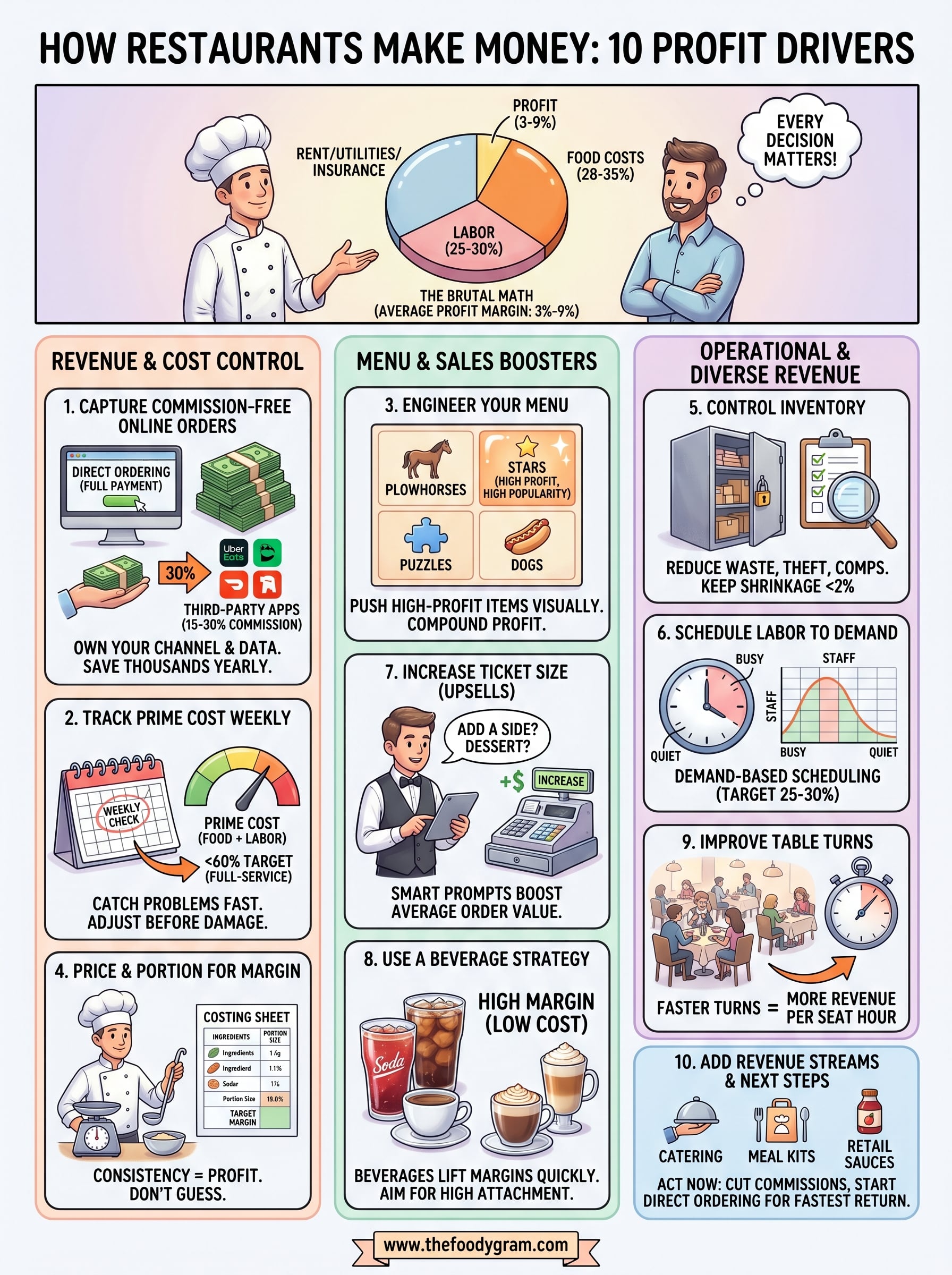
Most people assume how restaurants make money is straightforward: sell food for more than it costs to make. But anyone who's actually run a restaurant knows the math is far more brutal than that. Between food costs hovering around 28–35%, labor eating up another 25–30%, and rent, utilities, and insurance stacking on top, the average restaurant profit margin lands somewhere between 3% and 9%. That's razor thin, and it means every operational decision either protects your bottom line or chips away at it.
So what separates restaurants that barely survive from those that consistently turn a profit? It comes down to understanding the specific levers that drive revenue and control costs, and pulling them deliberately. Some of these levers are obvious (menu pricing, table turnover). Others, like owning your online ordering channel instead of handing 30% to third-party apps, are decisions many restaurant owners overlook until the damage is already done. That's exactly the problem we built The Foody Gram to solve: giving restaurants a commission-free ordering system so more of every dollar stays where it belongs.
This article breaks down 10 profit drivers that determine whether a restaurant makes money or just keeps the lights on. Each one is actionable, grounded in how real restaurants operate, and worth evaluating against your own numbers. Let's get into it.
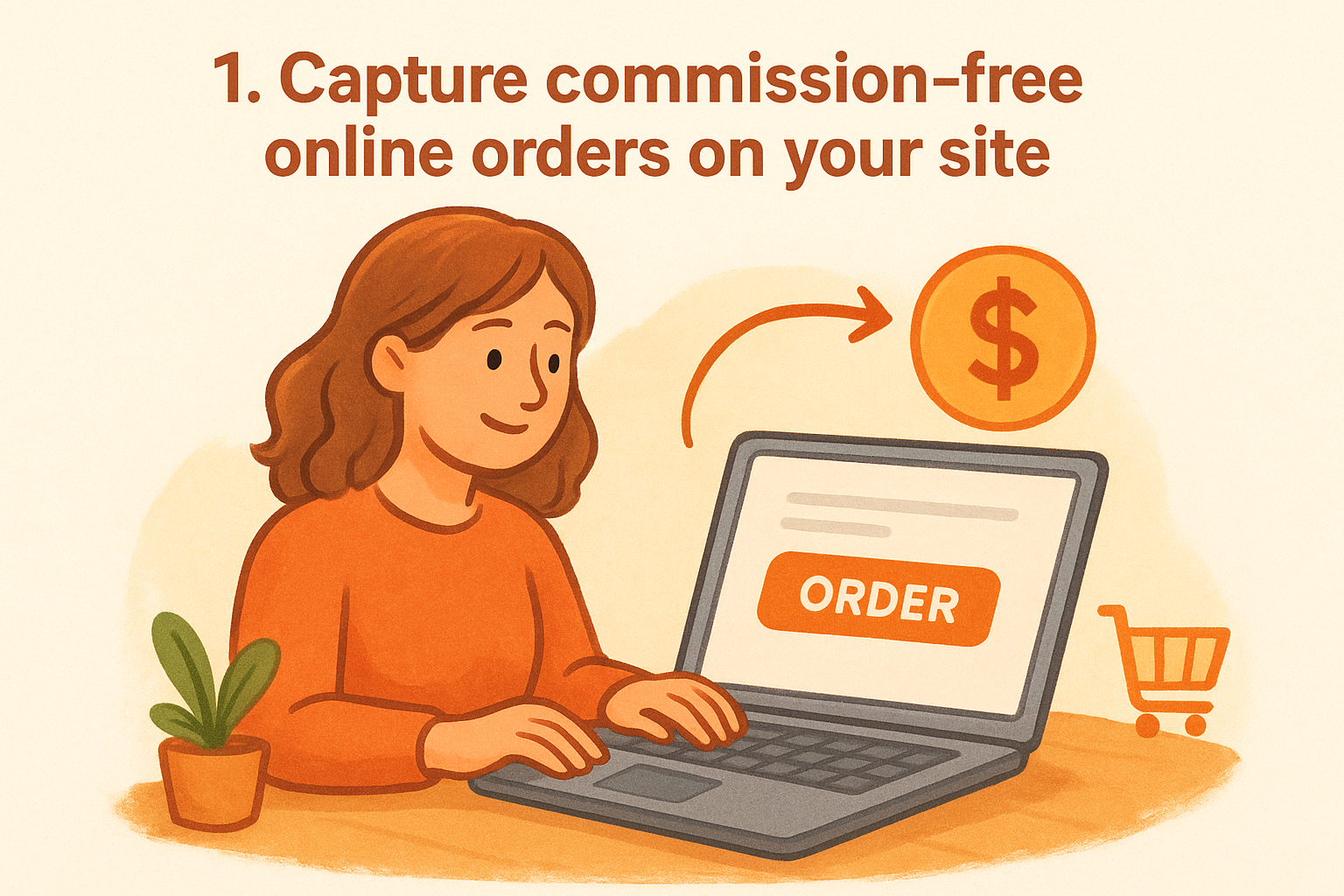
1. Capture commission-free online orders on your site
Third-party delivery apps make it easy to get online orders, but that convenience comes at a steep cost. Platforms like Uber Eats and DoorDash charge 15% to 30% commission per order, which means you're handing over a significant cut of every sale before you've paid a single staff member or supplier.
What it is
Commission-free online ordering means customers place orders directly through your own website or branded ordering page, and you collect the full payment minus standard payment processing fees (typically around 2–3%). No middleman takes a percentage, and no algorithm controls your visibility to your own customers.
Why it drives profit
This is one of the clearest answers to how restaurants make money without raising prices or cutting quality. On a $50 order, a 25% commission to a third-party app costs you $12.50. Multiply that across 100 orders a week and you're giving away $1,250 every week, or over $65,000 a year, to a platform that also owns your customer data and can show your competitors directly to your buyers.
Owning your ordering channel is not just a cost decision, it's a business control decision.
When orders come through your site, you keep the revenue and you collect the customer data, and you build a direct relationship that third-party apps actively block you from having.
How to implement it fast
You don't need a development team or months of setup time. Platforms like The Foody Gram can have your commission-free ordering site live within 48 to 72 hours, with menu uploads, mobile optimization, and payment processing handled for you. The flat monthly subscription replaces the per-order fees, and the math works in your favor from the first week if you have consistent order volume. Start by redirecting your existing social media links and Google Business Profile to your direct ordering page so current customers land there immediately.
Metrics and benchmarks to watch
Track online order revenue by channel so you can see exactly how much you're retaining each month compared to what you were surrendering before. A restaurant doing $10,000 in monthly online orders and switching from a 25% commission app to a flat-fee direct system saves roughly $2,500 per month on that channel alone. Aim to shift at least 50% of your delivery and pickup volume to your direct channel within 90 days of going live.
2. Track profit, margin, and prime cost every week
Most restaurant owners check their numbers monthly, if at all. By the time you spot a problem at month's end, you've already lost four weeks of margin to a food cost spike, a scheduling mistake, or unchecked waste. Weekly tracking gives you the visibility to fix problems before they compound.
What it is
Prime cost is the sum of your total food and beverage cost plus your total labor cost. It's the single most important number for understanding how restaurants make money, because these two categories together typically consume 55% to 65% of every dollar you bring in.
Why it drives profit
When you track prime cost every week, you catch problems in days instead of a month. A food cost that drifts from 30% to 36% becomes visible fast, and you can adjust purchasing, portioning, or pricing before it does real damage.
Restaurants that review prime cost weekly run tighter operations and protect more gross revenue than those relying on monthly reports.
How to implement it fast
Pull your weekly sales total from your POS system alongside your supplier invoices. Add your total food and beverage spend to your total labor cost, then divide that number by total revenue for the week. A basic spreadsheet handles this without any specialized software, and building the habit matters more than the tool you use.
Metrics and benchmarks to watch
Target a prime cost below 60% of total revenue for full-service restaurants, and below 55% for quick-service models. If your prime cost climbs above 65%, treat that as an immediate signal to audit purchasing, scheduling, or both before the month closes.
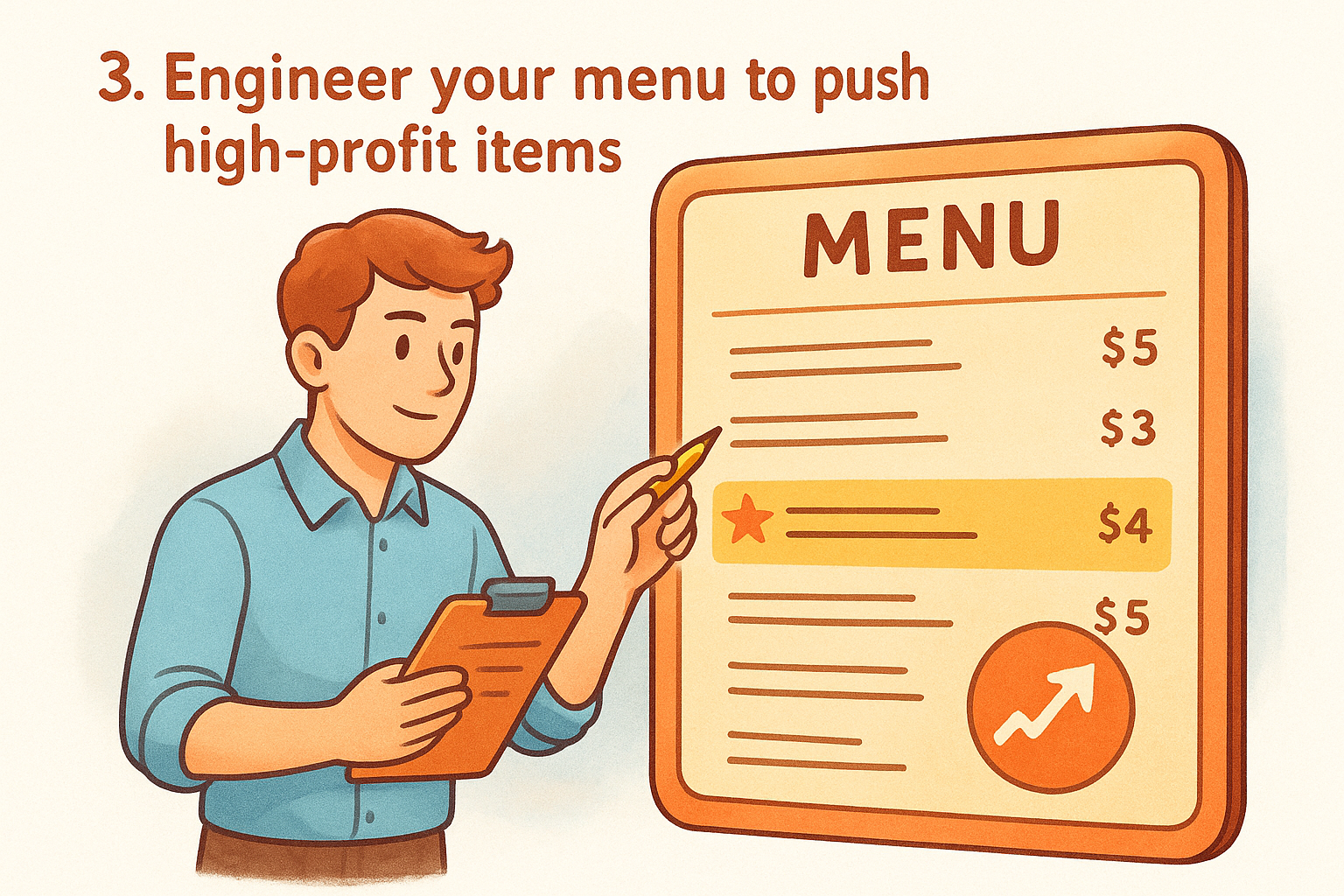
3. Engineer your menu to push high-profit items
Your menu is not just a list of what you serve. It's a sales tool, and how you arrange, describe, and position items directly shapes what customers order and how much profit each order generates.
What it is
Menu engineering is the practice of analyzing every item by two dimensions: how popular it is and how much gross profit it generates per sale. Once you know those two numbers for every dish, you can organize your menu to draw attention to the items that make you the most money.
Why it drives profit
This is one of the clearest examples of how restaurants make money without increasing foot traffic or raising prices. A better-placed photo or a busier section of your menu can shift customer choices toward a dish that earns you $8 in gross profit instead of $3.
Small changes in what customers order most can compound into thousands of dollars in additional monthly profit without adding a single new table.
How to implement it fast
Pull your sales mix report from your POS system and list every item alongside its food cost and selling price. Calculate gross profit per item, then group items into four categories: stars (high profit, high popularity), plowhorses (high popularity, low profit), puzzles (low popularity, high profit), and dogs (low on both). Highlight your stars in the upper-right of your menu, use descriptive language for your puzzles to boost their pull, and consider removing or repricing your dogs.
Metrics and benchmarks to watch
Track your menu mix shift monthly. If your stars grow as a percentage of total orders sold, your engineering is working. Aim for stars to represent at least 30% of total items sold within 60 days of relaunching your menu layout.
4. Price and portion for margin, not for vibes
Many restaurant owners set prices based on what "feels right" or what competitors charge nearby. That approach ignores the actual math behind profitability, and it's one of the fastest ways to lose money on dishes you're selling every single night.
What it is
Margin-based pricing means you set every menu price by working backward from your target food cost percentage, not forward from a gut feeling. Portion control is the other half: defining exact serving sizes for every dish so your actual food cost matches what you planned when you set the price.
Why it drives profit
Understanding how restaurants make money comes down to consistency. If your target food cost is 30% and your cooks plate portions that vary by two ounces per dish, your actual food cost could quietly run 35% or higher without anyone noticing until the month-end report hits.
Pricing and portioning are two sides of the same margin decision, and letting either one drift will erase profit you've already earned.
How to implement it fast
Build a recipe costing sheet for every item you sell. List every ingredient, the quantity used per portion, and the unit cost. Multiply those out to get your total ingredient cost per dish, then divide by your target food cost percentage to find your minimum selling price. Use portioning tools like a kitchen scale or a standardized ladle to lock in consistency at the line.
Metrics and benchmarks to watch
Review your actual versus theoretical food cost weekly. If the gap between what you planned to spend and what you actually spent exceeds 2 to 3 percentage points, your portions are drifting and your pricing assumptions no longer hold.
5. Control inventory to cut waste, theft, and comps
Inventory shrinkage is one of the most common profit leaks in any restaurant operation. It happens through three channels: food spoilage from over-ordering, theft at the line or back-of-house, and unauthorized comps that never make it onto a check. Each one costs you money you've already paid for.
What it is
Your inventory control system is the process of counting, tracking, and reconciling every ingredient you purchase against what you actually sell or use. It means knowing your par levels for each product, ordering to those levels consistently, and verifying that what leaves storage ends up on a paying customer's plate.
Why it drives profit
This is one of the quieter answers to how restaurants make money: protecting the ingredients you've already bought. A restaurant spending $15,000 per month on food with a 5% shrinkage rate is losing $750 every month to waste, theft, and comps that go untracked. Over a year, that's $9,000 gone with nothing to show for it.
Inventory you've already purchased is revenue you've already spent. Letting it leave without a paid ticket is the same as handing cash to a stranger.
How to implement it fast
Run weekly physical inventory counts at the same time each week, ideally before your busiest ordering day. Compare what you counted to what your POS system shows you should have used based on sales. For comps, require manager approval for any item that leaves the kitchen without a paid ticket attached.
Metrics and benchmarks to watch
Track your inventory variance percentage weekly by dividing the dollar value of unexplained shrinkage by total food purchases. Keep that number below 2%. Anything higher signals a process problem worth investigating immediately.
6. Schedule labor to match demand and protect service
Labor is typically your largest or second-largest cost category, and most restaurants manage it reactively rather than strategically. Overstaffing quiet shifts burns payroll you didn't need to spend, while understaffing busy ones costs you table turns, tips, and repeat customers. Getting this balance right is one of the most direct answers to how restaurants make money over the long run.
What it is
Demand-based scheduling means building your staff schedule around your actual sales patterns rather than habit or convenience. You look at historical sales data by day and daypart, then assign labor hours to match those periods of demand. This approach gives you the right number of hands on the floor when you need them and keeps payroll lean when traffic is light.
Why it drives profit
Every hour of labor scheduled beyond what your sales volume justifies directly compresses your margin. A single overscheduled shift costing $200 in unnecessary labor, repeated three times a week, adds up to over $30,000 in wasted payroll annually.
Labor is the one cost you can adjust in real time, which makes it your most powerful short-term lever for protecting profit.
How to implement it fast
Pull 90 days of sales data from your POS system and map your revenue by day and hour. Use those patterns to set a target labor-to-sales ratio for each daypart, then build every schedule to hit that target rather than simply repeating last week's lineup.
Metrics and benchmarks to watch
Track labor cost as a percentage of revenue each week by daypart. Target 25 to 30% for full-service restaurants and 20 to 25% for fast-casual concepts. If any shift consistently runs above your target ratio, adjust coverage before the next scheduling cycle.
7. Increase ticket size with smart upsells and add-ons
Getting more customers through the door is expensive. Getting existing customers to spend more per visit costs you almost nothing, which makes upselling and add-ons one of the most efficient answers to how restaurants make money without growing your customer base.
What it is
Upselling means prompting customers to choose a higher-priced version of what they already want, such as a larger size, a premium protein, or a seasonal special. Add-ons are complementary items offered alongside an order, like a side dish, a dipping sauce, or a dessert. Both strategies increase the total value of each transaction without requiring you to seat or serve an additional guest.
Why it drives profit
Your fixed costs, including rent, utilities, and base labor, stay the same whether a customer spends $14 or $22. Every additional dollar a customer adds to their order flows through at a much higher margin than the first dollar, because those fixed costs are already covered.
Increasing your average ticket by even $2 to $3 per order compounds into thousands of dollars in additional monthly revenue across your full order volume.
How to implement it fast
Train your front-of-house team to suggest one specific add-on per table based on what the guest already ordered rather than listing everything at once. For online orders, build modifier prompts directly into your ordering flow so customers see relevant add-ons before they check out.
Metrics and benchmarks to watch
Track your average ticket size weekly by dividing total revenue by total orders. Aim to grow that number by 5 to 10% within 60 days of actively training staff and adding online modifiers.
8. Use a beverage strategy to lift margins quickly
Beverages are one of the most overlooked answers to how restaurants make money at scale. Food items carry food costs. Beverages, especially non-alcoholic ones like fountain drinks, coffee, and specialty sodas, often carry food costs below 15%, which means every beverage sale contributes far more to your bottom line than most plates you send out.
What it is
A beverage strategy means deliberately designing your drink menu, pricing, and sales prompts to maximize the number of beverages sold per table or per order. This includes both alcoholic and non-alcoholic options, and it applies to dine-in, takeout, and online ordering equally.
Why it drives profit
Most food items carry a food cost between 28% and 35%. A fountain soda or a house coffee often runs below 10%. That gap is where your margin lives. A table of four that adds four beverages to their meal at $4 each generates $16 in revenue at a cost of roughly $1.50, compared to a shared appetizer that might cost you $6 or more to produce.
Beverages are the fastest way to lift average ticket size without adding complexity to your kitchen or slowing down your line.
How to implement it fast
Train your front-of-house team to suggest a specific beverage with every order rather than asking a generic "Can I get you something to drink?" prompt. For online orders, add beverage categories as a required step in your ordering flow before checkout so customers see the options before they finalize.
Metrics and benchmarks to watch
Track your beverage attachment rate, meaning the percentage of orders that include at least one drink. Target 70% or higher for dine-in and at least 40% for online and takeout orders.
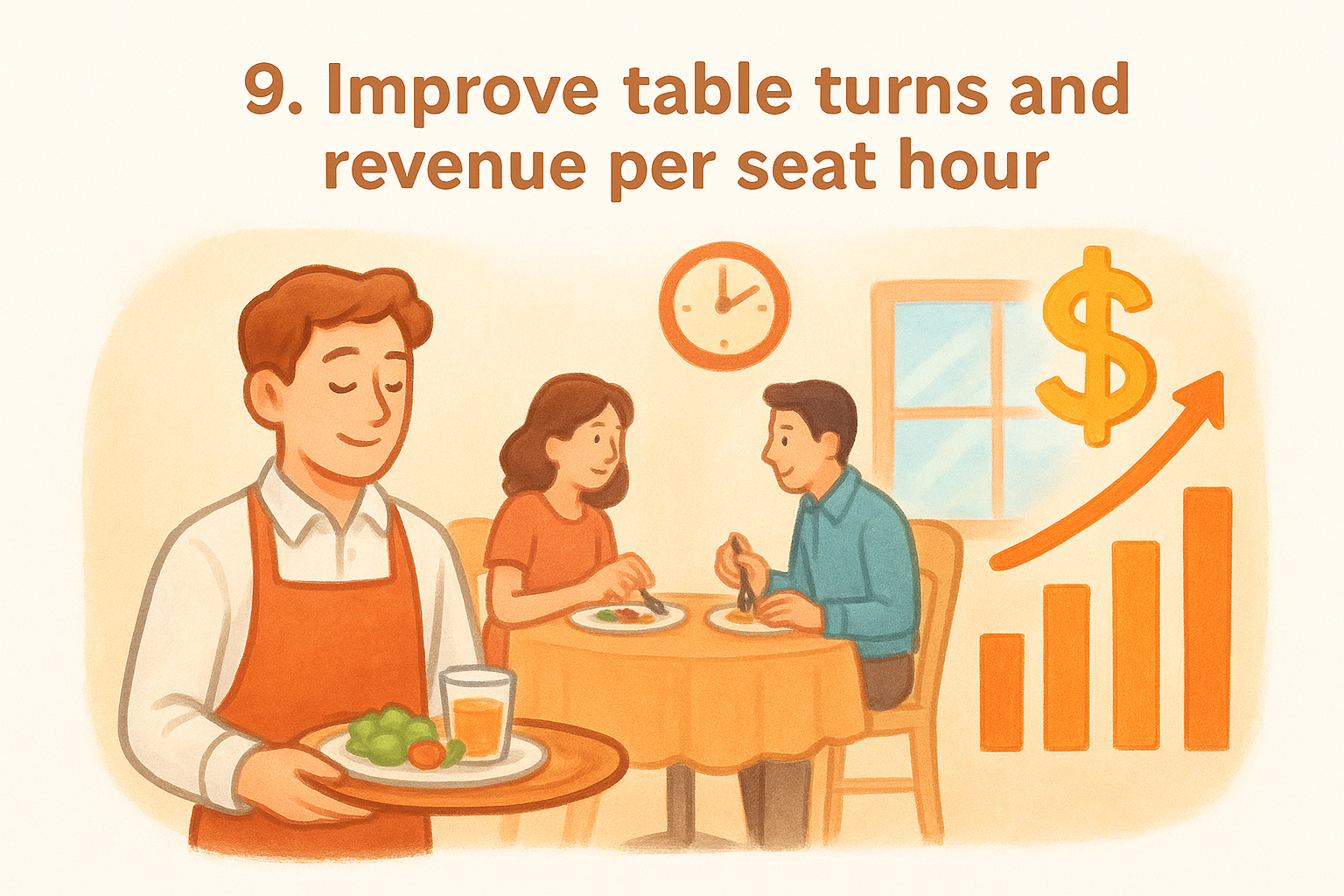
9. Improve table turns and revenue per seat hour
For dine-in restaurants, your physical space is a fixed asset. You have a set number of seats, and every hour those seats sit empty or hold a table that has finished eating costs you potential revenue you can never recover. Increasing how many times each table turns during a service period is one of the most direct levers for how restaurants make money without adding square footage.
What it is
Table turn rate measures how many times you seat and serve a complete party at a single table during a given service window. Revenue per seat hour takes that further by calculating how much money each seat generates per hour of operation, giving you a clearer picture of your dining room's actual productivity.
Why it drives profit
Your rent, utilities, and fixed labor cost the same whether each table turns once or twice during a dinner shift. Turning a four-top twice in a three-hour dinner service at an average check of $60 generates $120 from that table instead of $60, with no additional fixed costs applied.
Every additional turn on a busy night is pure margin gain because your fixed costs are already covered by the first seating.
How to implement it fast
Focus on reducing friction in your service flow rather than rushing guests. Have checks ready before guests ask, run food as soon as it's up, and keep your host trained to manage the waitlist proactively so the next party is ready to seat the moment a table clears. For online reservations, set time limits on peak-hour bookings to protect your turn capacity.
Metrics and benchmarks to watch
Track revenue per seat hour by dividing total dine-in revenue by the number of available seat hours per shift. Target improvements of 10 to 15% over 60 days by tightening service steps and managing your floor more deliberately during peak windows.
10. Add revenue streams beyond dine-in orders
Relying entirely on dine-in revenue puts your business at the mercy of weather, local events, and foot traffic patterns you can't control. Diversifying your revenue channels smooths out those fluctuations and gives you income that keeps coming in even when your dining room is quiet.
What it is
Alternative revenue streams are income sources that operate independently of a guest physically sitting at one of your tables. These include catering contracts, meal kits, retail sauces or rubs, cooking classes, private dining buyouts, and pre-order holiday meal packages. Each one monetizes your kitchen, your recipes, or your space during hours or occasions that wouldn't otherwise generate income.
Why it drives profit
This is one of the more underused answers to how restaurants make money at a sustainable scale. Your kitchen, equipment, and culinary team are already paid for. Putting them to work on a catering order or a product line generates incremental revenue with minimal added fixed cost, which means a higher share of that income flows directly to your bottom line.
Revenue that runs on top of your existing operation costs a fraction of what it would cost to build from scratch.
How to implement it fast
Start with one channel that fits your existing strengths. If your kitchen has morning capacity, launch a weekly meal kit. If you have a signature sauce customers ask about, bottle it and sell it at the counter or through your website's ordering page.
Metrics and benchmarks to watch
Track revenue per channel separately so you can see which stream is worth scaling. Aim for alternative channels to represent 10 to 20% of total monthly revenue within your first year.
Next steps to keep more of every sale
Understanding how restaurants make money is the first step. Acting on that understanding is what separates restaurants that grow from those that grind through each month hoping the numbers work out. Every profit driver in this list compounds when you run it alongside the others, so start with the one that gives you the fastest return on your current operation.
For most restaurants, cutting third-party commissions is the single fastest move because the savings show up immediately and require no change to what you serve or how you run your kitchen. If you're paying 25 to 30% per order to a delivery app right now, that money comes back to you the moment customers start ordering directly through your own site. See what a commission-free ordering setup costs compared to what you're losing today by checking The Foody Gram's pricing plans and running the numbers for yourself.