


9 Restaurant Menu Pricing Strategy Tips for Higher Profit
Your food costs are dialed in. Your kitchen runs tight. But if your restaurant menu pricing strategy is off, none of that matters, you're still leaving money on the table with every order. Pricing isn't just slapping a number next to a dish. It's a calculated decision that directly determines whether your restaurant stays profitable or slowly bleeds margin.
Most restaurant owners set prices once and forget about them. Others copy what the competition charges without understanding their own cost structure. Both approaches lead to the same place: thin margins that get even thinner when third-party apps take a 30% cut on top. That's exactly why we built The Foody Gram, to give restaurants a commission-free online ordering system so every dollar of revenue you earn through smarter pricing actually stays with you.
This guide breaks down nine proven pricing strategies that cover everything from food cost formulas and psychological pricing tactics to menu engineering techniques. Whether you're opening your first location or reworking prices across multiple spots, these tips will help you price with purpose and protect your bottom line.
1. Use The Foody Gram data to price for profit
When you run your orders through The Foody Gram, you generate real transaction data that most restaurant owners never tap into. Your order history, average ticket size, and best-selling items sit inside your dashboard, and that information is the foundation of a smarter restaurant menu pricing strategy.
Why it works
Generic pricing advice tells you to target a 28-32% food cost. Your actual data tells you something more specific: which items are selling at volume, which ones customers skip, and where your real margin is coming from. Decisions backed by your own numbers beat decisions based on industry averages every time.
When you stop guessing and start using your own sales data, pricing becomes a process instead of a gut call.
The platform's direct ordering model also gives you clean, unfiltered data. Because every order flows through your own system rather than a third-party app, nothing gets anonymized or held back. That transparency makes your pricing analysis faster and more accurate than anything a delivery marketplace report can provide.
How to do it
Pull your order reports from The Foody Gram dashboard and sort items by order frequency and total revenue generated. From there, calculate the actual margin on your top ten sellers by subtracting the recipe cost from the current sale price. If your highest-volume items are also your lowest-margin items, that's where a pricing adjustment will have the biggest immediate impact.
Use that data to set a baseline price floor for each menu category. If your average ticket across pickup orders sits at $24 and your food cost on those orders averages 35%, you can pinpoint exactly where margin is being compressed and which items need a correction first.
Watch-outs
Avoid making sweeping price increases across your entire menu based on a single month of data. Seasonal shifts, local events, and promotions all distort short-term numbers, so pull at least 90 days of transaction history before drawing firm conclusions.
Revenue data alone does not capture kitchen efficiency. Pair your sales report with a realistic read on which items your kitchen produces fastest, because a high-margin dish that backs up your line at peak hours costs you more than the numbers show.
2. Cost every recipe down to the gram and ounce
A solid restaurant menu pricing strategy starts at the ingredient level. If you don't know exactly what each dish costs to produce, you're guessing at your margin, and guessing gets expensive fast.
Why it works
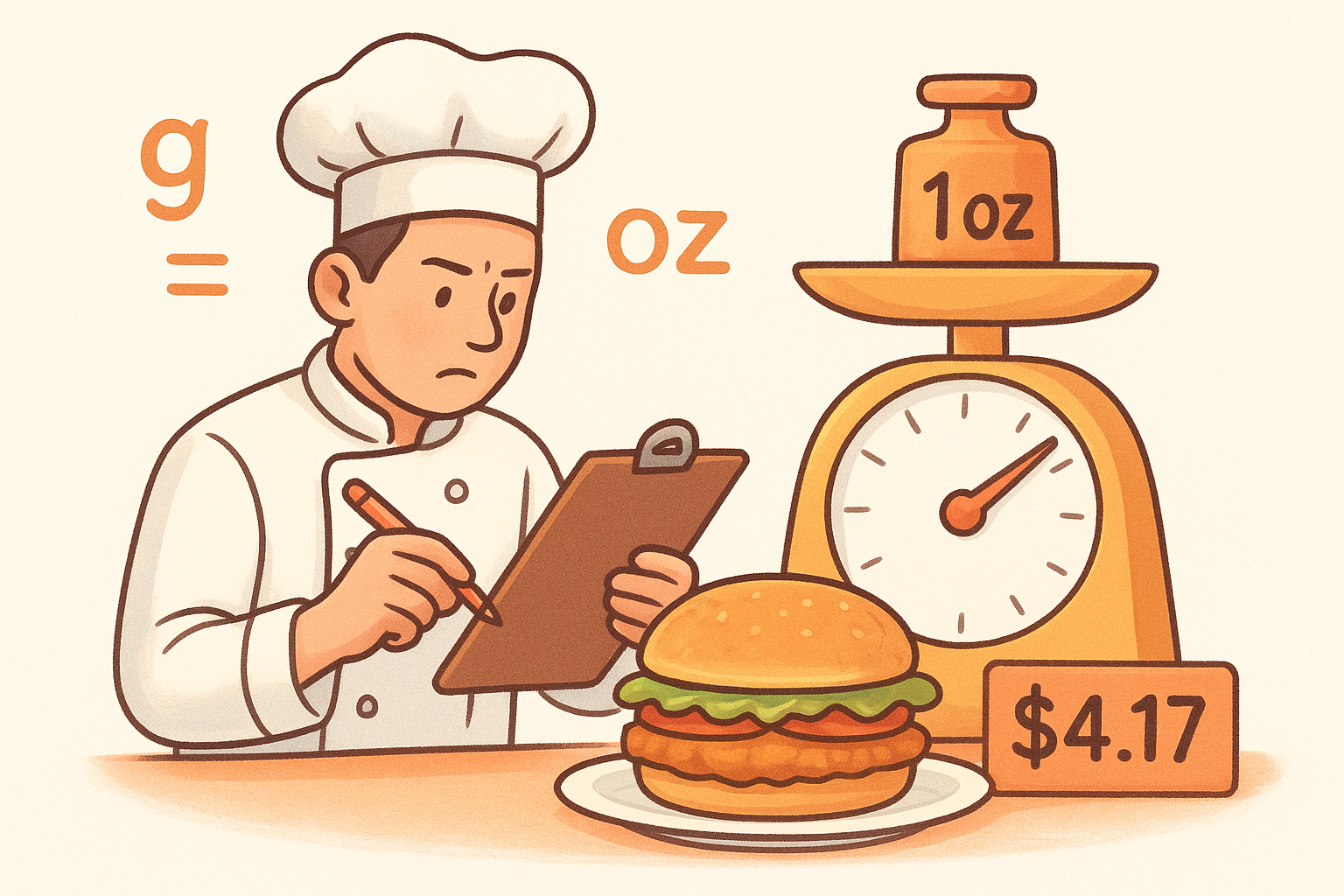
Precise recipe costing gives you a hard number to work from instead of an estimate. When you know your chicken sandwich costs $4.17 to produce, every pricing decision becomes grounded in reality.
Vague cost assumptions quietly lead to underpriced menu items that erode margin. Even small errors compound fast across high-volume dishes, turning a seemingly profitable menu into one that barely breaks even.
How to do it
Break each recipe into individual ingredients and record the exact quantity per portion in grams or ounces. Pull your most recent supplier invoice, calculate the unit cost per ingredient, then add every component, including oils, garnishes, and packaging, to get your true cost per plate.
Treat your recipe card like a financial document, not just a cooking reference.
- Update ingredient costs every time supplier prices change
- Include condiments, garnishes, and any to-go packaging
- Record portions by weight, not volume, for consistency
Watch-outs
Don't forget to account for waste and trim loss. A pound of beef that yields 12 ounces after trimming doesn't cost what the raw weight suggests.
Build a waste percentage into every recipe card for proteins and produce, or you'll consistently underestimate what each dish actually costs you to serve.
3. Price from target food cost and prime cost goals
Most restaurant owners price a dish and then hope the math works out. A stronger restaurant menu pricing strategy flips that process entirely: you set your target cost percentage first, then work backward to determine what each item needs to sell for.
Why it works
Working from cost targets gives you a built-in profitability benchmark rather than a number you rationalize after the fact. Most full-service restaurants aim for a food cost between 28% and 32%, while quick-service concepts typically run tighter at 25-30%. Prime cost, which combines food cost plus labor, should stay below 60-65% of total sales to keep the operation healthy.
Pricing backward from a target keeps your margins intentional instead of accidental.
How to do it
Divide your recipe cost by your target food cost percentage to get your minimum menu price. If a dish costs $4.50 to produce and you're targeting 30% food cost, your price floor is $15.00. Use this formula consistently across every category:
- Proteins: typically target 28-32% food cost
- Beverages: target 18-24% food cost
- Sides and appetizers: target 25-30% food cost
Watch-outs
Target percentages are useful benchmarks, but they do not account for actual dollar margin. A dish priced at $10 with a 25% food cost delivers less gross profit than a $20 dish at 32% food cost. Track dollar margin alongside percentages, or you risk optimizing the wrong number entirely.
4. Match price to perceived value and positioning
Your numbers can justify a price, but your customer's perception of value determines whether they'll actually pay it. A dish priced at $18 can feel like a steal at one restaurant and feel expensive at another, even with the same recipe cost. Your positioning signals value before anyone reads the full menu.
Why it works
Customers don't buy based on your cost structure. They buy based on what the experience feels worth to them. A strong restaurant menu pricing strategy ties your price points directly to the identity and experience you're selling.
Premium language, quality ingredients, and the atmosphere you project all raise what customers expect to pay. When your prices match that expectation, you cut friction at the point of purchase and increase both conversion and average ticket size.
The price you charge tells customers what kind of restaurant you are before they take a single bite.
How to do it
Define your positioning tier clearly and verify that every price on your menu supports that identity. Use descriptive menu language that emphasizes quality, sourcing, or preparation to lift perceived value without touching your recipe cost.
- Fast-casual: price to feel accessible but quality-forward
- Neighborhood staple: price for regulars who know your value
- Upscale casual: price to reflect the full dining experience
Watch-outs
Avoid inconsistent pricing across categories that sends mixed signals to customers. A $5 side next to a $9 entrée undercuts your positioning immediately. Every price point should reinforce the same value story, or customers will second-guess their order before they place it.
5. Check competitors and test local price tolerance
No restaurant operates in a vacuum. What your competitors charge and what your local market will actually pay are two data points your cost formulas can't tell you on their own. A complete restaurant menu pricing strategy accounts for both your internal cost targets and the external price ceiling your customers will accept before choosing someone else.
Why it works
Local price benchmarking gives you a realistic range to work within rather than a number set in isolation. If every pizza shop in your area charges $14-$18 for a large pie, pricing at $24 without a clear value differentiator will cost you customers, no matter how solid your food cost math looks.
Knowing what the market bears keeps your pricing grounded in what customers actually pay, not just what you need to charge.
How to do it
Visit three to five direct competitors in your area and document their prices across similar menu categories. Then test your own price sensitivity by running a limited increase on two or three items for 30 days and tracking order volume and repeat customer behavior through your dashboard. Small, controlled tests reveal local tolerance without putting your full menu at risk.
Watch-outs
Avoid matching competitor prices blindly without understanding their cost structure or positioning. A competitor running lower prices might be absorbing losses to gain market share or cutting ingredient quality. Use competitor data as context, not a ceiling, and always anchor your final price back to your own margin requirements.
6. Use menu engineering to spotlight high-margin items
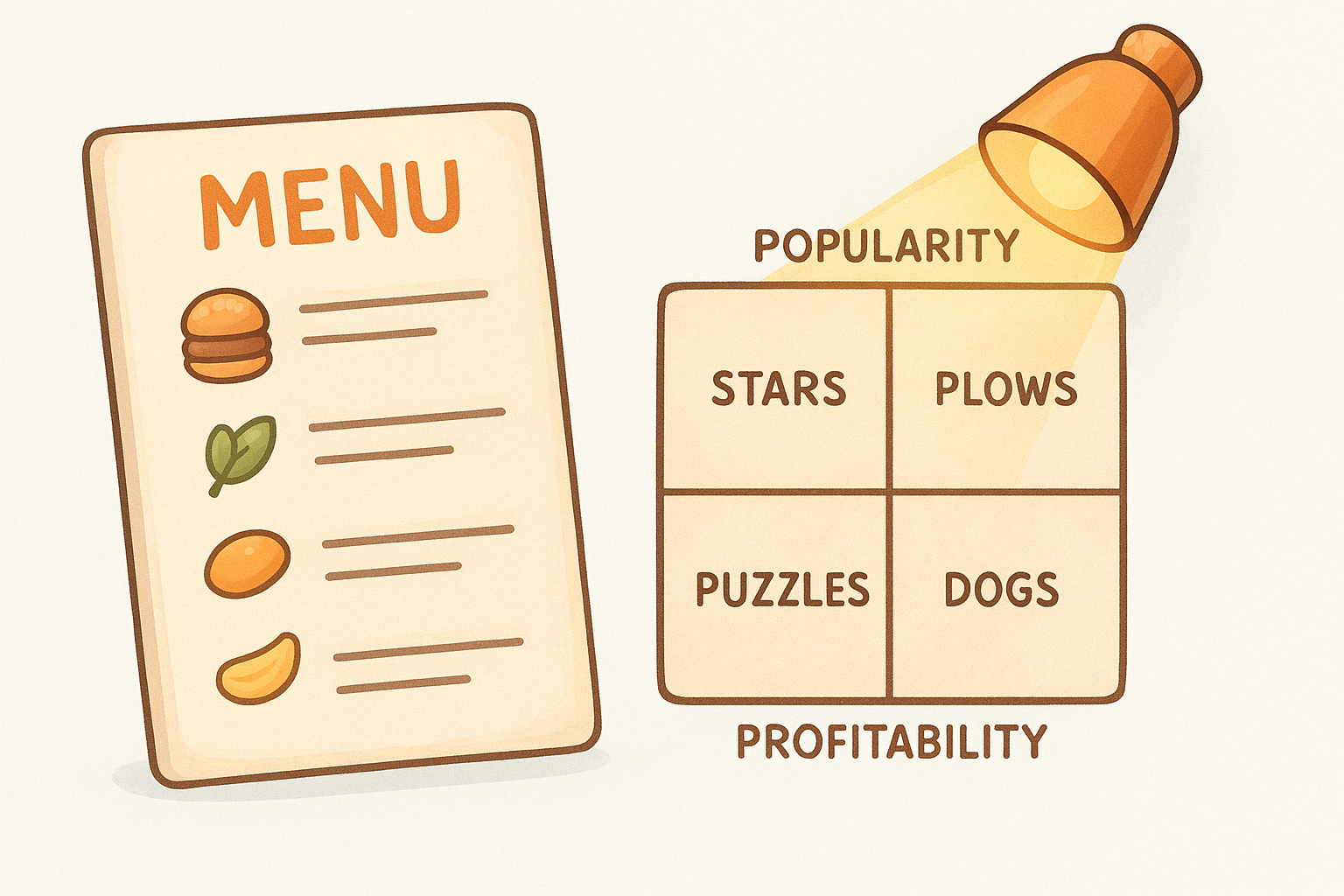
Menu engineering is a structured method for categorizing every item on your menu by popularity and profitability, then using that information to guide where your customers' eyes land first. Your restaurant menu pricing strategy only goes so far if your highest-margin items are buried in a corner while low-margin dishes get all the visual attention.
Why it works
The classic menu engineering matrix sorts every dish into four categories: stars (high profit, high popularity), plows (low profit, high popularity), puzzles (high profit, low popularity), and dogs (low profit, low popularity). Once you map each item to a category, you can make deliberate layout and promotion decisions that consistently steer customers toward the dishes that earn you the most.
Knowing what sells and what earns are two different things, and menu engineering tells you both at once.
How to do it
Start by pulling sales volume and gross margin data for every item on your current menu, then plot each one into the four-quadrant matrix. Give your stars the best real estate and the strongest descriptions. Move your puzzles to higher-visibility positions or sharpen their language to drive more orders. Redesign or cut dogs that consume kitchen time without returning meaningful margin.
Watch-outs
Avoid treating menu engineering as a one-time project. Supplier costs shift, customer tastes evolve, and seasonal availability moves items between quadrants throughout the year. Run a full matrix review every quarter so your layout decisions always reflect current numbers, not data that is already six months old.
7. Use menu psychology that increases average ticket
The way you present prices and frame choices shapes what customers order before they consciously decide. Menu psychology is a set of proven design and language techniques that nudge customers toward higher-value selections without any hard sell. Applying these tactics consistently is one of the simplest ways to lift your average ticket size without changing a single ingredient.
Why it works
Customers make faster decisions than they realize, and visual anchors, price formatting, and item placement all influence those decisions in measurable ways. Research on consumer behavior consistently shows that removing dollar signs, using odd pricing like $13.95 instead of $14, and placing premium items at the top of a category all increase the likelihood customers will order up.
Small formatting changes on your menu can shift customer behavior without a single conversation.
How to do it
Apply charm pricing by ending prices in .95 or .99 to make items feel more accessible. Place your highest-margin dish at the top of each category so it becomes the anchor against which customers compare everything below it. Use descriptive language that emphasizes preparation technique or ingredient origin to justify price without explanation.
- Remove dollar signs from digital and printed menus
- Use boxes or shading to highlight featured high-margin items
- Limit each category to seven or fewer items to reduce decision fatigue
Watch-outs
Overloading your menu with too many psychological tactics at once creates visual clutter that works against you. Pick two or three techniques, apply them to your most important menu sections, and measure the impact on average ticket before making further changes.
8. Build margins with beverages, sides, and bundles
Your entrees carry most of the pricing pressure because customers compare them directly against competitors. Beverages, sides, and bundles operate in a different space where margin potential is significantly higher and customer price sensitivity is typically lower. Treating these categories as an afterthought in your restaurant menu pricing strategy means leaving your most reliable profit drivers underutilized.
Why it works
Beverages consistently deliver the lowest food cost of any menu category, often landing between 15-20%, which means every drink sold pulls your blended margin upward. Bundled combinations give customers a perceived deal while simultaneously increasing your average ticket without raising the price of a single item.
The add-on categories you overlook often generate more margin per dollar than your signature dishes.
How to do it
Price beverages to reflect a 15-20% food cost target rather than defaulting to whatever local competitors charge. Build two or three bundle options that pair a high-margin side or drink with a popular entree, and price the bundle to maintain at least 30% food cost overall.
- Offer a drink-and-side add-on at a slight discount versus buying separately
- Create a family bundle using your highest-volume entree paired with low-cost sides
- Price specialty beverages at a premium tier to anchor the standard drink price lower
Watch-outs
Avoid building bundles around your lowest-margin entrees just because they sell well. Popularity without profitability amplifies margin loss at scale, and bundling a low-margin item at a discount makes a bad situation worse.
Run a full cost audit on every bundle combination before publishing it. A deal that looks attractive to customers should still deliver a combined food cost within your target range, or you're training customers to order the options that hurt you most.
9. Review pricing on a schedule and adjust fast
Pricing is not a set-it-and-forget-it decision. Supplier costs shift, customer behavior changes, and your own sales data tells a different story every quarter. A strong restaurant menu pricing strategy treats price reviews as a regular operating task, not a reactive scramble you only tackle when margins collapse.
Why it works
Scheduled reviews keep your prices anchored to current costs rather than what you were paying six months ago. Ingredient prices move constantly, and a quarterly audit catches margin compression before it becomes a serious problem. Small, frequent adjustments are far less disruptive to customers than one large price increase after a long delay.
Reacting slowly to cost changes is one of the fastest ways to erode profit on your highest-volume items.
How to do it
Set a quarterly calendar reminder to pull your food cost reports, review supplier invoices, and cross-check your top-selling items against current recipe costs. Make any necessary price adjustments and update your online menu through your dashboard immediately. Waiting even a few weeks after identifying a gap costs you money on every order processed in between.
Watch-outs
Avoid changing too many prices at once without a clear customer communication plan. Sudden broad increases can drive complaints and reduce order frequency. Prioritize the items with the widest gap between current cost and target margin first, then work through the rest in stages over the following review cycle.
What to do next
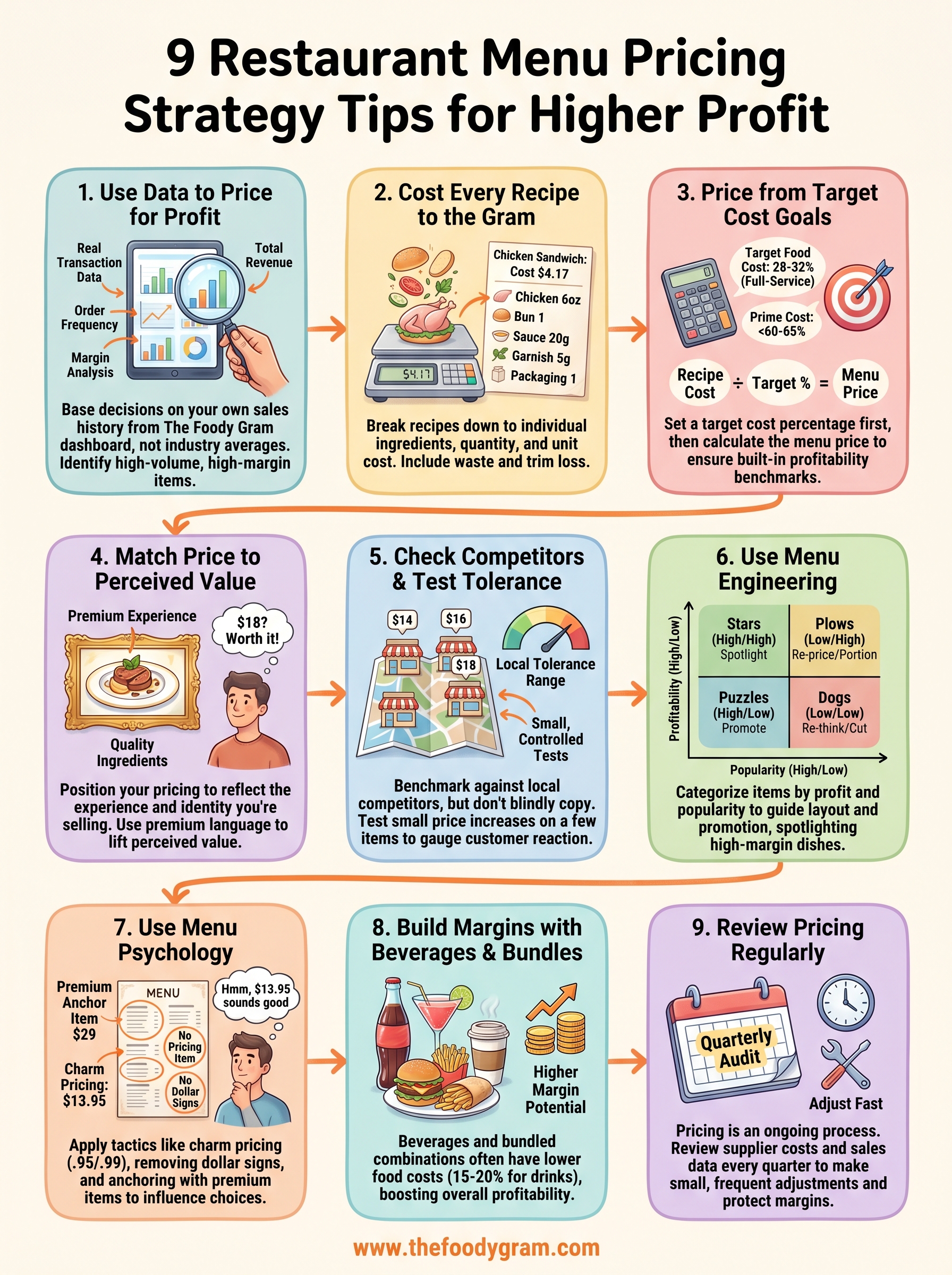
You now have nine concrete approaches to build a restaurant menu pricing strategy that actually protects your margin. From costing every recipe to the gram to using menu psychology and scheduling regular price reviews, each tip gives you a specific action you can take this week. Pricing done right is an ongoing process that compounds over time, not a decision you make once and move on from.
The biggest factor working against most restaurant owners is not weak pricing logic. Third-party apps take 30% off every order before your better pricing can do its job. Switching to a commission-free ordering platform means every improvement you make flows directly to your bottom line instead of subsidizing someone else's marketplace.
When you're ready to stop handing margin to delivery apps and start keeping more of every dollar your pricing earns, see what The Foody Gram costs per month and find the plan that fits your restaurant.