


Menu Pricing Formulas: How To Price a Restaurant Menu Right
Most restaurant owners set their menu prices based on gut feeling, what competitors charge, or what "feels right." And most of those restaurants struggle with razor-thin margins, or worse, lose money on their best-selling dishes without realizing it. Learning how to price a restaurant menu using actual formulas and data is one of the most impactful moves you can make for your bottom line. It's not guesswork, it's math.
Here's what makes this even more critical: if you're paying 30% commissions to third-party delivery apps on top of poorly priced menu items, you're bleeding profit from both ends. That's exactly why we built The Foody Gram, to eliminate those commission fees with flat-rate online ordering so restaurants keep more of what they earn. But even with zero commissions, your menu prices still need to be right.
This guide breaks down the specific formulas, food cost percentages, and pricing strategies you'll need to set prices that cover your costs, protect your margins, and keep customers ordering. We'll walk through ideal food cost targets, how to calculate per-item pricing, and strategic models that go beyond simple markup math. Whether you're opening your first restaurant or repricing an existing menu, this is the framework that gets it done right.
What you need before you set menu prices
Before you can apply any formula or figure out how to price a restaurant menu, you need accurate data in hand. Pricing off incomplete information is one of the fastest ways to build a menu that looks profitable on paper but fails in practice. The three categories of data you need are real ingredient costs, total overhead numbers, and honest market context. Gather all three before you touch a single price point.
Your complete list of ingredient costs
Every ingredient in every dish needs a current, accurate unit cost tied to what you actually pay your supplier right now, not what you paid six months ago. Supplier prices shift constantly, and if your cost data is stale, your pricing is already wrong before you start. Pull your most recent invoices for every item you stock and build a cost-per-unit breakdown using a table like this:
| Ingredient | Purchase Unit | Purchase Cost | Yield % | Cost per Usable Unit |
|---|---|---|---|---|
| Chicken breast | 10 lb case | $28.00 | 90% | $3.11/lb |
| Roma tomatoes | 25 lb case | $18.00 | 85% | $0.85/lb |
| Pasta (dry) | 10 lb bag | $9.00 | 100% | $0.90/lb |
| Olive oil | 1 gallon | $22.00 | 100% | $0.17/oz |
The yield percentage column matters more than most operators realize. A chicken breast at $2.80 per pound sounds affordable until you account for trim and moisture loss, and suddenly your actual usable cost jumps significantly. Build this table for every ingredient before you price a single item.
Your overhead numbers
Ingredient cost alone does not tell you what a dish needs to sell for. You also need to know your total fixed and variable overhead costs, which include rent, utilities, labor, insurance, packaging, and any platform or technology fees you pay monthly. Add these up, then divide by your average monthly order or cover count to get a rough overhead cost per transaction.
Once you know your overhead cost per order, you can factor it directly into your pricing targets alongside food cost, which prevents you from setting prices that cover ingredients but still lose money overall.
For example, if your monthly overhead totals $18,000 and you fulfill 1,500 orders per month, your overhead cost per order is $12.00. That number sets a floor for how you think about pricing, not a ceiling.
Your sales data and competition context
If you are repricing an existing menu, pull your sales mix report from your POS system first. You need to see which items sell most often and which ones customers skip, because high-volume, low-margin items are the ones that quietly drain your profits every single week.
Beyond your own numbers, you need a clear read on what the market around you charges for comparable dishes. This is not about matching competitors price-for-price. It is about understanding the price ceiling your customers carry in their heads before they even place an order. Review nearby competitor menus, note the price ranges for similar categories, and use that data as a reference point when you stress-test your formulas in the steps ahead.
Step 1. Calculate true plate cost for every item
Plate cost is the total cost of every ingredient in one serving of a dish, calculated at the exact portion you plate it. This is the foundation of knowing how to price a restaurant menu correctly. Without an accurate plate cost, every formula you apply later produces a number that drifts from reality, and you will not know it until your margins disappear.
List every ingredient and portion for each dish
Start by breaking every menu item down to its individual components. Write out each ingredient and the exact portion weight or volume used per serving, then multiply by your cost-per-usable-unit from the ingredient table you built earlier. Here is a plate cost template using a grilled chicken pasta dish as an example:
| Ingredient | Portion | Cost/Unit | Line Cost |
|---|---|---|---|
| Chicken breast | 6 oz | $3.11/lb | $1.17 |
| Dry pasta | 3 oz | $0.90/lb | $0.17 |
| Roma tomatoes | 2 oz | $0.85/lb | $0.11 |
| Olive oil | 0.5 oz | $0.17/oz | $0.09 |
| Garlic, herbs, salt | batch | (batch cost) | $0.08 |
| Total plate cost | $1.62 |
Run this calculation for every dish on your menu, not just your top sellers. Skipping lower-volume items leaves pricing gaps that quietly add up.
If you ignore even a handful of menu items in this step, you will have pricing blind spots that cost you money every single day.
Factor in packaging and direct prep labor
Your plate cost does not stop at raw ingredients. Packaging costs for takeout and delivery orders, including containers, bags, and lids, add real money to every transaction. Estimate your average packaging cost per order and add it directly to each dish's plate cost. For most casual concepts, this runs $0.50 to $1.50 per order depending on what you use.
Direct prep labor is harder to isolate per dish, but a rough time-based allocation gives you a more complete plate cost before you move on to applying pricing formulas in the next step.
Step 2. Set targets and price with formulas
Once you have an accurate plate cost for every dish, you can apply two formulas that tell you exactly what to charge. The first formula uses your target food cost percentage to back into a menu price. The second uses contribution margin to confirm that each item generates enough raw profit per sale to actually matter.
Set your food cost percentage target
Your target food cost percentage is the share of a dish's menu price that you allow ingredients to consume. Most full-service restaurants aim for 28% to 35%, while fast-casual concepts typically run closer to 25% to 30%. The right target for your restaurant depends on your overhead, your labor model, and what your category realistically supports.
Set a tighter food cost target on protein-heavy dishes, since those ingredients fluctuate most with supply prices and absorb the most variance.
Different menu categories carry different realistic targets. Use these as a starting benchmark:
| Category | Typical Food Cost Target |
|---|---|
| Proteins / entrées | 28% to 32% |
| Pasta and grain dishes | 22% to 28% |
| Appetizers | 25% to 30% |
| Desserts | 20% to 25% |
| Beverages (non-alcohol) | 15% to 20% |
Apply the formula to get your price
The core formula for how to price a restaurant menu item is straightforward: divide your plate cost by your target food cost percentage. If your grilled chicken pasta has a plate cost of $1.62 and you target a 30% food cost, the math looks like this:
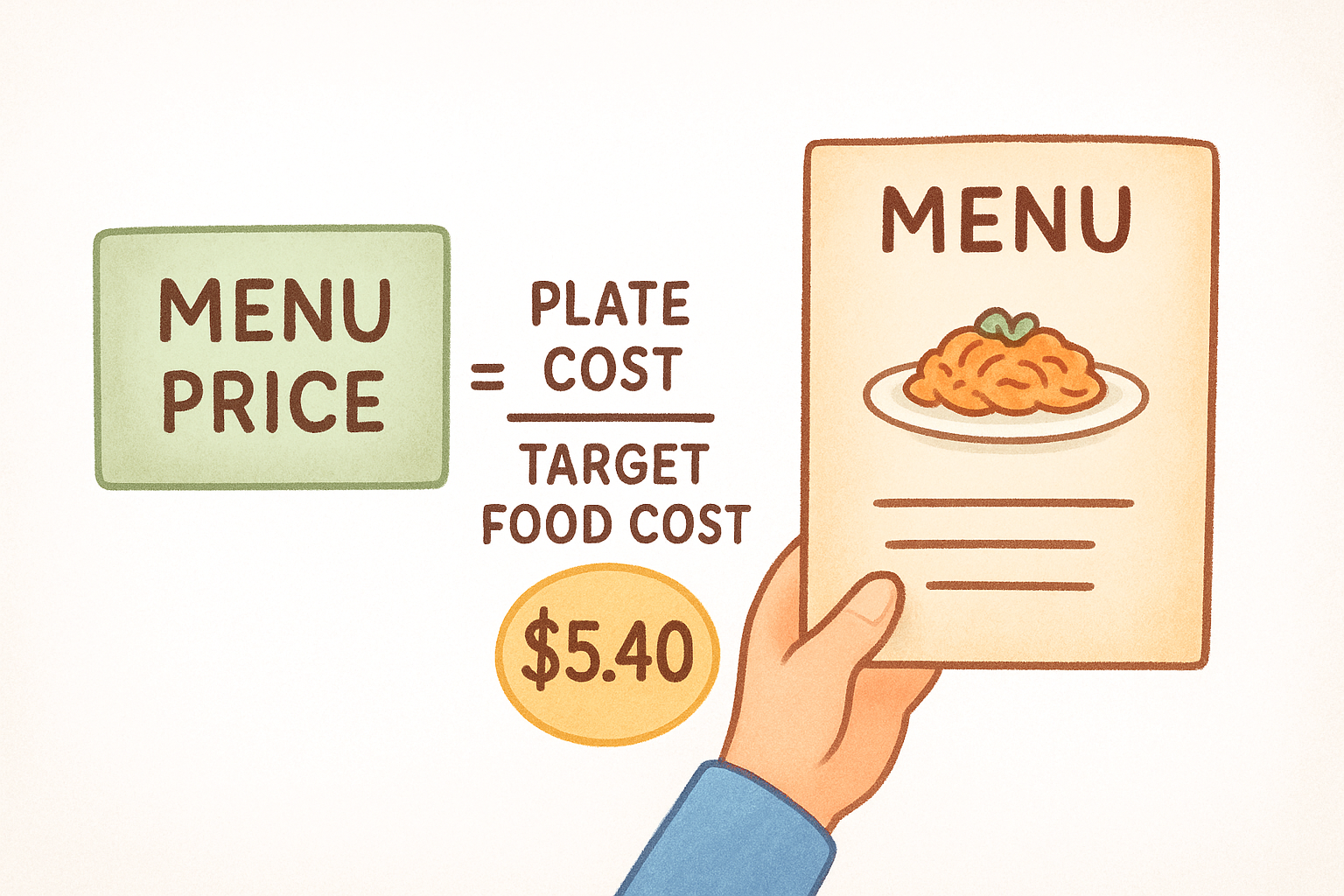
Menu Price = Plate Cost / Target Food Cost Percentage
$1.62 / 0.30 = $5.40
That result is your floor price, not your final price. Round up to a clean number that fits your menu format, then factor in packaging costs and your overhead-per-order figure before you commit to anything.
Use contribution margin as a second check
Contribution margin is the dollar amount left after you subtract plate cost from the menu price, and it shows you how much each sale contributes toward covering overhead and profit. Multiply your contribution margin by expected weekly sales volume for that item to see its real earnings impact. High-volume dishes with low margins often deserve a price increase more urgently than low-volume items with strong ones.
Step 3. Pressure-test prices with the real world
Formulas give you a defensible starting price, but they cannot predict how your specific customers will respond to what they see on the menu. Before you commit every new price permanently, you need to test them in real conditions and watch what actually happens. This is a critical step in understanding how to price a restaurant menu that works beyond the spreadsheet.
Run a soft launch with a subset of items
Pick five to ten menu items across different categories, apply your new formula-based prices, and run them for two to four weeks without changing anything else. Resist the urge to roll out your entire repriced menu at once, because if something triggers a negative response, you want to isolate which item caused it.
A targeted soft launch gives you real purchase data to act on, rather than customer complaints about an entirely new menu.
Track the following for each test item during your soft launch window:
| Metric | What to watch for |
|---|---|
| Order frequency | Did volume drop more than 15% after the price change? |
| Customer feedback | Are you seeing complaints about value in reviews or directly? |
| Attach rate | Are customers still adding sides, drinks, or extras? |
| Revenue per order | Is your average ticket moving in the right direction? |
Evaluate your sales mix against your margin targets
Once your test window closes, pull your sales mix data from your POS and compare it against the margin targets you set in Step 2. Look specifically at whether your highest-volume items are now generating contribution margins that cover your overhead-per-order figure. If a top seller is moving fast but still leaving you short on margin, the price is not high enough regardless of what your formula produced.
Customers who continue ordering at the new price are telling you the value holds. Customers who drop off are telling you something else entirely, and that feedback is worth more than any benchmark you read online.
Step 4. Monitor, tweak, and raise prices safely
Pricing is not a one-time task. Ingredient costs shift, labor rates change, and your sales mix evolves month to month, which means the prices you set today will drift out of alignment with your actual costs if you never revisit them. Building a simple monthly review habit is what keeps your margins from quietly eroding over time, and it is the final piece of understanding how to price a restaurant menu that holds up long-term.
Track key metrics on a monthly schedule
Pull three numbers every month without exception: your actual food cost percentage, your contribution margin per item, and your average ticket size. Compare each against the targets you set in Step 2. If your actual food cost percentage climbs more than two points above your target, something changed, whether supplier prices moved, portion sizes drifted, or waste increased, and you need to find the source before you adjust prices.
A consistent monthly review catches pricing problems weeks before they show up as a loss on your income statement.
Use this simple tracking template to stay organized:
| Month | Item | Target FC% | Actual FC% | Contribution Margin | Action Needed |
|---|---|---|---|---|---|
| June | Grilled chicken pasta | 30% | 34% | $3.80 | Review portion or reprice |
| June | Margherita pizza | 28% | 27% | $6.10 | On target |
| June | Caesar salad | 25% | 26% | $4.50 | Monitor |
Raise prices without losing customers
When your data confirms a price increase is necessary, raise prices gradually and selectively rather than repricing your entire menu at once. A 5% to 8% increase on your top three to five sellers causes far less friction than a sweeping menu overhaul. Pair each increase with a visible quality signal, such as updated photography, a menu description refresh, or a new ingredient callout, so customers perceive added value rather than a straight markup.
Timing your increases matters too. Raise prices after a menu refresh, a seasonal ingredient update, or a well-received new item launch, not during a slow period when customers are already spending cautiously.
Next steps for better menu margins
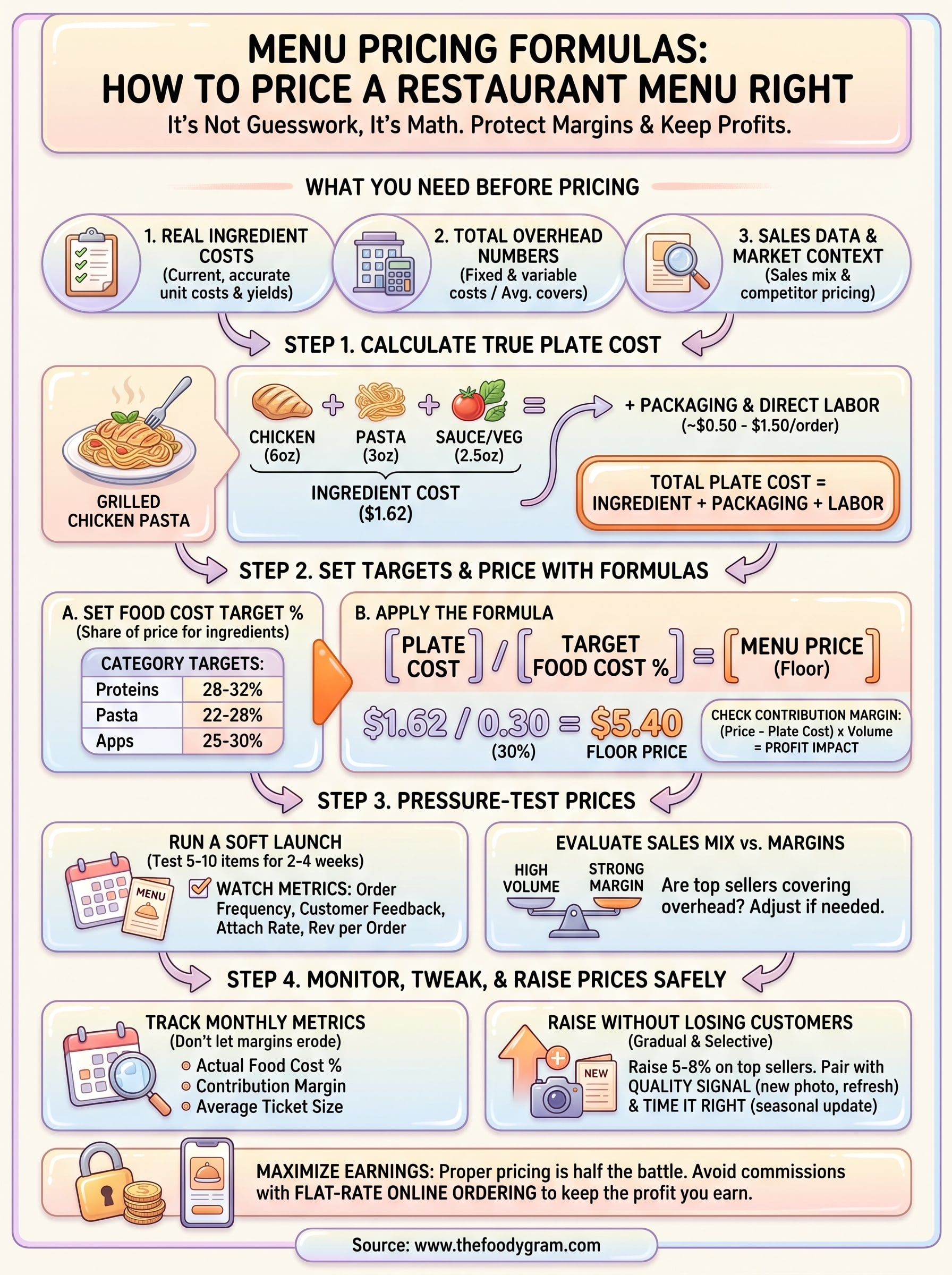
You now have a complete system for how to price a restaurant menu that actually protects your profits. Start with accurate ingredient costs, build real plate costs for every dish, apply the food cost percentage formula, and test your prices before committing. Then track the results monthly so nothing drifts out of alignment without you catching it.
Pricing your menu correctly is only half the equation. If you are still sending 30% of every order to a third-party delivery app, your margins shrink no matter how well you price. That is the problem The Foody Gram solves directly. With flat-rate, commission-free online ordering and a branded restaurant website, you keep the profit your menu is designed to generate.
Check out our commission-free online ordering plans and see exactly what it costs to stop paying commissions on every single order you earn.