


How To Price Food Menu Items For Profit: Formulas & Examples
Most restaurant owners set their menu prices based on gut feeling or by copying what competitors charge. Both approaches leave money on the table. Knowing how to price food menu items correctly is the difference between a restaurant that barely breaks even and one that builds real profit month after month.
Here's the thing, pricing isn't just about covering your food costs. You need to account for labor, rent, utilities, packaging, and every other expense that keeps your doors open. Miss any of these variables, and your margins shrink fast. Factor in the 15–30% commission fees that third-party delivery apps take per order, and those margins can disappear entirely. That's exactly why we built The Foody Gram: to give restaurant owners a commission-free online ordering system so more of each sale stays in your pocket, right where it belongs.
This guide breaks down the exact formulas, methods, and real-number examples you need to price every item on your menu with confidence. Whether you're building a menu from scratch or reworking prices to improve profitability, you'll walk away with a clear, repeatable process that works.
What to know before you set menu prices
Before you touch a single formula, you need a clear picture of your restaurant's cost structure and the market you operate in. Jumping into pricing math without this foundation leads to prices that look reasonable on paper but fail in practice. Think of this section as the groundwork that makes every formula in this guide actually work for your specific restaurant.
The four cost categories that drive every price
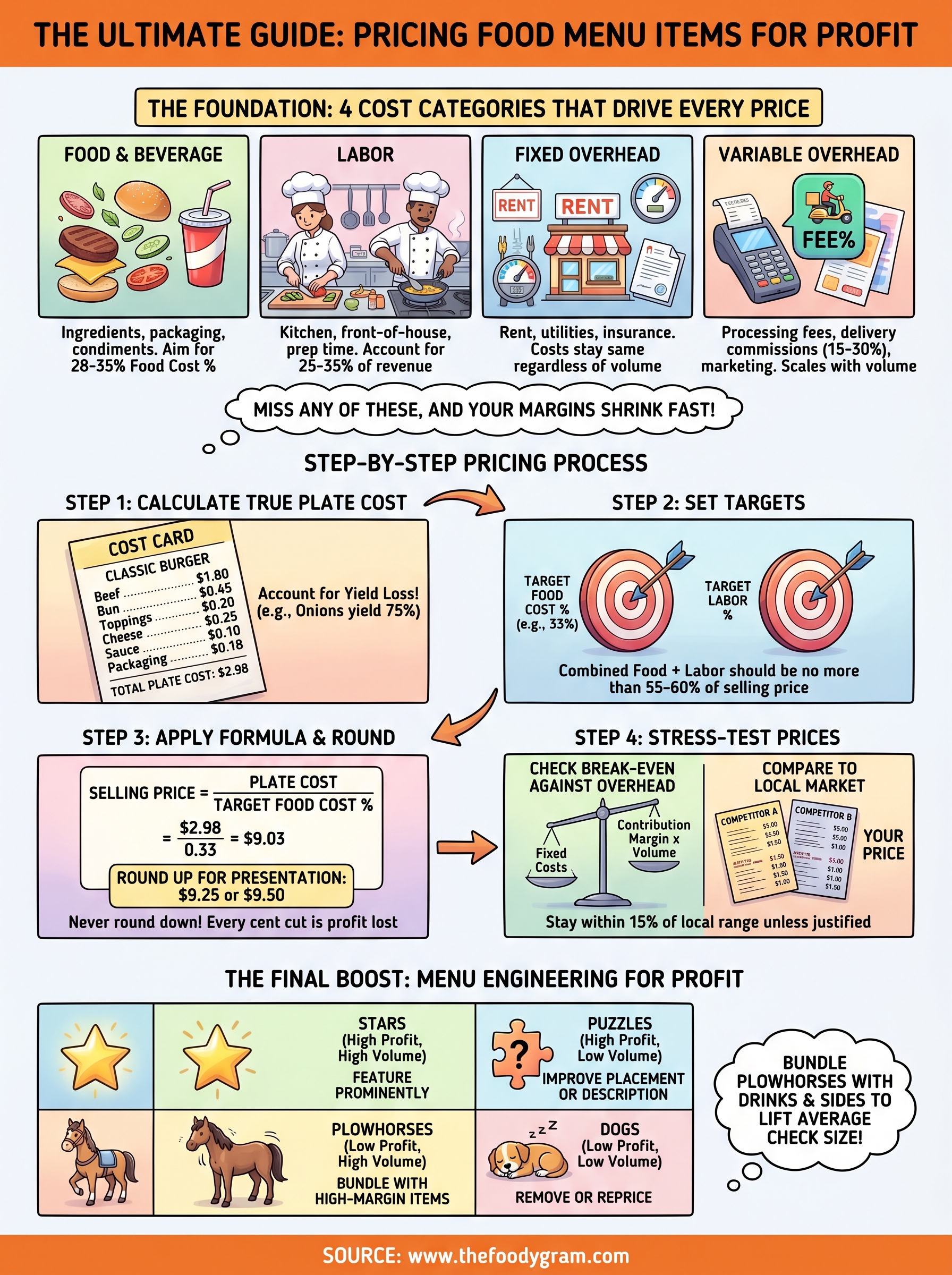
Understanding how to price food menu items starts with knowing what actually costs you money. Most restaurant owners only think about ingredient costs, but that's a fraction of the full picture. Your total costs break down into four main categories:
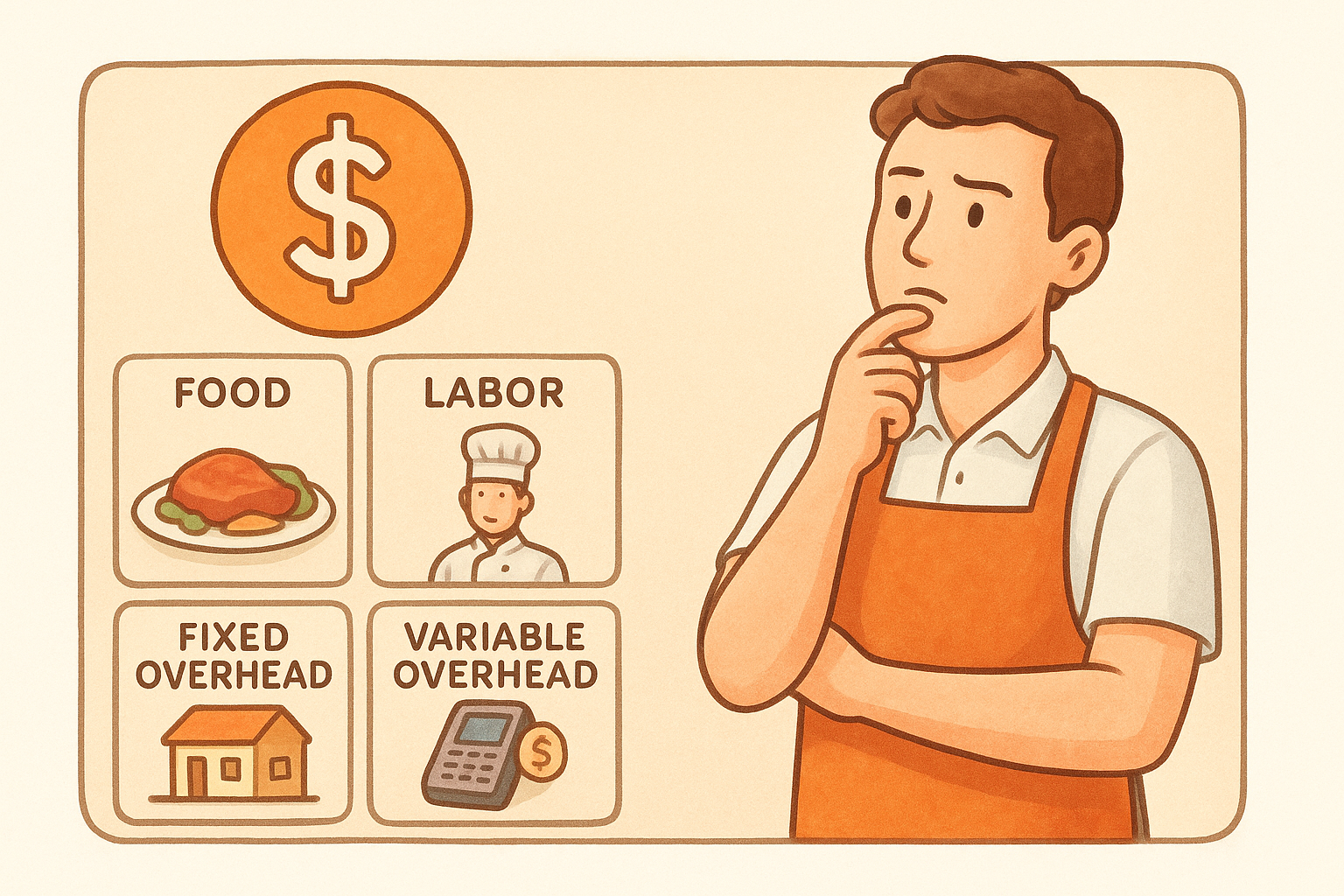
- Food and beverage costs: Ingredients, packaging, condiments, and anything that goes into or alongside the dish
- Labor costs: Kitchen staff, front-of-house workers, and any prep time tied to producing the item
- Fixed overhead: Rent, utilities, insurance, equipment leases, and software subscriptions
- Variable overhead: Credit card processing fees, delivery platform fees, and marketing spend
Miss even one of these categories, and your prices will under-cover your real costs, no matter how careful your math is.
Each category hits your bottom line differently. Fixed costs stay the same whether you sell 10 plates or 1,000. Variable costs scale with your volume, which means they can erode margins quickly when you rely on high-commission delivery platforms to drive orders.
How your sales channels change the math
Where customers order from has a direct impact on how you should price. If a customer orders through a third-party app, that platform takes 15-30% per transaction off the top before you see a cent. On a $15 plate with a $4 food cost, a 25% commission leaves you with $7.25 to cover labor, overhead, and profit. That's a thin margin before you've paid a single utility bill.
Direct ordering channels, like your own branded website or a commission-free system, eliminate that cut entirely. The same $15 plate now gives you $11 to work with. Knowing your channel mix upfront lets you set baseline prices that hold up across every order source, rather than prices that only work when conditions are perfect.
Why local market positioning matters before the math
Your pricing also needs to reflect where your restaurant sits in the market. A family-run pizzeria in a suburban neighborhood operates in a completely different pricing reality than an upscale Italian spot in a city center. Before you run any numbers, check what comparable restaurants in your area charge for similar items. This gives you a price ceiling your customers will accept and a floor below which you'd be leaving profit on the table. The math sets your minimum; the market sets your maximum.
Step 1. Calculate the true plate cost per item
The first real step in learning how to price food menu items is knowing exactly what each dish costs you to produce. Most restaurants guess at this number or use a rough estimate, which means they price items too low and only discover the problem when cash runs tight. You need a precise plate cost for every item before any pricing formula can do its job.
Build a cost card for every dish
A cost card lists every ingredient in a dish, the exact quantity used, and the cost per unit. This document becomes your source of truth for pricing decisions and helps you catch cost creep when supplier prices change. Here is a simple cost card template for a classic burger:
| Ingredient | Quantity Used | Unit Cost | Line Cost |
|---|---|---|---|
| Beef patty (6 oz) | 1 patty | $1.80 | $1.80 |
| Brioche bun | 1 bun | $0.45 | $0.45 |
| Lettuce, tomato, onion | 2 oz total | $0.20 | $0.20 |
| Cheese slice | 1 slice | $0.25 | $0.25 |
| Sauce and condiments | 1 serving | $0.10 | $0.10 |
| Packaging (bag, wrap) | 1 set | $0.18 | $0.18 |
| Total plate cost | $2.98 |
Account for yield loss
Raw ingredients rarely give you 100% usable product. A 6-pound bag of onions might yield only 4.5 pounds after trimming, which means your real cost per usable ounce is higher than the invoice price suggests. Divide the ingredient cost by the usable yield percentage to get your true cost per portion.
Skipping yield calculations can inflate your plate costs by 10-20% without you ever realizing it.
For example, if trimmed onions yield 75%, a $2.00/lb invoice price becomes $2.67/lb of usable product.
Step 2. Set targets for food cost, margin, and labor
Once you have your plate costs in hand, you need to set numerical targets before you calculate a single selling price. These targets act as guardrails throughout the entire pricing process. Without them, knowing how to price food menu items turns into a guessing game rather than a structured, repeatable decision.
Industry benchmarks for food cost percentage
Your food cost percentage is the share of a menu item's selling price that the ingredients actually cost. Most profitable restaurants target a food cost percentage between 28% and 35%, though this varies by concept and category. High-volume, low-complexity items like fries can run at 20%, while protein-heavy dishes often push toward 38%. The table below gives you solid starting benchmarks by category:
| Menu Category | Target Food Cost % |
|---|---|
| Appetizers | 20–28% |
| Proteins (chicken, beef) | 30–38% |
| Pasta and grains | 18–25% |
| Desserts | 20–30% |
| Beverages (non-alcohol) | 10–20% |
Your blended food cost across all menu items should land between 28–32% to protect your gross margin.
Labor cost targets and how they connect to pricing
Labor cost typically runs 25–35% of total revenue in a full-service restaurant. A dish that takes 15 minutes of skilled prep time costs more to produce than one requiring 3 minutes, even when ingredients cost the same. Factor that prep time difference into your targets before you assign a price.
Use these combined cost targets as your pricing baseline:
- Food + labor combined: no more than 55–60% of selling price
- Overhead allocation: 15–20% of selling price
- Target net profit: 10–15% of selling price
Step 3. Price each item with formulas and clean rounding
Now that you have your plate costs and cost targets locked in, you can run the actual pricing math. This is where knowing how to price food menu items gets concrete. Two formulas cover the vast majority of restaurant pricing decisions, and both are straightforward to apply once your cost cards are complete.
The food cost percentage formula
The most widely used pricing method divides your plate cost by your target food cost percentage. The formula looks like this:
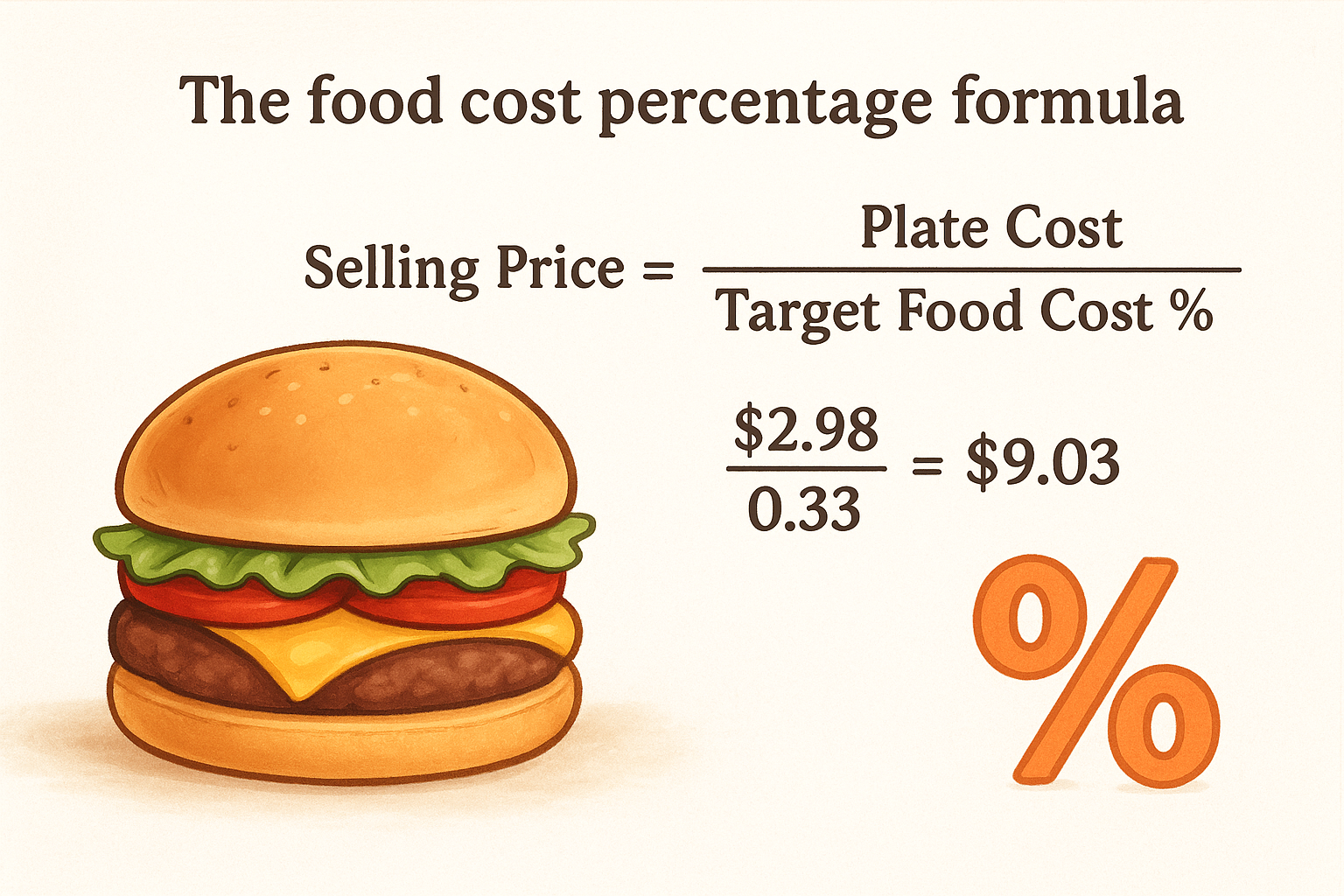
Selling Price = Plate Cost / Target Food Cost %
Apply it to the burger from Step 1 with a 33% food cost target:
$2.98 / 0.33 = $9.03
That gives you your minimum price to hit your food cost target. You can also use a contribution margin approach if you prefer to think in dollar profit per plate rather than percentages. Set the margin you need per item, then add it directly to your plate cost:
Selling Price = Plate Cost + Target Contribution Margin
For example: $2.98 + $6.00 = $8.98. Both formulas should produce prices in a similar range. If they diverge significantly, revisit your cost card or your targets.
Run both formulas on every item and use the higher result as your starting price before you move to rounding.
Round prices for clean presentation
Raw formula outputs like $9.03 look awkward on a printed menu. Round up to the nearest $0.25 or $0.50 to produce prices that read cleanly and naturally. The burger becomes $9.25 or $9.50, which also slightly improves your actual margin. Never round down, since every cent you cut comes directly out of your profit.
Step 4. Stress-test prices against overhead and the market
A price that covers your food cost and hits your margin target in a spreadsheet can still fail in the real world. Overhead expenses and competitor pricing create two additional filters your prices must pass before you finalize them. This step is where knowing how to price food menu items moves from math into practical validation.
Check your break-even against fixed overhead
Your fixed overhead costs exist whether you sell one plate or one hundred. You need to know your monthly break-even revenue and verify that your current menu prices and projected volume can realistically hit it. Calculate your monthly fixed costs, then divide by your average contribution margin per plate to get the number of covers you need to break even.
For example, if your fixed overhead is $8,000 per month and your average contribution margin per plate is $7.00:
$8,000 / $7.00 = 1,143 plates per month to cover overhead before profit
If that number feels unreachable based on your current traffic, your prices are too low, not your volume expectations.
Raise prices on your highest-volume items first; even a $0.50 increase on a bestseller that sells 400 times a month adds $200 in pure margin.
Compare your prices to the local market
Pull menus from three to five nearby competitors that serve similar food at a similar quality level. Map each of your items to the closest equivalent on their menus, then note where your price lands relative to theirs. You want your prices within 15% of the local range unless your brand clearly justifies a premium. If you're significantly below that range, you have room to increase prices without losing customers.
Step 5. Tune your menu to sell higher-profit items
Knowing how to price food menu items correctly is only half the job. The other half is positioning your menu so customers naturally gravitate toward the items that earn you the most money per plate. Menu engineering turns your menu layout into a tool that guides ordering behavior without pressuring anyone.
Use menu engineering to classify every item
Menu engineering splits your items into four categories based on two factors: popularity and profit margin. High-profit, high-volume items are your Stars. High-profit, low-volume items are Puzzles. Low-profit, high-volume items are Plowhorses. Low-profit, low-volume items are Dogs.
| Category | Popularity | Profitability | Action |
|---|---|---|---|
| Stars | High | High | Feature prominently |
| Puzzles | Low | High | Improve placement or description |
| Plowhorses | High | Low | Rewrite description or bundle |
| Dogs | Low | Low | Remove or reprice |
Stars deserve the top-right corner of your menu or the first position in each section, since those spots capture the most eye movement.
Reposition and bundle to lift average check size
Bundling a Plowhorse item with a high-margin side or drink turns a low-profit seller into a package that hits your margin targets. For example, a popular but low-margin chicken sandwich can be paired with a high-margin fountain drink and fries combo, shifting the combined margin well above what the sandwich earns on its own. Rewrite item descriptions to emphasize quality cues like "house-made" or "slow-roasted" since stronger descriptions increase perceived value and support slightly higher price points without menu restructuring.
Wrap it up and set your next pricing review
You now have everything you need to know how to price food menu items with real numbers instead of guesswork. Build your cost cards, set your targets, run the formulas, validate against overhead and the market, and position your menu to push customers toward your most profitable items. Each step builds on the last, so skipping any one of them weakens your entire pricing structure.
Pricing isn't a one-time task. Set a quarterly review on your calendar to revisit your cost cards when supplier prices shift, and check your food cost percentages monthly to catch margin creep before it compounds. A $0.20 ingredient increase across five items adds up fast if you ignore it for six months.
Cutting commission fees is one of the fastest ways to protect the margins your pricing work creates. See how The Foody Gram's commission-free ordering works and keep more of every sale you make.