


What Is Menu Engineering? The Menu Matrix + Psychology Guide
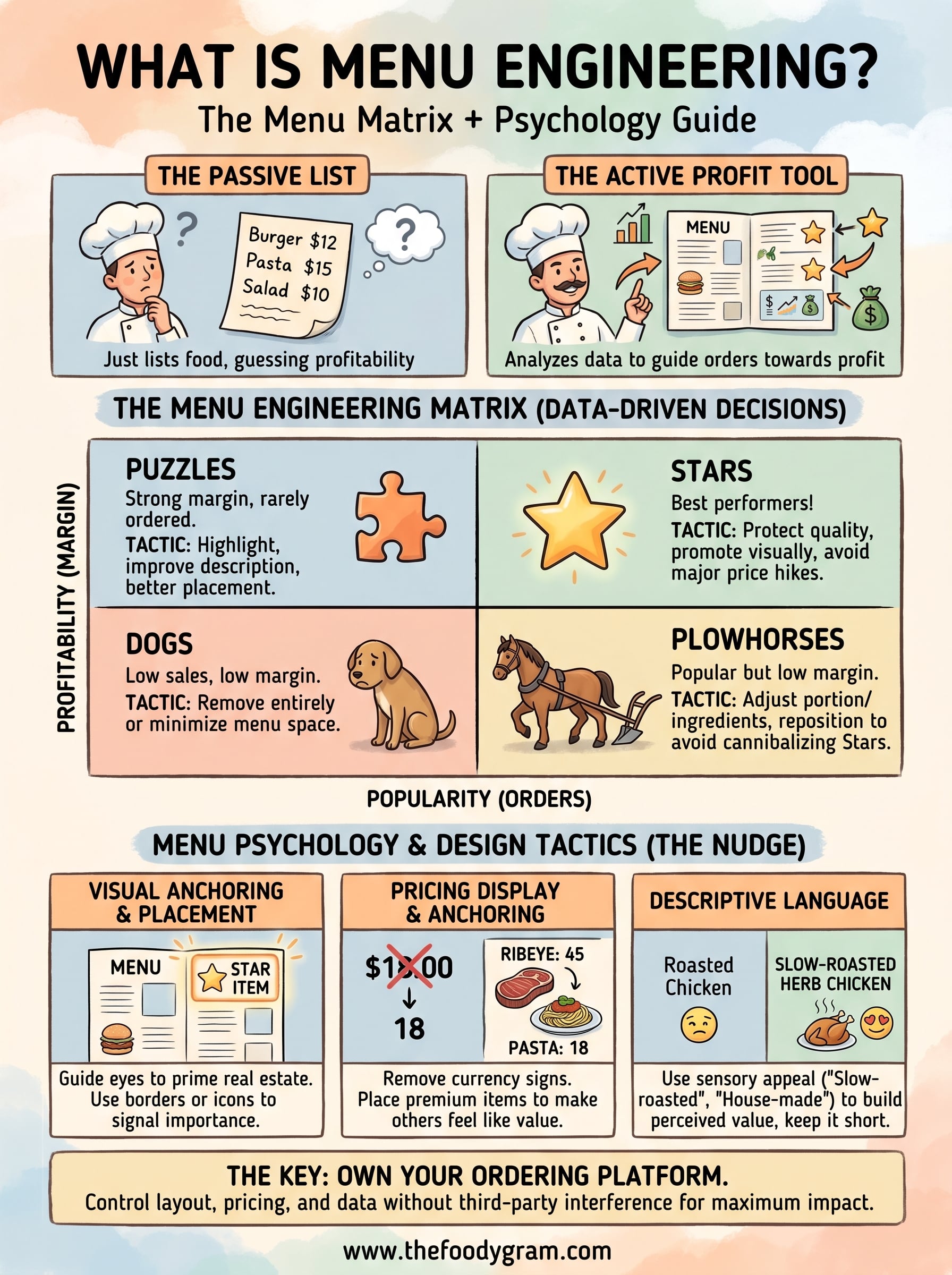
Most restaurant owners spend hours perfecting recipes but barely glance at how those dishes are arranged on the menu. That's a problem, because what is menu engineering if not the difference between a menu that sells and one that just lists food? It's a structured method for analyzing every dish based on profitability and popularity, then using that data to redesign your menu so the right items get ordered more often.
The concept blends hard numbers with psychology. You categorize each dish into a menu matrix (stars, plowhorses, puzzles, and dogs), then apply design and pricing tactics that nudge customers toward your most profitable items. Restaurants that take this seriously routinely see higher average check sizes without adding a single new dish.
Here's where it gets practical: menu engineering works best when you control your own ordering platform. At The Foody Gram, we build commission-free online ordering systems for restaurants, which means you own your menu layout, your pricing strategy, and your customer data. No third-party app dictating how your food is displayed. That control is exactly what makes menu engineering strategies stick.
This guide breaks down the full framework, from building your menu matrix to applying the psychology behind item placement, pricing, and descriptions, so you can turn your menu into one of your most effective revenue tools.
Why menu engineering matters for restaurant profits
Most restaurants run on margins thinner than people outside the industry realize. Food costs, labor, and rent consume the majority of revenue before the owner takes anything home. The dishes you sell, and how often customers order them, directly determine whether you end up profitable or just busy. That's the core problem menu engineering solves: it turns your menu from a passive list into an active profit tool.
A well-engineered menu doesn't just show customers what you serve; it guides them toward the items that keep your restaurant financially healthy.
The real cost of an unanalyzed menu
Few restaurant owners have ever calculated the contribution margin on every single dish. Contribution margin is what remains after you subtract the food cost from the selling price. It's the number that tells you how much each item actually contributes to covering overhead and generating profit. Without that number, you're essentially guessing which dishes deserve prime menu real estate.
When a low-margin dish gets heavy promotion or a prominent position, you work harder for less return. Your servers upsell it, your kitchen preps it in volume, and at the end of the night you've produced a lot of output for a thin financial payoff. Menu engineering fixes this by giving you the data to make deliberate decisions rather than reactive ones.
How small shifts compound into real revenue
The impact of rethinking your menu isn't always dramatic on day one, but it compounds fast. Shifting just 15 to 20 percent of orders from low-margin items to high-margin ones creates a significant dollar difference when you multiply it across a full year of service. Restaurants running 200 covers a day can generate tens of thousands of dollars in additional annual profit simply by adjusting which dishes get visual priority and refined pricing.
Picture a pizza restaurant where the highest-margin pie sits in the middle of a cluttered page with no visual emphasis. A competing item with lower margins has a photo, a compelling description, and a prominent spot. Customers choose the second one more often, not because it tastes better, but because the menu told them to. That's money left behind on every single shift, night after night.
Why this matters even more with delivery in the picture
The rise of third-party delivery apps changed the profit math in a painful way. When you lose 20 to 30 percent of every order to commission fees, your per-dish margin shrinks before it even hits your books. Menu engineering becomes more critical here because you're starting from a lower baseline, and every recovered dollar matters more when a platform is skimming a cut off the top.
Restaurants that switch to commission-free ordering systems see menu engineering pay off faster for exactly this reason. When you own the ordering experience, you control how items appear, how they're described, and what gets featured. You're not constrained by a third-party interface that flattens every dish into the same visual template. Understanding what is menu engineering starts with recognizing that the format and context of your menu carry just as much weight as what's printed on it.
Menu engineering vs menu psychology
Menu engineering and menu psychology get used interchangeably all the time, but they're two distinct disciplines that work best in sequence. Menu engineering is the analytical side: you examine sales data, calculate contribution margins, and sort dishes into categories based on measurable performance. Menu psychology focuses on how customers perceive, read, and respond to your menu through design choices, language, and item placement.
What menu engineering actually measures
Menu engineering gives you a data-driven framework for evaluating every dish on your roster. You look at two specific variables for each item: how often customers order it and how much money it puts in your pocket after food costs are subtracted. Those two numbers form the foundation of what is menu engineering in practice, and without them, every other decision you make about your menu is a guess.
A dish might sell frequently but leave you with thin margins because ingredient costs run high. Another item might be highly profitable but rarely ordered because nothing on the menu draws attention to it. Engineering surfaces both problems at the same time so you can act on both at once rather than fixing one while ignoring the other.
What menu psychology actually changes
Menu psychology is the collection of design and language tools you deploy once the engineering analysis is complete. It covers where high-margin items sit on the page, whether you use photos or descriptive copy, how pricing gets displayed to reduce cost sensitivity, and which visual cues guide the eye toward specific sections of the menu.
The two disciplines are most powerful in sequence: engineering identifies what to promote, and psychology determines how to promote it effectively.
Restaurants that skip the engineering step and jump straight to design changes often optimize the wrong dishes. You might craft compelling descriptions and photography for an item that barely covers its food cost, which generates orders without generating profit. Knowing which items deserve the spotlight is a prerequisite before any psychological tactic pays off.
Used together, menu engineering and psychology create a productive feedback loop. The data tells you what to feature, the design makes customers choose it more often, and the updated sales figures either confirm your original analysis or give you reason to adjust.
How the menu engineering matrix works
The menu engineering matrix is a four-quadrant classification system that sorts every dish on your menu into one of four categories based on two variables: popularity and profitability. Every item you sell lands in one of these quadrants, and the quadrant tells you exactly what to do with it. This is the operational core of what is menu engineering: turning two simple data points into clear, actionable priorities.
Stars, plowhorses, puzzles, and dogs
Each quadrant carries a label that reflects its character. Understanding each one helps you treat your menu as a portfolio of assets rather than a flat list of food.
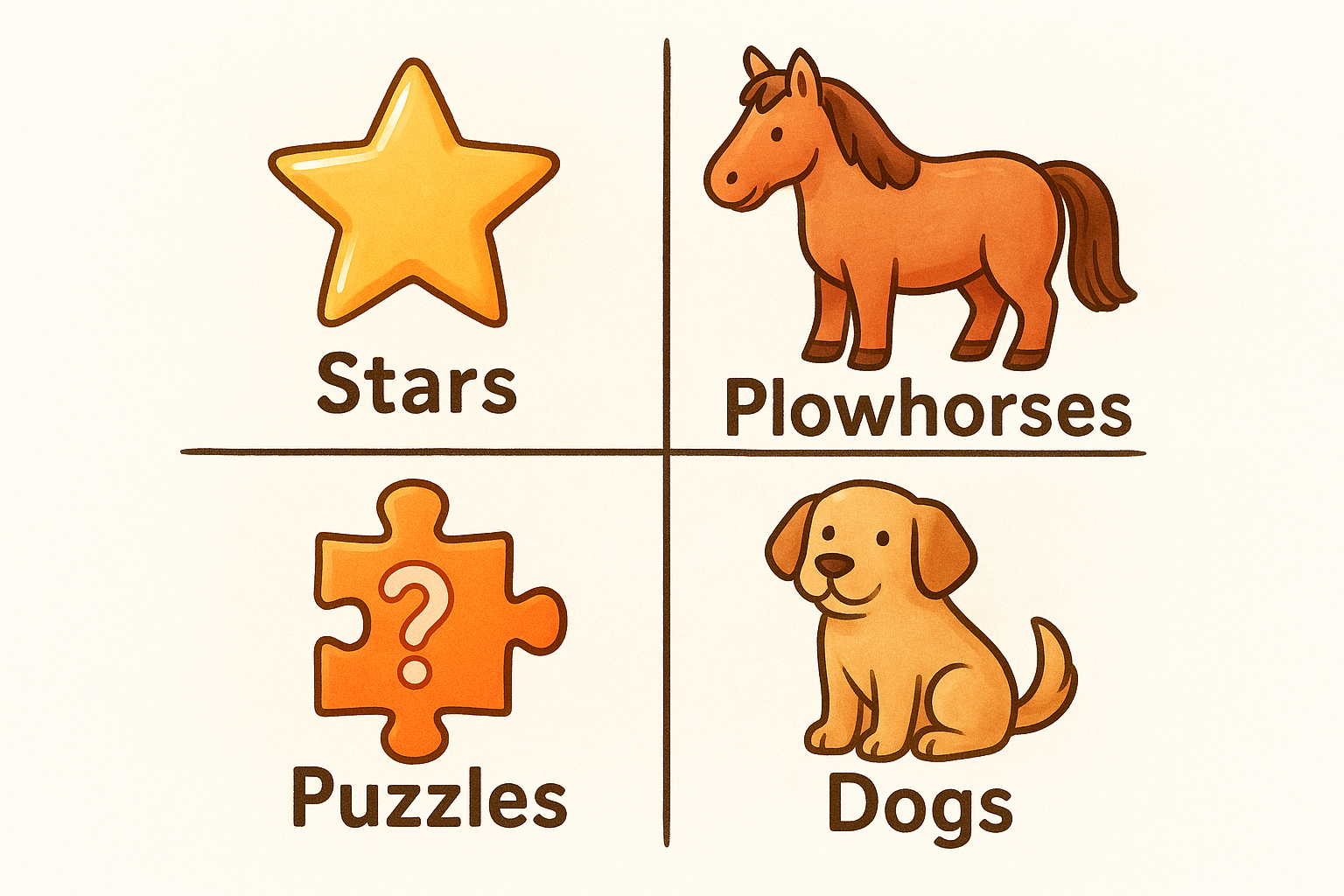
Stars are your best performers. They sell frequently and carry strong contribution margins, which makes them the items you protect and promote. Your goal with stars is to keep their quality consistent, give them visual prominence on your menu, and avoid unnecessary price increases that could reduce order frequency.
Plowhorses sell well but leave thin margins behind. Customers love them, so removing them creates friction, but selling them at volume without profit is a financial drain. The right response here is to either reduce portion sizes slightly, adjust ingredient sourcing, or reposition them on the menu so they don't cannibalize orders from higher-margin dishes.
Plowhorses are the most misunderstood category because high sales volume can mask how little they actually contribute to your bottom line.
Puzzles flip the problem: they carry strong profit margins but rarely get ordered. The dish is financially worthwhile every time someone chooses it, but most customers never get there. These items benefit most from better placement, stronger descriptions, and targeted promotion by your front-of-house staff.
Dogs score low on both measures. They generate neither strong sales nor meaningful profit, which means they consume prep time, inventory space, and menu real estate without justification. Most dogs should be removed entirely, though occasionally one serves a strategic purpose for a specific customer segment.
How the matrix guides every decision
Once every dish has a category, the matrix becomes your decision filter. Price changes, menu redesigns, staff training priorities, and featured item selections all flow from the same framework. You stop making menu decisions based on personal preference or assumption and start making them based on performance data that reflects your actual customers.
How to run a menu engineering analysis
Running a menu engineering analysis doesn't require expensive software or a hospitality consultant. What it requires is accurate sales data, your food cost figures, and enough time to work through the numbers systematically. The process takes most restaurant owners two to three hours the first time, and considerably less once you've built a working template.
Pull your sales data and food costs first
Before any calculation happens, you need two sets of numbers for each dish on your menu. The first is total units sold over a defined period, typically 30 to 90 days of actual service. The second is your food cost per serving, which is the raw ingredient cost to produce one portion of that item. If you don't already track per-dish food costs, start by costing out each recipe line by line. A simple spreadsheet works fine at this stage.
Most point-of-sale systems generate an item sales report automatically. Pull that data for the same time window you used for food costs, so the comparison is valid. Inconsistent time frames produce misleading analysis and undermine every decision you make from the matrix.
Calculate contribution margin for each item
Once you have both data sets, the math is straightforward. Subtract the food cost per serving from the selling price, and the result is your contribution margin for that dish. A pasta dish that sells for $18 with a $5 food cost carries a $13 contribution margin. That's the number that tells you how much the item actually contributes to covering your overhead and profit.
Contribution margin, not revenue, is the number that matters in menu engineering because high-revenue items with high food costs can actually hurt your bottom line.
Run this calculation for every item on your menu, then rank each dish by both contribution margin and total units sold. You'll quickly see which items perform well on one dimension but not the other, and which ones dominate or drag across both.
Sort dishes into the matrix
With your numbers in hand, plot each dish into the four quadrants using your average contribution margin and average sales volume as the dividing lines. Items above the average on both measures are stars. Below average on both are dogs. The other two fall into plowhorses or puzzles depending on which metric they lead on. This is the practical heart of what is menu engineering: turning raw numbers into clear categories that tell you exactly where to focus your energy next.
Menu design tactics that move the numbers
Once your matrix tells you which dishes deserve more orders, design becomes your delivery mechanism. The layout, language, and pricing format on your menu directly influence what customers choose, often more than the actual food quality does. Understanding what is menu engineering in full means recognizing that the analytical work only pays off when the design work reinforces it.
Placement and the visual anchor
Your customers don't read a menu like a document. They scan it, and their eyes follow predictable patterns. Research on reading behavior shows that the upper right corner and the top of the first column receive the most initial attention on a standard menu. That makes those spots your highest-value real estate, and your stars belong there by default.
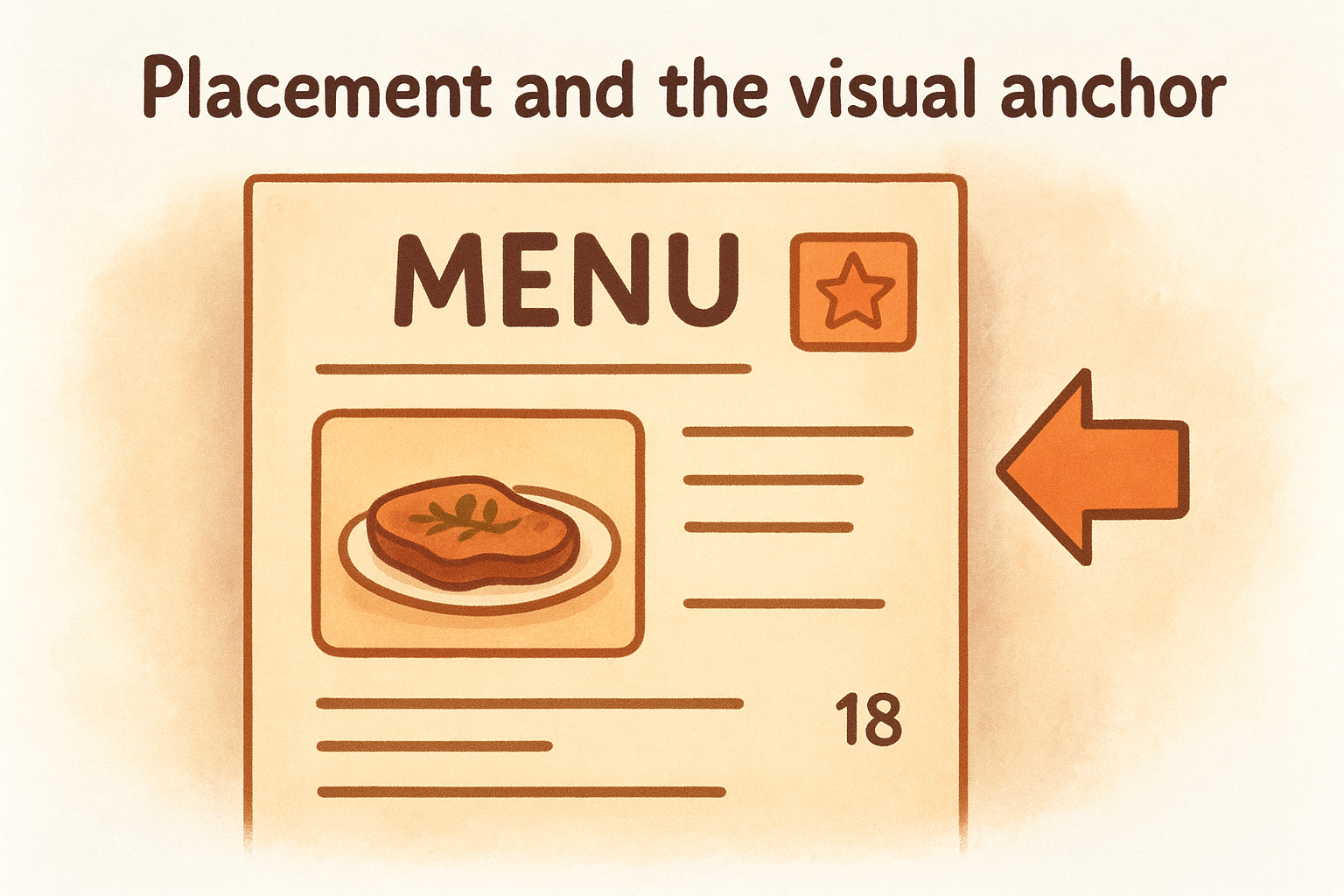
Placing a high-margin item in a low-attention zone is the same as hiding it from your customers.
You can further reinforce placement with visual anchors like a bordered box, a small icon, or a subtle background contrast. These elements signal to the reader that a specific item deserves attention, and customers respond to that signal without realizing they're following it.
Pricing display and anchoring
How you present prices shapes how customers evaluate them. Removing the dollar sign from your menu reduces the psychological sting of spending and encourages customers to focus on the food rather than the cost. Listing prices as numerals only ("18" instead of "$18.00") is a small change that measurably reduces cost sensitivity in dining studies.
Anchoring works alongside this. Placing one premium item near the top of a category makes adjacent mid-range items feel like reasonable value by comparison. Customers often choose the second or third most expensive option when a higher-priced item sets the reference point.
Descriptions that sell without selling
A well-written description does two things: it communicates sensory appeal and it builds perceived value. Phrases that highlight origin, preparation method, or texture tend to outperform generic ingredient lists. "Slow-roasted" performs better than "roasted." "House-made" builds more trust than "fresh."
Keep descriptions short and specific, typically two to three lines. Longer copy loses readers and slows the ordering process, which creates friction at exactly the wrong moment.
Wrap-up and next step
Menu engineering is a repeatable process, not a one-time project. You now have the full picture of what is menu engineering: calculate contribution margins, sort every dish into the matrix, and apply design tactics that guide customers toward your highest-margin items. Small adjustments in placement, descriptions, and pricing compound into meaningful revenue gains across every service period.
None of that works well when a third-party platform controls how your menu looks. Owning your ordering experience is the prerequisite that makes every engineering decision stick, because you control the layout, the descriptions, and the featured item placement from end to end. Every dollar a delivery app takes in commissions shrinks the margin improvement you just worked to build.
If you're ready to take full ownership of your menu and your revenue, see our commission-free plans and find the right fit for your restaurant's bottom line.