


How Much Do Delivery Apps Charge Restaurants? Fees Explained
If you've ever wondered how much do delivery apps charge restaurants, the short answer is: a lot more than most owners expect. Platforms like DoorDash, Uber Eats, and Grubhub typically take between 15% and 30% of every order, and that's before factoring in additional fees for marketing, promotions, and payment processing. On a $50 order, you could be handing over $15 or more, just for the privilege of being listed.
These commission structures have a direct and measurable impact on restaurant profit margins, which already run thin in most cases. Yet many restaurant owners sign up without fully understanding the fee tiers, contract terms, or hidden costs buried in the fine print. That lack of clarity is exactly what keeps third-party platforms profitable, and keeps restaurants struggling to break even on delivery orders.
At The Foody Gram, we built a commission-free online ordering platform specifically because we saw how these fees were gutting independent restaurants. This article breaks down exactly what each major delivery app charges, compares their fee structures side by side, and explains where your money actually goes, so you can make an informed decision about how you sell online.
Why delivery app fees matter for restaurants
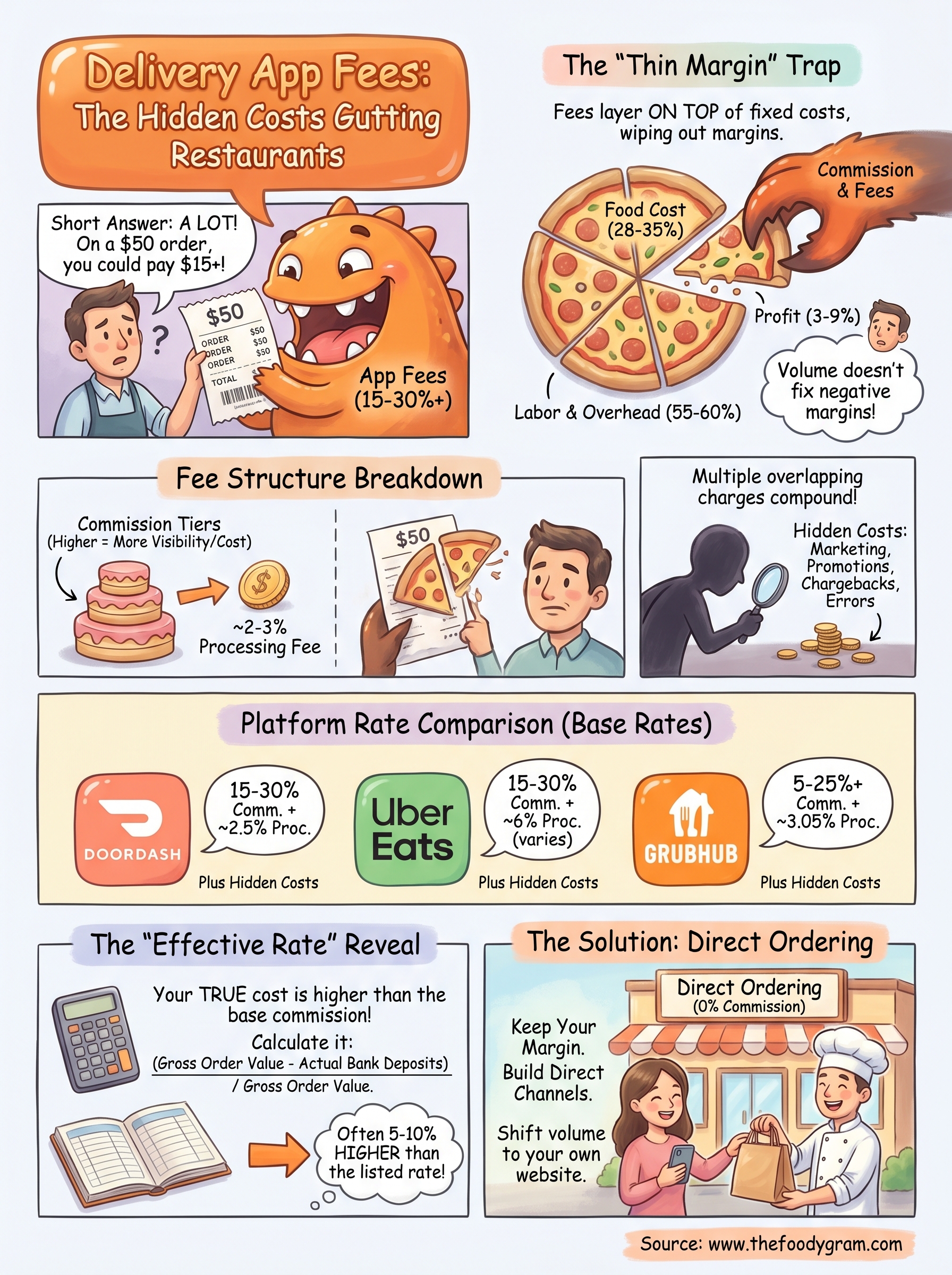
Restaurant profit margins are notoriously thin. The typical independent restaurant operates on net margins between 3% and 9%, which means a $50 order might generate only $2 to $4.50 in profit under ideal conditions. When a delivery app takes 20% to 30% of that same order, the entire margin disappears, and in many cases you're losing money on each sale. Understanding how much do delivery apps charge restaurants isn't just a financial curiosity. It's a survival question for any operator accepting orders through third-party platforms.
A 25% commission on a $50 order wipes out more profit than most restaurants earn on that order under normal operating conditions.
The real cost of thin margins
Most restaurants calculate food cost as a percentage of revenue, typically 28% to 35% of the menu price. Add labor, rent, utilities, and supplies, and you're already sitting at 85% to 95% of revenue spent before a cent of profit is counted. Delivery app commissions layer directly on top of these fixed costs, which means a fee structure that sounds manageable in theory can completely invert your unit economics in practice.
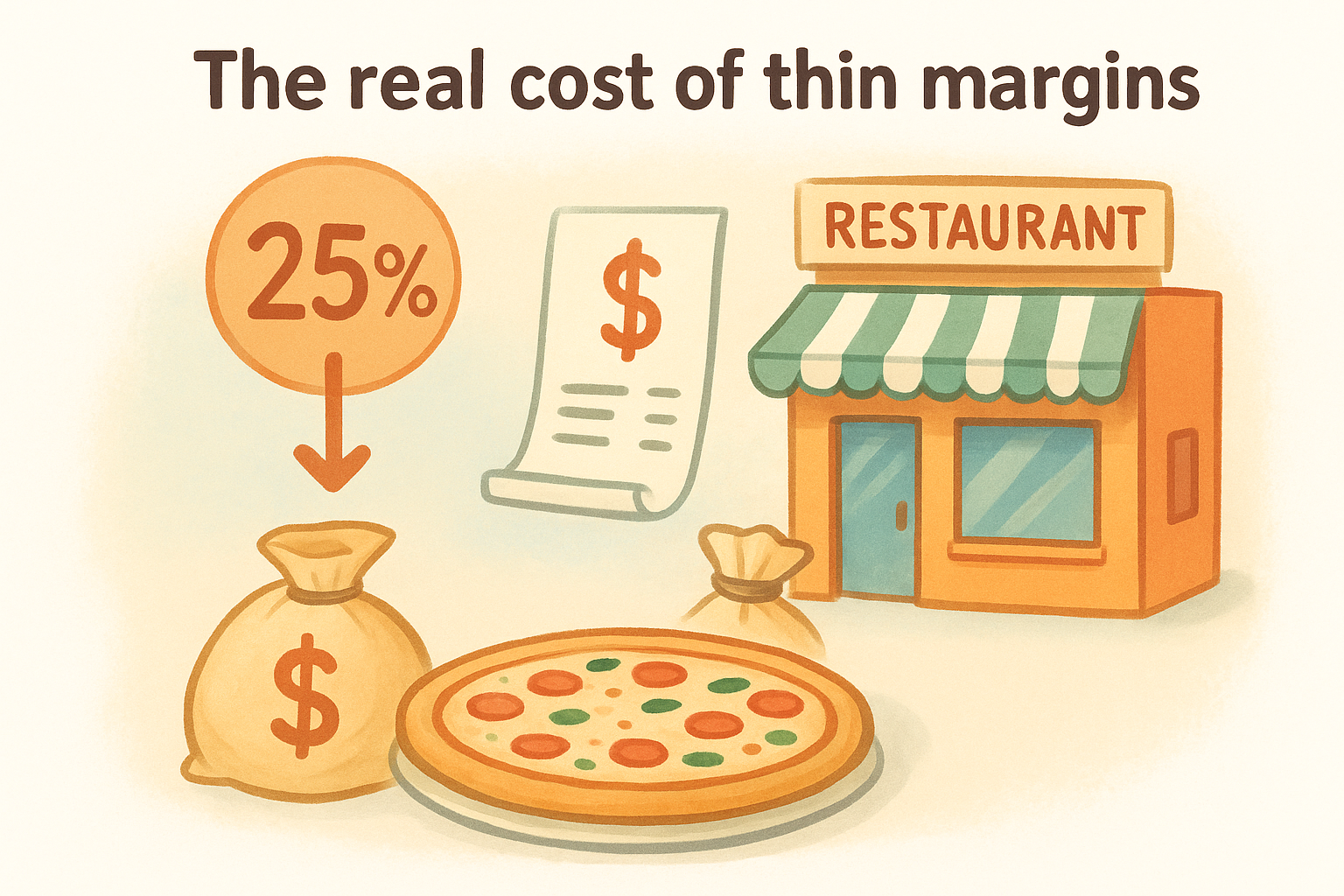
Consider a pizza that sells for $18. Your food cost might be $5.40, and labor plus overhead might account for another $9, leaving $3.60 in margin. A 25% delivery app commission takes $4.50 off the top, meaning you lose $0.90 on every pizza you sell through that channel before handling any driver costs or customer service issues.
Why volume doesn't solve the problem
Many restaurant owners assume that higher order volume through delivery apps will compensate for the fee hit. The math doesn't support that assumption. If you're losing money on each transaction, processing more orders at the same rate accelerates the loss rather than fixing it. Scaling a negative-margin channel ties up kitchen capacity that could serve profitable orders from your own direct channels.
Your channel strategy, your pricing structure, and how you build customer relationships all hinge on a clear understanding of what third-party platforms actually cost you. Restaurants that rely heavily on delivery apps without tracking their true cost per order often find themselves operationally busy but financially stuck, unable to raise prices enough to recover without losing placement on the platform.
How delivery apps charge restaurants
Delivery platforms don't use a single flat fee. Instead, they build their revenue from multiple overlapping charges that compound on each order. Understanding the structure behind how much do delivery apps charge restaurants gives you a clearer picture of where your revenue actually goes before you ever touch it.
Commission tiers
Every major delivery app uses a [tiered commission model](https://www.thefoodygram.com/pages/commission-free-online-ordering), where you pay a higher or lower percentage depending on which plan you select. Higher tiers typically unlock better placement in search results, priority customer support, and broader marketing exposure within the app. Lower tiers cost less per order but bury your listing and reduce your visibility to new customers.
Paying a lower commission tier often costs you more in lost order volume than the savings are worth, which keeps restaurants locked into expensive plans.
The tier structure creates a trap. Choosing the cheapest plan limits your discoverability, so fewer customers find you. Choosing the premium plan pushes your commission above 25%, which destroys your margin on every order. Most restaurants land somewhere in the middle, paying more than they expected while still not getting enough reach to justify the cost.
Per-order fees beyond commission
Commission is just the starting point. Platforms also charge a payment processing fee on each transaction, typically between 2% and 3%, which comes out separately from your commission rate. Some platforms add a flat per-order fee on top of that. If you participate in sponsored placement or in-app promotions, those costs get deducted from your payout as well, often without a clear line-item breakdown. By the time you add up the commission, the processing fee, and any promotional spend, your effective fee rate on a given order can run significantly higher than the base percentage your contract lists.
Delivery app commission rates by platform
When you ask how much do delivery apps charge restaurants, the answer depends on the platform and the plan you choose. Each major platform structures its commissions differently, but the ranges below reflect publicly available information on their standard tiers.
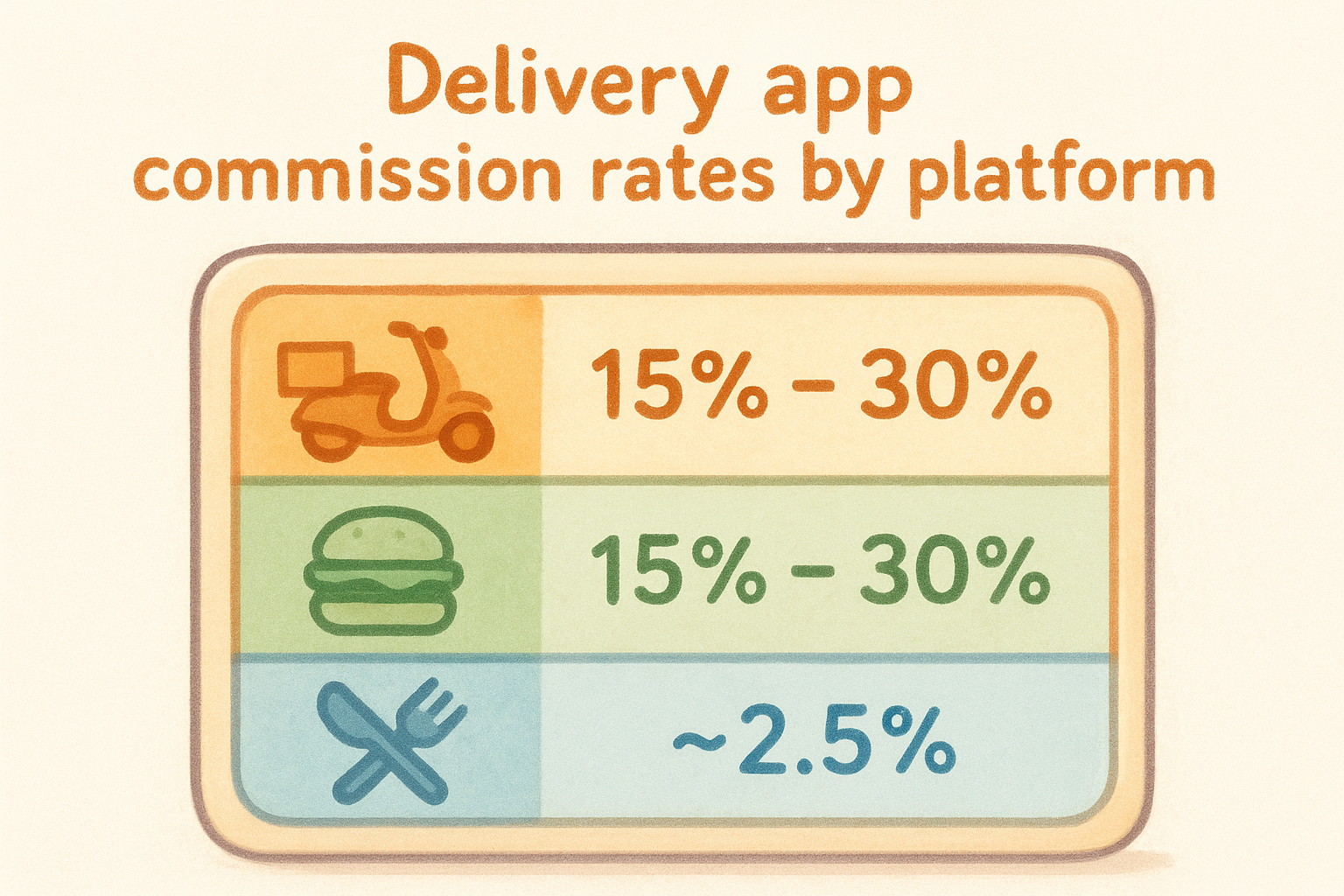
| Platform | Commission Range | Processing Fee |
|---|---|---|
| DoorDash | 15% to 30% | ~2.5% |
| Uber Eats | 15% to 30% | ~6% (included in some plans) |
| Grubhub | 5% to 25%+ | ~3.05% |
DoorDash
DoorDash offers three main plans: Basic, Plus, and Premier. Basic starts at 15% commission but limits your delivery radius and visibility. Premier, which runs up to 30% per order, unlocks broader marketing and a demand guarantee for qualifying restaurants.
Restaurants on lower-tier plans frequently report poor placement in search results within the app. Upgrading to get meaningful exposure often pushes your effective commission rate above 25%, which is where most independent restaurants stop making money on delivery orders.
Uber Eats
Uber Eats structures its commissions around delivery, pickup, and Dine-in options, with delivery commissions ranging from 15% to 30% depending on your plan tier. Its Lite plan sits at the lower end, while its full-service Uber One integration pushes rates higher.
Payment processing on Uber Eats is bundled into some plans and broken out separately in others, which makes direct comparisons harder. The total cost per order tends to be higher than the headline commission rate suggests once you account for all deductions.
Grubhub
Grubhub's pricing is the most variable of the three. Its base marketing commission starts around 5% for restaurants that drive their own traffic, but most restaurants need Grubhub's sponsored placement to generate volume, which pushes the effective rate to 20% or above.
Grubhub's flexible floor makes it look affordable on paper, but the real cost surfaces once you factor in the paid placement fees required to compete for visibility.
Hidden costs that raise your real fee rate
When you ask how much do delivery apps charge restaurants, the commission rate is only part of the answer. Platforms layer additional charges on top of your base commission that rarely appear as clear line items in your payout summary. These deductions accumulate quietly, and most restaurant owners don't notice them until they compare gross order volume against actual bank deposits.
Marketing and promotional deductions
Delivery apps push restaurants to participate in sponsored listings, discount campaigns, and loyalty promotions to maintain visibility within the platform. When you join a promotion, the cost comes directly out of your payout, not from the platform's own budget. A 20% discount offered through a DoorDash or Grubhub promotion means you absorb that discount on top of your existing commission, effectively doubling down on margin loss for every order that uses it.
Promotional fees can add 5% to 10% or more to your effective cost per order, often without a clear breakdown in your dashboard.
Chargebacks and error adjustments
Platforms handle customer complaints, refund requests, and order errors in ways that frequently shift the financial burden to your restaurant, even when the issue originates with the driver or the platform itself. A driver delivers the wrong item or a bag gets opened in transit, and the platform issues a refund to the customer while deducting the full amount from your next payout.
You absorb the loss on food cost, labor, and the commission you already paid on that order. Some platforms also apply dispute resolution deductions that pull the entire order value rather than just the disputed item. Over the course of a month, these adjustments quietly reduce your actual deposit by several percentage points beyond what your contract rate would suggest on paper.
How to calculate and reduce your true fee rate
Knowing how much do delivery apps charge restaurants in theory is useful, but calculating your actual effective rate on real orders gives you the number that actually matters. Your effective fee rate isn't the commission percentage your contract lists. It's the total amount deducted from every order divided by the gross order value, including commissions, processing fees, promotional deductions, and chargeback adjustments.
Calculate your effective rate per order
Pull your last 30 days of payout reports from each platform and run this calculation for each order channel:
- Add up your total gross order value for the period
- Subtract your actual bank deposits from that platform
- Divide the difference by gross order value
- Multiply by 100 to get your true fee percentage
If you collected $10,000 in orders through DoorDash but only deposited $6,800, your effective rate is 32%, not the 25% your plan lists. Most restaurants find their real rate runs 5% to 10% higher than the base commission once all deductions are counted.
Running this calculation monthly gives you a clear picture of which channels are actually profitable and which ones are quietly draining your margins.
Reduce your dependency on third-party platforms
Once you know your true cost per channel, you can make deliberate decisions about where to shift your volume. Direct ordering through your own website eliminates the commission layer entirely, which means every dollar your customer spends stays with your business instead of funding the platform. You can encourage existing delivery app customers to reorder directly by including a card in each bag with your website address and a small incentive, such as a free item or priority queue on busy nights. Over time, even a 20% shift in volume away from third-party apps to a direct channel can meaningfully improve your monthly profitability without changing your menu prices.
Where to go from here
Now that you understand how much do delivery apps charge restaurants, you have the numbers you need to evaluate every order channel you use. The gap between your listed commission rate and your actual effective fee rate is where most restaurant owners lose money without realizing it. Once you run that calculation and see the real cost, the path forward becomes straightforward: reduce your dependency on platforms that take a cut of every transaction and build a direct ordering channel that keeps that revenue with your business.
Your customers already want to support you. Giving them a way to order directly removes the platform from the middle and puts that margin back in your pocket. If you want to see what a flat monthly fee looks like compared to per-order commissions, check out The Foody Gram's commission-free pricing and run the numbers against what you currently pay.