


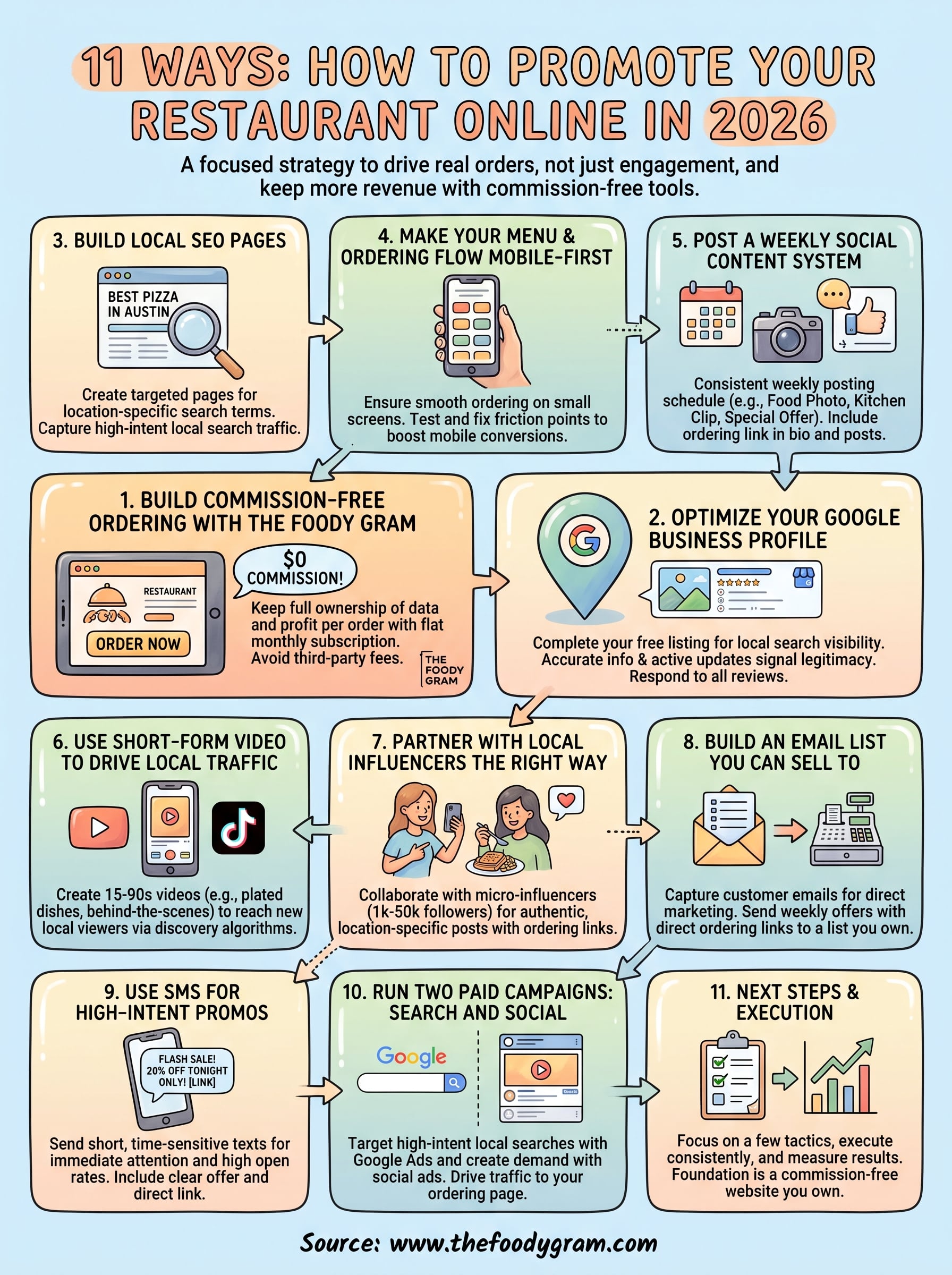
11 Ways: How To Promote Your Restaurant Online In 2026
Most restaurant owners already know they need an online presence. The harder question is how to promote your restaurant online in a way that actually drives orders, not just likes, follows, or empty engagement. With more diners discovering restaurants through Google, Instagram, and direct websites than ever before, your digital strategy directly impacts your bottom line.
The good news? You don't need a massive marketing budget or a dedicated social media team to make it work. What you do need is a focused approach that puts your restaurant in front of the right people, at the right time, through the right channels. From optimizing your Google Business Profile to building a commission-free online ordering website that you actually own, every tactic in this guide is designed to help you attract more customers and keep more of the revenue they generate.
At The Foody Gram, we help restaurants take control of their online presence with branded websites and direct ordering systems, no commissions, no middlemen. We've seen firsthand what works (and what doesn't) when it comes to growing a restaurant's digital footprint. This article breaks down 11 proven strategies you can start using right now to get more visibility, more orders, and more repeat customers.
1. Build Commission-Free Ordering With The Foody Gram
If you're serious about learning how to promote your restaurant online, the first thing you need is a direct ordering channel you actually own. Third-party apps like DoorDash and Uber Eats take anywhere from 15% to 30% per order, which means you're handing over a significant cut of every sale just to stay visible on someone else's platform. The Foody Gram gives you a branded restaurant website with built-in commission-free ordering so customers order directly from you, and the money lands in your account.
What It Is and Why It Works
The Foody Gram is a managed platform that builds you a custom, mobile-optimized restaurant website with a fully functional online ordering system. You pay a flat monthly subscription instead of a percentage of every order. That structure matters because your profit per order stays the same whether you do 50 orders a week or 500. You also keep full ownership of your customer data, which means you can market directly to the people who already buy from you.
The average restaurant paying 25% commission on $10,000 in monthly online orders loses $2,500 every month to platform fees alone.
How to Do It Step by Step
Getting started is straightforward. First, sign up for a plan and share your menu, logo, photos, and brand details with the setup team. The team builds your site within 48 to 72 hours. After that, you review the site, request any changes, and go live. From that point, your ordering link is yours to share on Google, Instagram, your email list, and anywhere else you promote your restaurant.
Tools and Costs
The Foody Gram plans start at $159 per month with no setup fees, no contracts, and a 45-day money-back guarantee. That flat fee covers your website, the ordering system, menu management support, and 24/7 customer service. There are no hidden per-order charges eating into your margins.
Mistakes to Avoid
The biggest mistake restaurants make is building a website and then sending all their traffic to a third-party app anyway. Link directly to your own ordering page in every bio, every ad, and every email you send. A second mistake is leaving your menu outdated. Keep your items, prices, and photos current because an inaccurate menu erodes customer trust faster than almost anything else.
2. Optimize Your Google Business Profile
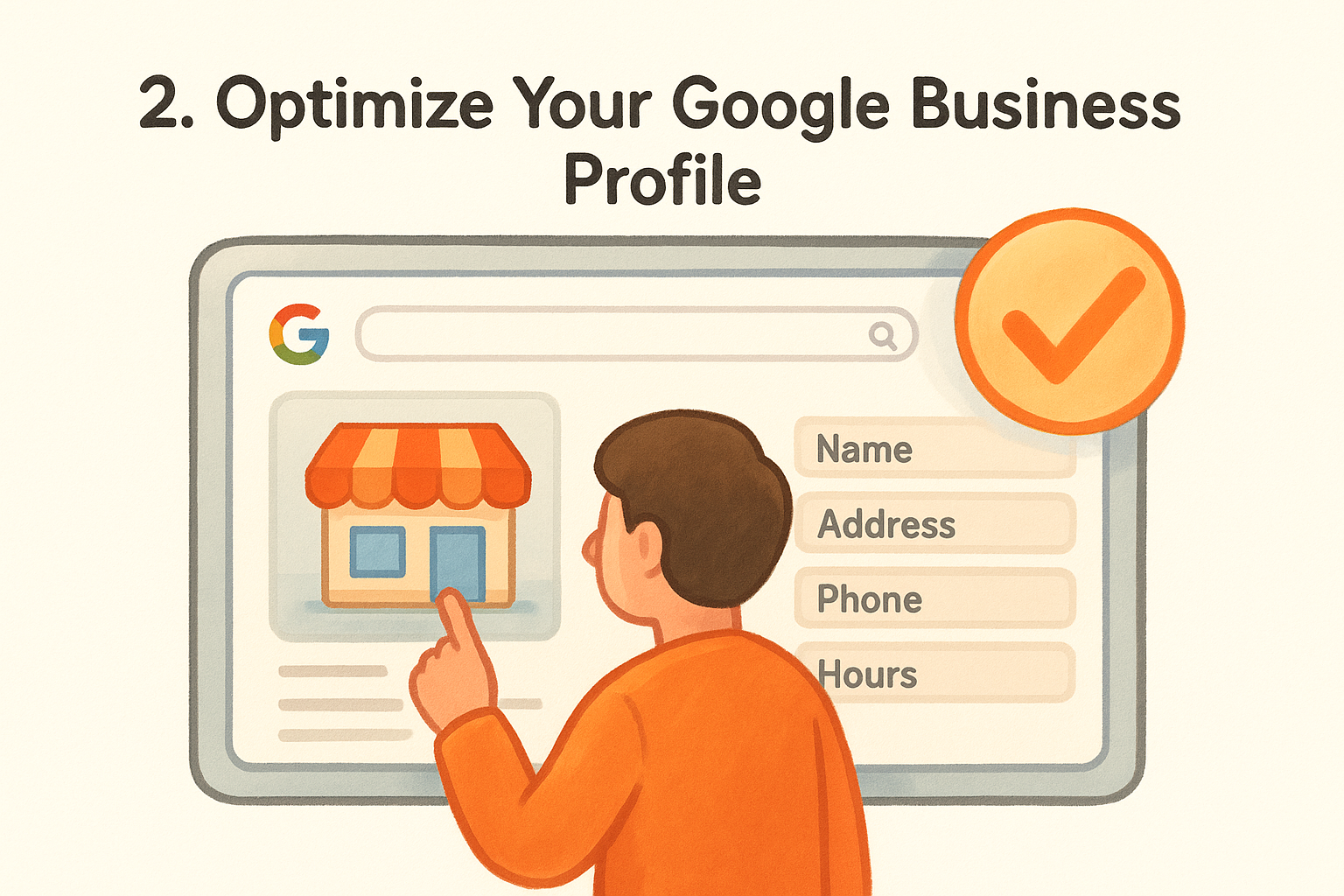
Your Google Business Profile (GBP) is often the first thing a potential customer sees when they search for your restaurant. It shows up in Google Maps, local search results, and the knowledge panel on the right side of the screen. Getting it right is one of the fastest, highest-leverage moves in how to promote your restaurant online.
What It Is and Why It Works
Google Business Profile is a free listing that controls how your restaurant appears in local search. When someone types "pizza near me" or "best tacos in [your city]," Google pulls from GBP data to decide which restaurants to surface. A complete, accurate, and active profile signals to Google that your business is legitimate and worth showing.
Restaurants with complete GBP listings receive significantly more direction requests and website clicks than those with incomplete profiles.
How to Do It Step by Step
Claim your profile at google.com/business if you haven't already. Then fill out every field: business name, address, phone number, hours, website, and cuisine category. Upload at least 10 high-quality photos covering your food, interior, and exterior. Add your menu directly to the profile. Post weekly updates using the Posts feature to share specials, events, or new items. Respond to every review, positive or negative, within 24 hours.
Tools and Costs
Google Business Profile is completely free. The only investment is your time, which runs about 30 minutes to set up and 15 minutes per week to maintain.
Mistakes to Avoid
The most common mistake is setting up the profile and ignoring it. Outdated hours and unanswered reviews both push customers away. Verify your hours during holidays and update them before customers show up to a closed door.
3. Build Local SEO Pages That Match Real Searches
Your website can rank in Google for specific, high-intent searches if you build the right pages. Most restaurants skip this entirely, which means you have a real opportunity to show up when someone types "best [cuisine] in [city]" or "[city] restaurant delivery." This is one of the most underused tactics in how to promote your restaurant online.
What It Is and Why It Works
Local SEO pages are dedicated pages on your website built around location-specific search terms your customers actually type into Google. Instead of hoping your homepage ranks for everything, you create targeted pages that match exactly what local diners are searching for. Google rewards pages that are specific and relevant, so a page titled "Order Italian Food in Austin, TX" performs far better than a generic homepage.
Restaurants that create location-specific landing pages capture search traffic that competitors with single-page websites miss entirely.
How to Do It Step by Step
Start by researching what people search in your area. Use Google Search's autocomplete feature to find real queries by typing your cuisine and city name and seeing what Google suggests. Build a dedicated page for each strong search term you find. Each page needs a clear headline with the location, a description of your food and ordering options, and a direct link to your online ordering system.
Tools and Costs
Google Search is free to use for research. If you have a Foody Gram website, you can request new pages through the platform's support team at no extra cost.
Mistakes to Avoid
Avoid copying the same content across multiple location pages and just swapping city names. Thin, duplicate content gets penalized by Google. Write each page with unique details relevant to that specific neighborhood or city.
4. Make Your Menu and Ordering Flow Mobile-First
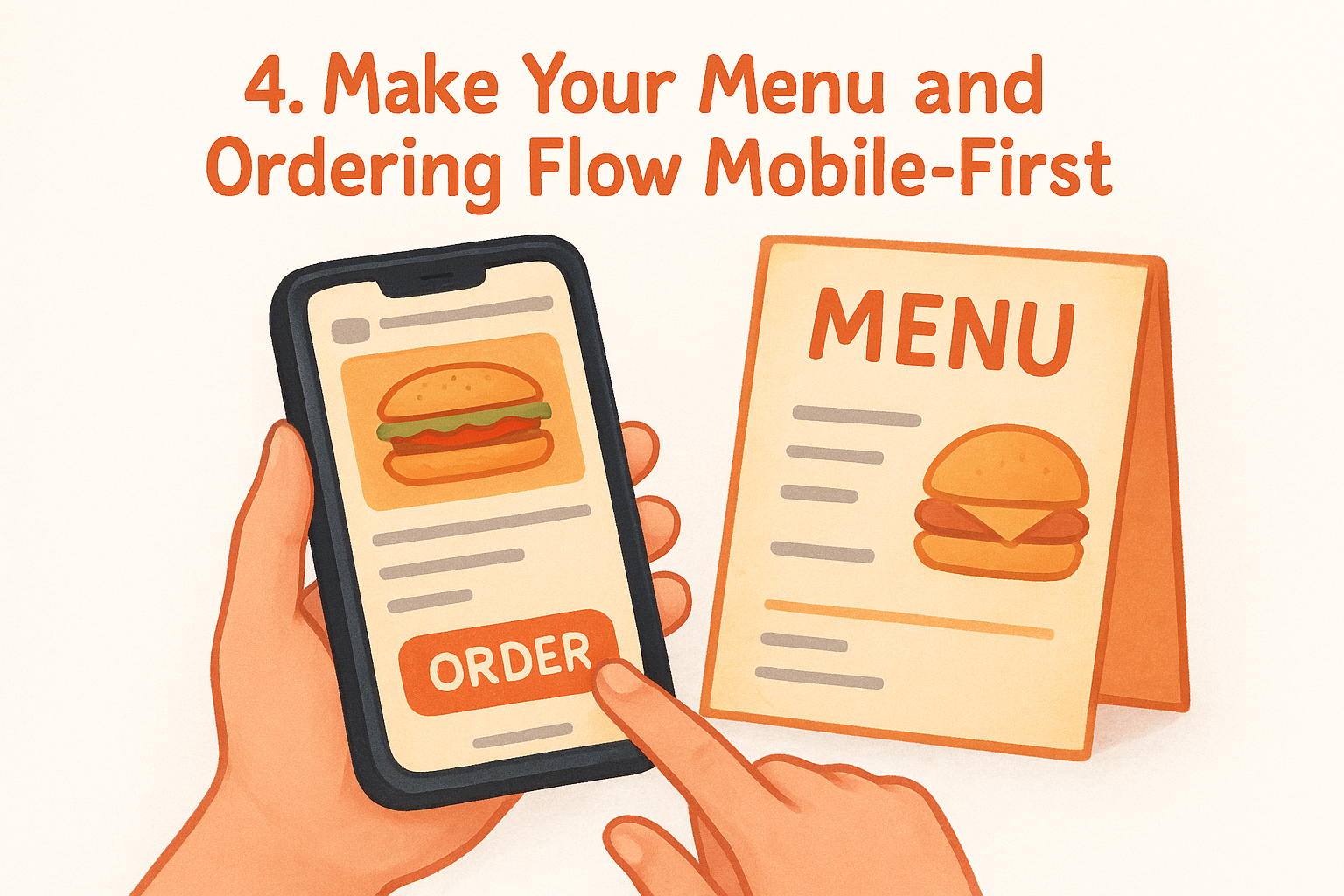
More than 60% of restaurant searches happen on a phone, and if your ordering experience breaks down on a small screen, you lose that customer before they ever reach checkout. A mobile-first approach is not optional anymore; it is a baseline requirement for anyone figuring out how to promote your restaurant online effectively.
What It Is and Why It Works
Mobile-first means your menu, ordering flow, and checkout are designed and tested for small screens before anything else. Most restaurant websites are built on a desktop and then scaled down, which creates friction: tiny buttons, hard-to-read text, and slow load times. Fixing that friction directly increases the percentage of visitors who complete an order.
A one-second delay in mobile page load time can reduce conversions by up to 20%.
How to Do It Step by Step
Open your website on your own phone and place a test order from start to finish. Note every point where you have to pinch, zoom, or scroll sideways to interact with anything. Your menu categories should load in under three seconds, item photos should scale cleanly, and the add-to-cart and checkout buttons should be large enough to tap without zooming. Fix each friction point before driving paid or organic traffic to the page.
Tools and Costs
Google's PageSpeed Insights is free and gives you a mobile performance score with specific fixes listed. Foody Gram websites are built mobile-optimized by default, so you start from a strong baseline.
Mistakes to Avoid
Never assume desktop performance equals mobile performance. Test on multiple screen sizes and on a real cellular connection, not just Wi-Fi, to get an accurate picture of what your customers actually experience.
5. Post a Weekly Social Content System
Posting randomly on Instagram or Facebook whenever you feel inspired is not a strategy. A consistent, repeatable weekly posting schedule is what keeps your restaurant visible to local followers and builds the kind of familiarity that turns scrollers into paying customers. This is a core part of how to promote your restaurant online without spending money on ads.
What It Is and Why It Works
A weekly social content system means you assign specific content types to specific days and repeat that structure every week. Instead of staring at your phone wondering what to post, you follow a predictable rhythm. Algorithms on Instagram and Facebook reward consistent posting by showing your content to more of your followers over time.
Restaurants that post at least four times per week on Instagram see significantly higher engagement rates than those that post once or less.
How to Do It Step by Step
Build a simple weekly template. Assign Monday to a food photo or featured menu item, Wednesday to a behind-the-scenes kitchen clip, and Friday to a special offer or weekend promotion. Stick to three to four posts per week. Write captions that include your city name and a direct link to your ordering page in your bio.
Tools and Costs
Meta Business Suite is free and lets you schedule posts for both Instagram and Facebook in one place. You can batch-create a full week of content in under an hour on Sunday.
Mistakes to Avoid
Avoid posting without a clear call to action on every piece of content. Every post should direct followers somewhere, your ordering link, your location, or your phone number.
6. Use Short-Form Video to Drive Local Traffic
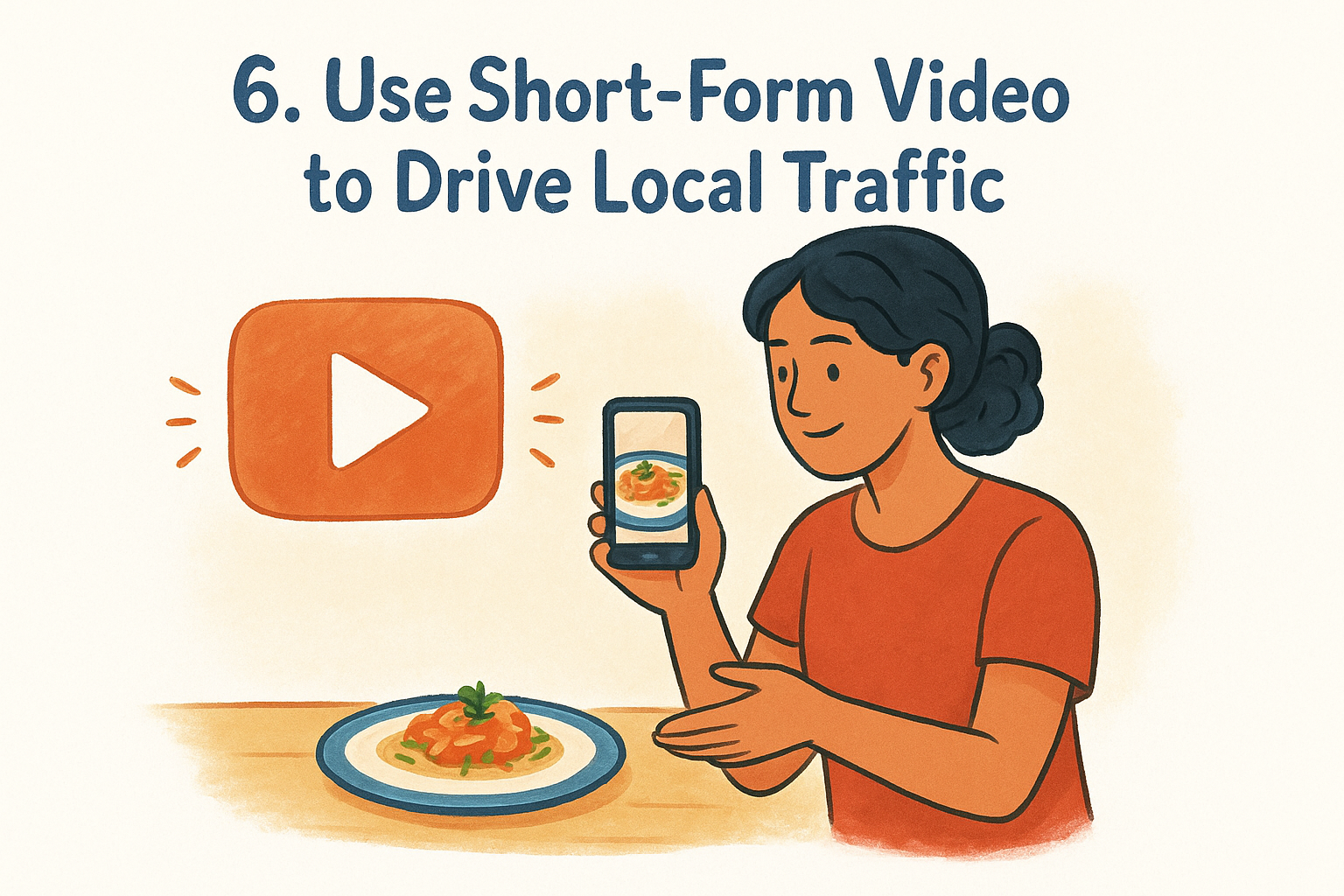
Short-form video on TikTok, Instagram Reels, and YouTube Shorts has become one of the most effective ways to put your restaurant in front of local diners who have never heard of you. Unlike static posts, video content gets pushed to non-followers through each platform's discovery algorithm, which means you can reach new local customers without spending a dollar on ads. If you're working through how to promote your restaurant online without a big budget, video is the highest-leverage free channel available right now.
What It Is and Why It Works
Clips between 15 and 90 seconds showing your food, your kitchen, or your team in action are what drive results on these platforms. The algorithm pushes your video to people nearby who match the interest profile of viewers who already engaged with similar content. When someone searches "best tacos in [your city]" on TikTok or Reels, a well-made clip puts you in front of that buyer.
Restaurants that post short-form video consistently report higher profile visits and direct ordering inquiries compared to photo-only accounts.
How to Do It Step by Step
Film one video per week using your phone and follow the same simple structure each time:
- Show a dish being plated or a behind-the-counter moment
- Add your city name in the caption for location signals
- Drop your ordering page link in your bio and reference it in the clip
Tools and Costs
Your phone camera is enough to start. Both Instagram and TikTok provide free built-in editing tools that handle captions, cuts, and music without extra software or subscriptions.
Mistakes to Avoid
Avoid filming in poor lighting or with muffled audio. Bad production undercuts the appetite appeal that makes food video effective in the first place. Shoot near a window or grab a basic clip-on ring light before worrying about anything else.
7. Partner With Local Influencers the Right Way
Local influencer partnerships give your restaurant direct access to an engaged, location-specific audience without the cost of traditional advertising. This is one of the more overlooked tactics in how to promote your restaurant online, mostly because restaurant owners assume it requires a big budget or celebrity-level creators.
What It Is and Why It Works
Local influencer marketing means working with creators in your city who have between 1,000 and 50,000 followers in your area. These smaller creators, often called micro-influencers, typically have higher engagement rates than large accounts because their audience is more tightly connected to them. A single post from a trusted local food account can drive more real walk-ins than a broad paid ad.
Micro-influencers with under 10,000 followers consistently produce higher engagement rates than accounts with larger, less targeted audiences.
How to Do It Step by Step
Search Instagram and TikTok for accounts that post food content in your city. Look for profiles where the comments are genuine questions and reactions, not generic praise. Reach out with a clear offer: a complimentary meal in exchange for an honest review post that tags your location and links to your ordering page.
Tools and Costs
No paid tools are required to find local influencers. Use the location search feature on Instagram and TikTok to browse creators already posting about food in your area. The main cost is the complimentary meal you provide, which typically runs between $30 and $60.
Mistakes to Avoid
Avoid sending influencers a rigid script. Authentic, spontaneous content performs better than anything that reads like a paid promotion. Let the creator describe their genuine experience in their own voice, and make sure they tag your location and include a link to your ordering page.
8. Build an Email List You Can Sell To
Email is one of the few marketing channels where you own the audience completely. Unlike social media followers who disappear when an algorithm shifts, your email list stays yours regardless of what any platform does. For any restaurant working through how to promote your restaurant online, building a direct list of past and interested customers is one of the most reliable revenue channels available.
What It Is and Why It Works
An email list gives you a direct line to customers who already buy from you or want to hear about what you offer. When you send a promotion, it lands in their inbox rather than competing inside a filtered social feed. That kind of direct access turns into real, repeatable orders when you use it consistently.
Email marketing returns an average of $36 for every $1 spent, making it one of the highest-ROI channels available to small business owners.
How to Do It Step by Step
Add an email capture form to your website's homepage and your order confirmation page. Give people a specific reason to sign up, such as 10% off their next order. Then follow a simple weekly rhythm:
- Send a welcome email immediately after someone joins
- Share one offer, new item, or special per week
- Include a direct link to your ordering page in every send
Tools and Costs
Mailchimp offers a free plan for up to 500 contacts, which covers most restaurants starting out. Paid plans begin around $13 per month as your list grows.
Mistakes to Avoid
Avoid sending emails with no clear reason to open them. Vague updates and generic newsletters train your list to ignore you. Every email needs one specific offer and a single link that takes readers straight to checkout.
9. Use SMS for High-Intent Promos
SMS is one of the most direct channels available when you're thinking about how to promote your restaurant online. Text messages carry an open rate above 90%, and most are read within minutes of delivery. That kind of reach is hard to match with any other channel.
What It Is and Why It Works
SMS marketing means sending short, time-sensitive text messages to customers who have opted in to hear from you. Unlike email, which competes in a crowded inbox, a text message sits on a phone's lock screen and demands immediate attention. Restaurants use it most effectively for flash deals, limited-time specials, and weekend promos that need a fast response.
SMS open rates outperform email open rates by more than 3x, making it one of the highest-visibility channels for direct customer communication.
How to Do It Step by Step
Build your list by adding an opt-in prompt to your ordering confirmation page and at your counter with a simple sign. Keep every message under 160 characters and include one clear offer with a direct link to your ordering page. Send no more than two to three texts per month to avoid opt-outs.
Tools and Costs
SlickText and similar platforms start around $30 per month for basic plans that cover several hundred contacts. Most tools include compliance features that handle opt-in and opt-out management automatically.
Mistakes to Avoid
Avoid sending texts without a specific offer attached. A message that just says "check us out" gives customers no reason to act. Every SMS you send needs a clear deal, a deadline, and a single link that takes them straight to checkout.
10. Run Two Paid Campaigns: Search and Social
Organic traffic takes time to build. Paid campaigns put your restaurant in front of high-intent local buyers right now, and when you run them with a direct ordering page as the destination, you can measure exactly what each dollar returns. Pairing search ads with social ads covers both ends of the buyer journey: people actively looking for a place to eat and people who just need a well-timed nudge.
What It Is and Why It Works
Search ads on Google target people who are already typing queries like "pizza delivery near me" or "best Thai food in [your city]." Social ads on Meta let you target local users by zip code, age, and interest to put your food in front of people who are not searching yet but will order if you show up at the right moment. Running both at once means you capture demand that already exists and create new demand at the same time.
Restaurants that run Google search ads alongside social retargeting campaigns consistently see higher order volume than those relying on a single paid channel.
How to Do It Step by Step
Start with a Google search campaign targeting three to five keywords that match how locals search for your cuisine. Set a daily budget of $10 to $15 and send all clicks directly to your ordering page, not your homepage. Then build a separate Meta campaign that targets users within five miles of your location with a photo of your best-selling dish and a link to order.
Tools and Costs
Both Google Ads and Meta Ads Manager are free to access. Your actual spend depends on your budget, but starting with $20 to $30 per day across both platforms gives you enough data to optimize within two weeks.
Mistakes to Avoid
The most common mistake is sending paid traffic to a slow or confusing ordering page. Every dollar you spend on ads disappears if the page frustrates the visitor before checkout. Fix your mobile ordering flow first, then spend on ads. Also, avoid running campaigns without conversion tracking enabled, because without it you have no way to know which campaign is actually driving orders when you're figuring out how to promote your restaurant online effectively.
Next Steps
You now have a complete playbook for how to promote your restaurant online in 2026. Every strategy in this list works on its own, but the ones that deliver the highest return all share one thing: they send traffic to a direct ordering page you actually own, not a third-party app that takes a cut of every sale. Start by picking two or three tactics from this list, execute them consistently for 30 days, and measure what actually drives orders before adding more channels.
The foundation that makes everything else work is a branded website with commission-free ordering. Without that, you're spending time and money driving customers to platforms that take 15% to 30% of every transaction. If you're ready to stop paying commissions and start owning your revenue, check out The Foody Gram's pricing and plans to see exactly what you get for a flat monthly fee.