


7 Restaurant Menu Pricing Strategies to Boost Profit in 2026
Your food costs are dialed in. Your kitchen runs tight. But if your menu prices are off, none of that matters. Restaurant menu pricing strategies directly control whether your restaurant clears a healthy profit or barely breaks even, and most owners set prices based on gut feeling rather than a repeatable, data-backed method.
Here's the real problem: even perfectly priced menu items lose their edge when third-party apps skim 30% off every order. That's exactly why we built The Foody Gram, a commission-free online ordering platform that lets restaurants keep 100% of their revenue and pair smart pricing with a direct sales channel they actually own. Because pricing strategy only works when the profits land in your pocket, not someone else's.
This guide breaks down seven proven pricing strategies you can apply to your menu right now. You'll learn how to calculate ideal price points using food cost formulas, use psychology to guide customer choices, and structure your menu so your most profitable items get the attention they deserve. Whether you run a single location or manage multiple spots, these strategies will help you build margins that stick heading into the rest of 2026.
1. Use Commission-Free Online Ordering to Protect Margins
Before you adjust a single price, you need to know what each order actually costs you to fulfill. Third-party apps like Uber Eats and DoorDash charge 15-30% per order, which means your carefully built margins disappear before the money hits your account. Your restaurant menu pricing strategies only hold up when you control the channel you sell through.
Why Channel Costs Change Your Real Menu Pricing
A $15 pasta dish that costs you $5 to make looks like a solid margin on paper. Once a delivery app takes its 25% cut, you net roughly $6.25 instead of $10. That gap forces many restaurants to inflate prices on third-party apps, which then hurts customer conversion and repeat order volume.
Pricing the same item identically across every channel without accounting for commission costs is one of the most common margin killers in restaurant operations.
Where Direct Ordering Lets You Price More Competitively
When customers order through your own website, you keep 100% of the item revenue. That extra margin gives you room to price items at fair rates, run targeted promotions, or simply hold margins steady without raising prices. Direct channels also give you full customer data, which helps you make smarter pricing decisions over time.
How to Structure Pickup and Delivery Pricing Without Losing Money
Set a delivery fee that reflects your actual fulfillment cost, whether you use in-house drivers or a third-party logistics service. For pickup orders, price items at your standard rate since fulfillment costs are minimal. Avoid absorbing delivery costs into item prices across the board, because that approach penalizes pickup customers who receive no added service.
How to Present Service Fees, Delivery Fees, and Minimums Clearly
Display all fees at the start of checkout rather than revealing them at the final payment step. Customers who see a $3 delivery fee early accept it readily; customers who see it appear as a surprise at payment abandon their cart. Set order minimums that make each delivery run profitable, typically $20-$30 depending on your average ticket size.
Mistakes That Make Direct Ordering Pricing Backfire
The most common errors that undercut your direct channel include:
- Copying third-party app prices directly to your own site without adjusting for the lower channel cost
- Setting no minimum order for delivery, which creates fulfillment costs that exceed the order value
- Hiding fees until checkout, which kills customer trust and increases abandonment rates
2. Build a Cost-Plus Baseline for Every Item
Cost-plus pricing is the foundation of solid restaurant menu pricing strategies. Before you apply psychology or engineer your menu layout, you need to know exactly what each item costs you to produce. Without that number, every other pricing decision is guesswork dressed up as strategy.
What to Include in Your True Plate Cost
Your true plate cost covers every ingredient that touches the dish, including sauces, garnishes, cooking oils, and condiments that most operators forget to count. Build your cost from a detailed recipe card that lists quantities and current unit prices for every component, including:
- Proteins, starches, and vegetables at usable yield weight
- Sauces, seasonings, and finishing oils per portion
- Packaging materials for items commonly ordered for pickup or delivery
The Core Formulas for Menu Price and Food Cost Percentage
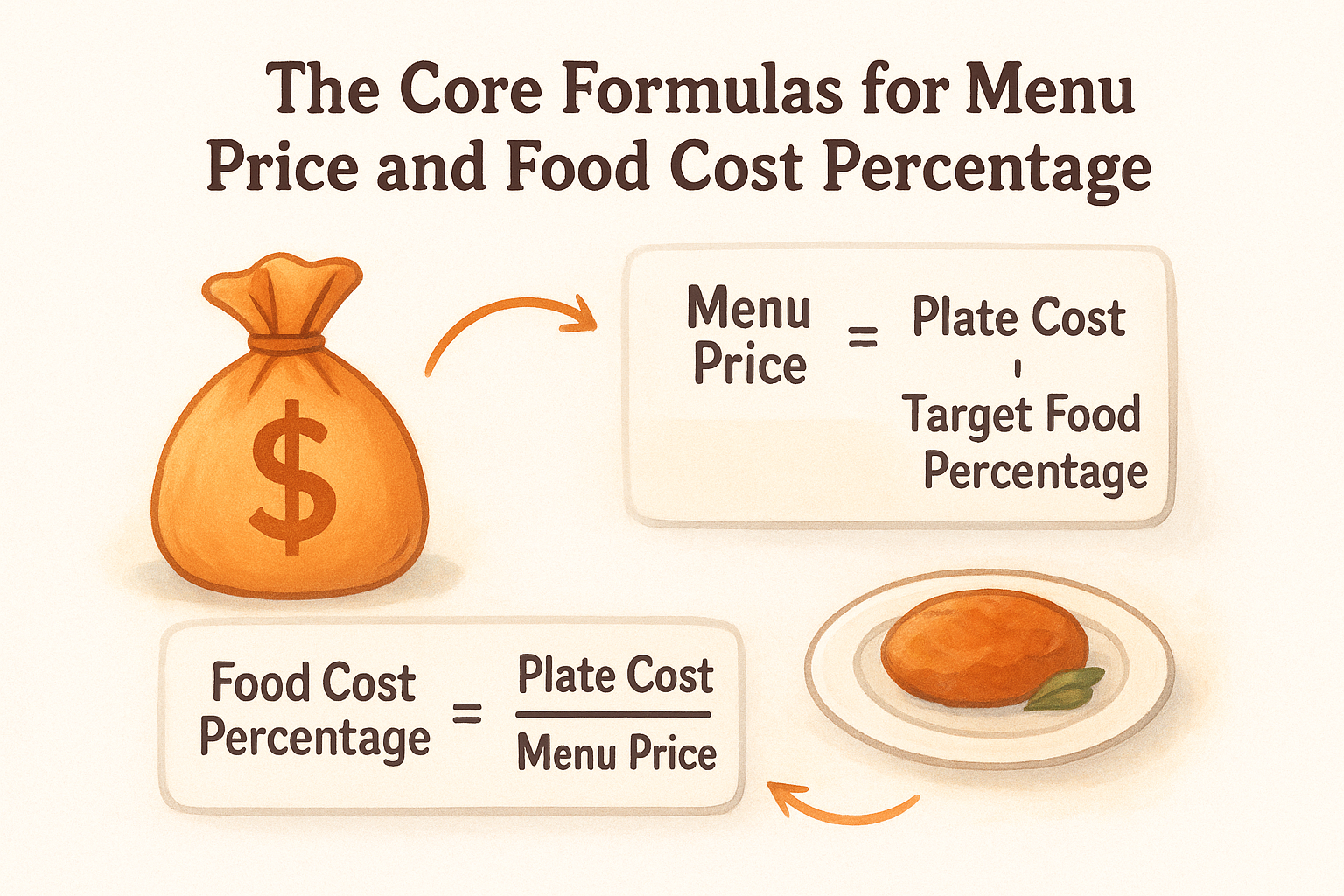
Two formulas anchor all cost-plus decisions. Menu Price equals Plate Cost divided by your Target Food Cost Percentage. Food Cost Percentage equals Plate Cost divided by Menu Price, multiplied by 100. Run both calculations for every item before finalizing prices.
How to Set Target Food Cost by Restaurant Type
Your target food cost percentage depends on your concept. Full-service restaurants typically aim for 28-35%, while fast-casual and counter-service spots often target 25-30%.
Setting your target food cost percentage before building prices gives every decision a clear, consistent benchmark.
How to Handle Yield Loss, Prep Shrink, and Waste
Raw ingredients lose weight through trimming, cooking, and portioning. A 16 oz chicken breast might yield only 11 oz after butchering and heat loss, so always price based on usable yield weight, not the purchase weight shown on your invoice.
Quick Example With a Full Ingredient Build
A burger with a $3.50 plate cost priced against a 30% food cost target needs a menu price of $11.67. Round that to $11.99 to capture charm pricing and protect your margin at the same time.
3. Price for Contribution Margin, Not Just Food Cost
Food cost percentage tells you how much of your revenue goes toward ingredients, but it doesn't tell you how much actual cash an item puts in your pocket after every cost is paid. Shifting your focus to contribution margin gives your restaurant menu pricing strategies a more accurate foundation for profitability decisions.
Define Contribution Margin and Why It Matters More Than Percentages
Contribution margin is the dollar amount left over after subtracting all variable costs from an item's selling price. A dish with a 28% food cost but a $4 contribution margin earns you less than a dish with a 35% food cost and a $7 contribution margin.
Selling more of a high food cost item with a strong contribution margin will always outperform selling more of a low food cost item with a weak one.
How to Factor Labor, Packaging, and Delivery Labor Into Item Pricing
Labor cost per item varies by prep complexity. A hand-rolled pasta dish with 20 minutes of prep carries far more labor cost than a grilled chicken sandwich. Add packaging costs for any item sold through pickup or delivery channels, since containers, liners, and bags reduce your net margin on every order.
How to Identify and Fix Low Margin High Volume Items
Pull your top 10 sellers and calculate the contribution margin on each one. If a bestseller earns under $4 per plate, either raise its price slightly, trim a garnish, or renegotiate the ingredient cost with your supplier.
How to Set Add-Ons and Modifiers That Lift Margin
Modifiers like extra protein, premium sauces, or specialty sides carry near-zero labor cost and high perceived value. Price each modifier at two to three times its ingredient cost to capture strong contribution margin without the customer feeling overcharged.
Quick Example Comparing Two Items With the Same Food Cost Percent
Both items carry a 30% food cost percentage. Item A sells for $10 with a $3 plate cost, netting a $7 contribution margin. Item B sells for $16 with a $4.80 plate cost, netting an $11.20 contribution margin. Same percentage, but Item B earns 60% more cash per sale.
4. Use Menu Engineering to Raise Profit Without Raising Prices
Menu engineering is one of the most underused restaurant menu pricing strategies available to independent operators. Instead of raising prices across the board, you reorganize your menu so customers naturally gravitate toward your most profitable items.
Classify Items by Popularity and Profitability
Sort every menu item into one of four categories based on two factors: how often it sells and how much contribution margin it generates. This two-axis classification gives you a clear picture of which items are working for your bottom line and which ones are working against it.
What to Do With Stars, Workhorses, Puzzles, and Dogs
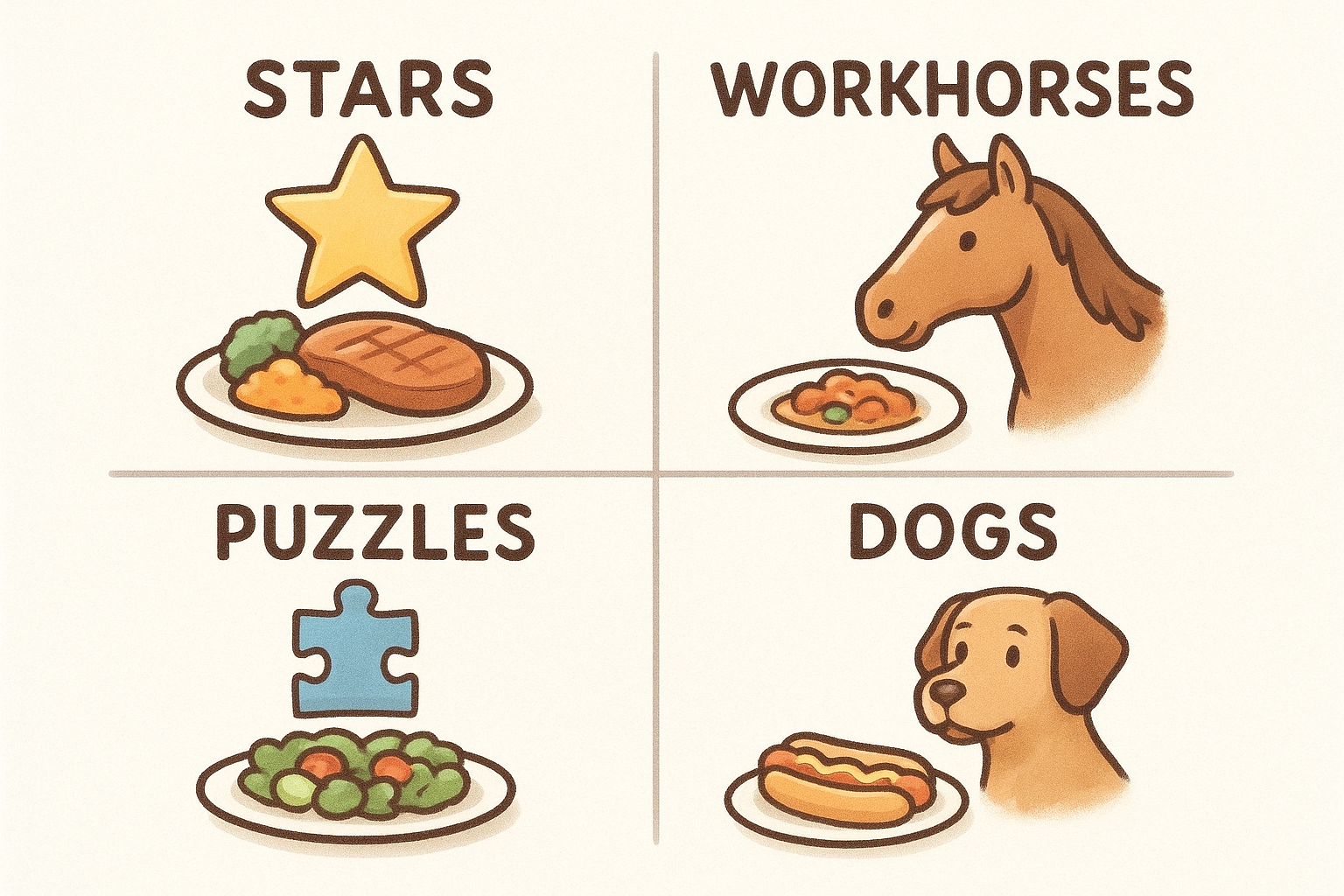
Stars are high popularity, high margin items, and your job is to keep them exactly as they are. Workhorses sell well but carry thin margins, so either raise their price slightly or reduce portion size. Puzzles are high margin but low traffic, so reposition them with better placement and descriptions. Drop dogs entirely or replace them with stronger performers.
Removing a low-margin, low-traffic item from your menu also reduces kitchen complexity and speeds up ticket times.
How to Redesign Portions and Plating to Improve Margin Quietly
Reducing portion size by 10-15% on workhorse items rarely triggers customer complaints when plating presentation improves. Use smaller plates or taller builds to maintain visual satisfaction while protecting your contribution margin.
How to Place Items on the Menu to Increase High Margin Sales
Customers scan menus in predictable patterns, so place your star items in the top-right position on each menu section. Use boxes, callouts, or photos sparingly to draw attention to high-margin dishes without cluttering the layout.
A Simple Monthly Review Cadence Using Sales Mix Data
Pull your sales mix report every 30 days and check whether your stars are still leading volume. If a workhorse climbs into star territory after a price adjustment, that signals your item-level pricing decisions are working. Review and reclassify every item quarterly at minimum.
5. Combine Value-Based and Competitor-Based Pricing
Cost-plus gives you a floor, but customer perception and local market rates determine your ceiling. Pairing value-based thinking with competitor research is one of the most practical restaurant menu pricing strategies for operators who want to charge what their food is actually worth.
How to Define Perceived Value for Your Concept and Neighborhood
Your prices need to match what your specific customer base believes your food is worth, not what a generic industry average suggests. A neighborhood taqueria and a modern Mexican concept can sell similar dishes at very different price points because their environments, branding, and service levels signal different value to customers.
How to Run a Competitor Price Check That Actually Helps
Check the prices of three to five direct competitors within your trade area, meaning restaurants with a similar concept, price point, and customer demographic. Focus on your top-selling categories, not every item on your menu, so the comparison stays relevant and manageable.
A competitor price check only helps when you compare restaurants your customers actually consider as alternatives to yours.
When to Price Above, Match, or Undercut and Why
Price above competitors when your ingredient quality, portion size, or dining experience clearly justifies the gap. Match when your offer is comparable. Undercut only as a short-term tactic, since sustained low pricing trains customers to expect discounts and erodes your margin permanently.
How to Protect Your Brand When Costs Force a Price Jump
Raise prices in small increments, 5-8% at a time, rather than one large adjustment. Brief menu notes highlighting fresh, local, or premium ingredients give customers a concrete reason to accept the change without friction.
Red Flags That Mean You Priced for the Wrong Customer
If your average ticket consistently lands below your break-even threshold despite strong traffic, your price point attracts customers your concept cannot profitably serve. Adjust prices upward and let your menu and brand positioning filter toward the right audience naturally.
6. Bundle and Use Price Psychology to Lift Average Ticket
Bundling and price presentation are two of the fastest restaurant menu pricing strategies you can deploy without touching a single ingredient cost. When executed correctly, both tactics increase your average ticket size while making customers feel like they got a better deal than they actually did.
Bundle Structures That Work for Dine-In, Pickup, and Delivery
Build bundles around a main item plus two supporting items that carry strong individual margins, such as a protein-forward entree paired with a side and a drink. For delivery, add a dessert or shareable item to the bundle since customers placing delivery orders tend to spend more per session than dine-in guests.
How to Price Combos So They Feel Like a Deal and Still Pay You
Set your bundle price at 10-15% below the sum of individual items when purchased separately. That gap creates clear perceived savings while your contribution margin stays healthy because you control which items enter the bundle. Avoid bundling your highest-margin standalone items at a deep discount.
Customers do not calculate exact savings; they respond to the perception of value, so even small bundle discounts drive conversion.
Psychological Price Presentation That Increases Conversion
Remove dollar signs from your printed and digital menu where local norms allow it, since currency symbols activate cost-consciousness in customers. Align prices in a single column only if all items carry similar price points; mixed price ranges in a column cause customers to anchor on the cheapest option.
When Charm Pricing Works and When It Hurts Trust
Charm pricing, ending a price in $.99 or $.95, works well for items under $20 in casual and fast-casual concepts. At higher price points, round numbers signal quality and confidence, so a $28 entree reads better than $27.99 in a full-service environment.
Common Menu Formatting Mistakes That Reduce High Margin Sales
Never list prices in a right-aligned column, because that layout trains customers to scan prices first and descriptions second. Write item names and descriptions that lead with flavor and experience, and let the price appear as an afterthought at the end of the description.
Put Your Pricing Into Action
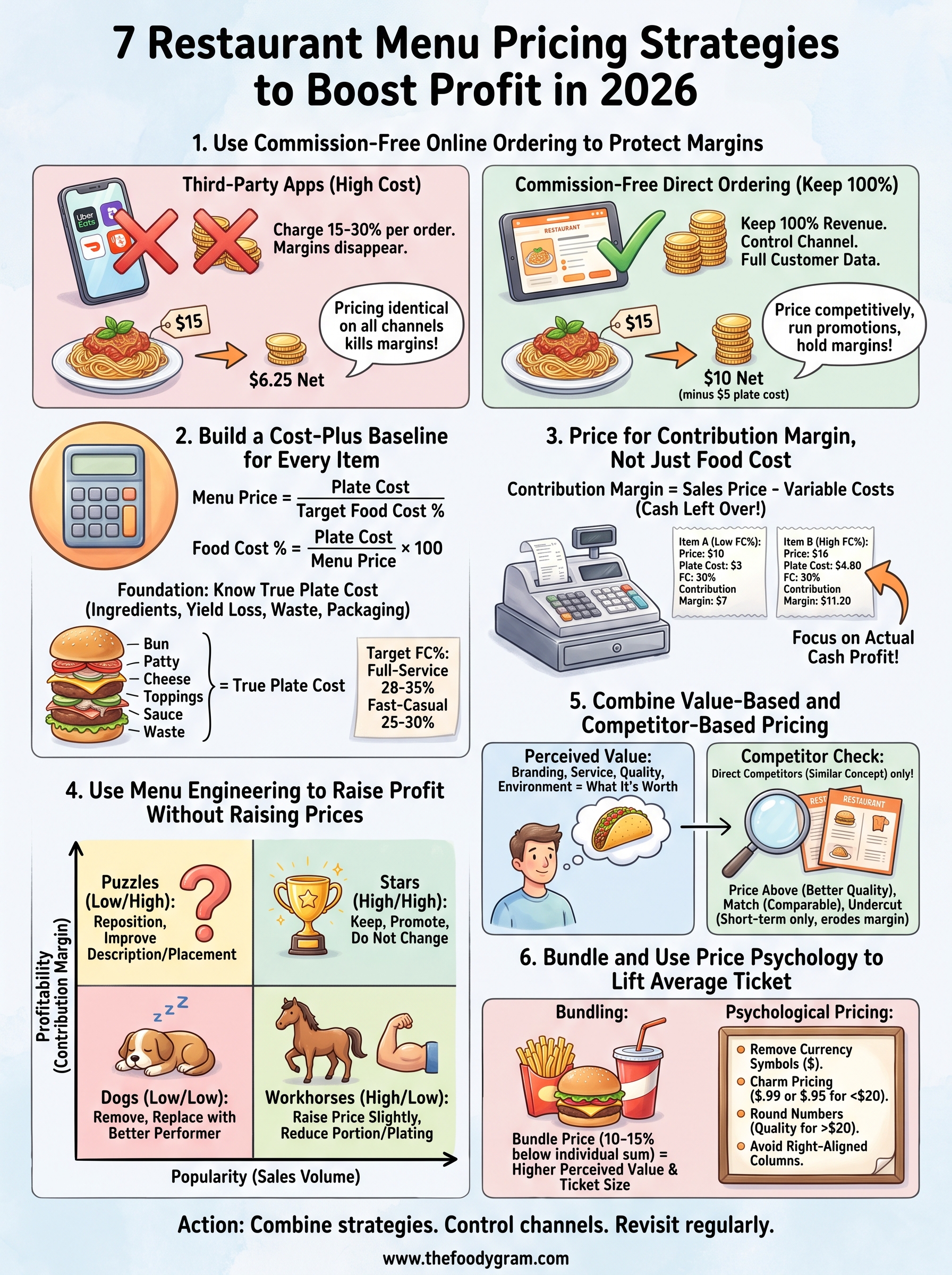
Every strategy in this guide works on its own, but they deliver the most impact when you apply them together as a system. Start with your true plate cost, layer in contribution margin thinking, then use menu engineering and psychology to guide customers toward your highest-earning items. Restaurant menu pricing strategies only deliver lasting results when you revisit them regularly, since ingredient costs, competition, and customer behavior shift constantly throughout the year.
Your pricing also depends heavily on where customers place their orders. When third-party apps take 30% of every transaction, even a well-built pricing structure fails to protect your margins the way it should. Switching to a commission-free direct ordering channel gives your prices room to work as intended and keeps that margin in your pocket instead of a platform's. Check out The Foody Gram's online ordering plans and find out exactly how much more you could keep on every order.