


What Is a Restaurant Loyalty Program? Types, Examples, ROI
A regular customer who visits your restaurant twice a week is worth far more than a dozen one-time visitors, but most restaurants do nothing to reward that loyalty. A restaurant loyalty program gives you a structured way to change that, turning occasional diners into repeat customers who spend more and refer others to your business.
So how do these programs actually work, and which type makes sense for your restaurant? That depends on your setup, your customers, and how you handle online ordering. At The Foody Gram, we help restaurants build their own branded online ordering systems, commission-free, which means you own the customer data needed to run a loyalty program that actually performs. No middleman. No giving your best customers away to a third-party app.
This guide breaks down exactly what a restaurant loyalty program is, the most common types, real-world examples worth studying, and how to measure whether your program is generating a real return on investment.
Why restaurant loyalty programs matter now
The restaurant industry runs on thin margins. Food costs, labor, rent, and delivery app commissions can strip a restaurant down to 3-5% net profit on a good month. Understanding what is a restaurant loyalty program and why it belongs in your business strategy is not just a marketing exercise - it is a direct response to the financial pressure independent restaurants face right now. Repeat customers spend more per visit, cost far less to retain than to acquire, and generate referrals that no advertising budget can replicate.
The cost of losing a regular customer
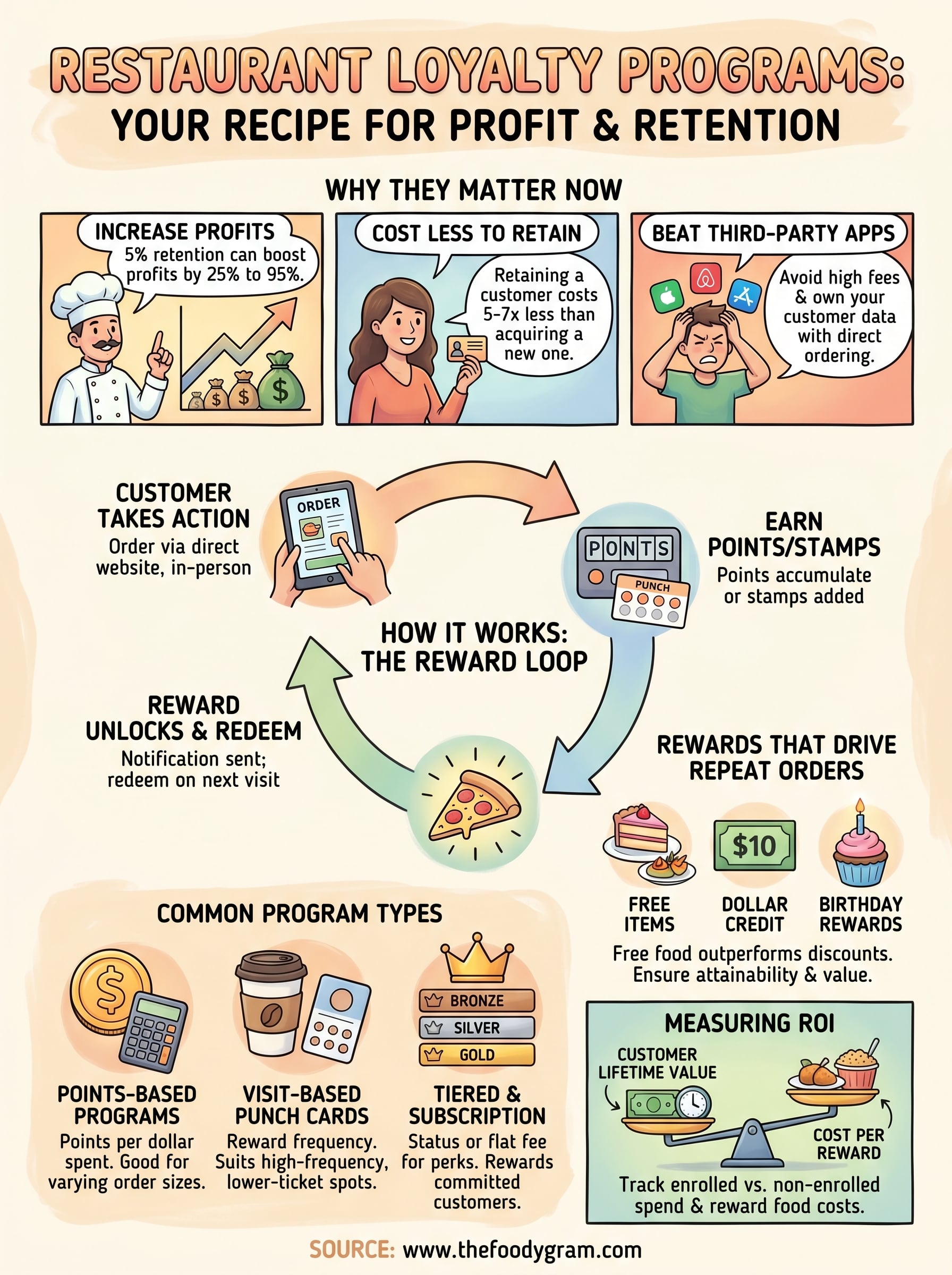
Most restaurants pour energy into getting new customers through the door, but the numbers do not support that as a primary strategy. Research from Harvard Business School shows that increasing customer retention by just 5% can increase profits by 25% to 95%. A customer who orders from you twice a month and spends $45 each visit generates over $1,000 in annual revenue. Lose that customer to a competitor or a delivery app that promotes someone else, and that is more than $1,000 per year gone from your bottom line - multiplied across dozens of regulars, the damage compounds fast.
Retaining an existing customer costs five to seven times less than acquiring a new one, which makes a well-run loyalty program one of the highest-ROI investments a restaurant can make.
Third-party apps actively work against you
Platforms like Uber Eats and DoorDash charge commission fees that typically run 25% to 30% per order. Beyond the fees, those platforms own the customer relationship entirely. They hold the data, control the promotions, and redirect your regulars to whoever pays for better placement on any given day. When you rely on a third-party app as your primary ordering channel, you are not building a loyal customer base - you are renting access to someone else's audience at a steep cost on every single transaction.
Running your loyalty program through your own direct ordering system flips that dynamic completely. You collect the email addresses, the order history, and the purchase preferences. You send the reward notifications. You decide who gets recognized and when, with zero interference from a platform that profits from your relationship with your own customers.
Customers now expect rewards
Consumer expectations have shifted significantly over the past several years. Loyalty programs are no longer a differentiator reserved for large national chains - customers actively factor them in when deciding where to spend their money. A survey by Bond Brand Loyalty found that over 70% of consumers say loyalty programs influence where they choose to eat and shop. Smaller independent restaurants that offer even a simple rewards structure compete more effectively against chain restaurants with multimillion-dollar marketing budgets and large app ecosystems backing them up.
Your regulars already want to choose you over a generic delivery app experience. A loyalty program gives them one more concrete, tangible reason to skip the middleman, visit your website directly, and place that order with you instead of letting a third-party platform take its cut.
How restaurant loyalty programs work
Understanding what is a restaurant loyalty program at a mechanical level helps you build one that actually runs without constant manual effort. At its core, every loyalty program operates on a simple loop: a customer takes a trackable action, earns a reward for it, and receives that reward in a way that brings them back. The specific mechanics vary by program type, but that loop is always present.
The reward loop in practice
A customer places an order through your website or in your restaurant. Your system records that transaction against their profile, whether that is tracked by phone number, email address, or a loyalty app. Points accumulate or a stamp gets added, and once the customer hits the threshold you set, a reward unlocks. They receive a notification by email or text, redeem the reward on their next visit or order, and the cycle restarts.
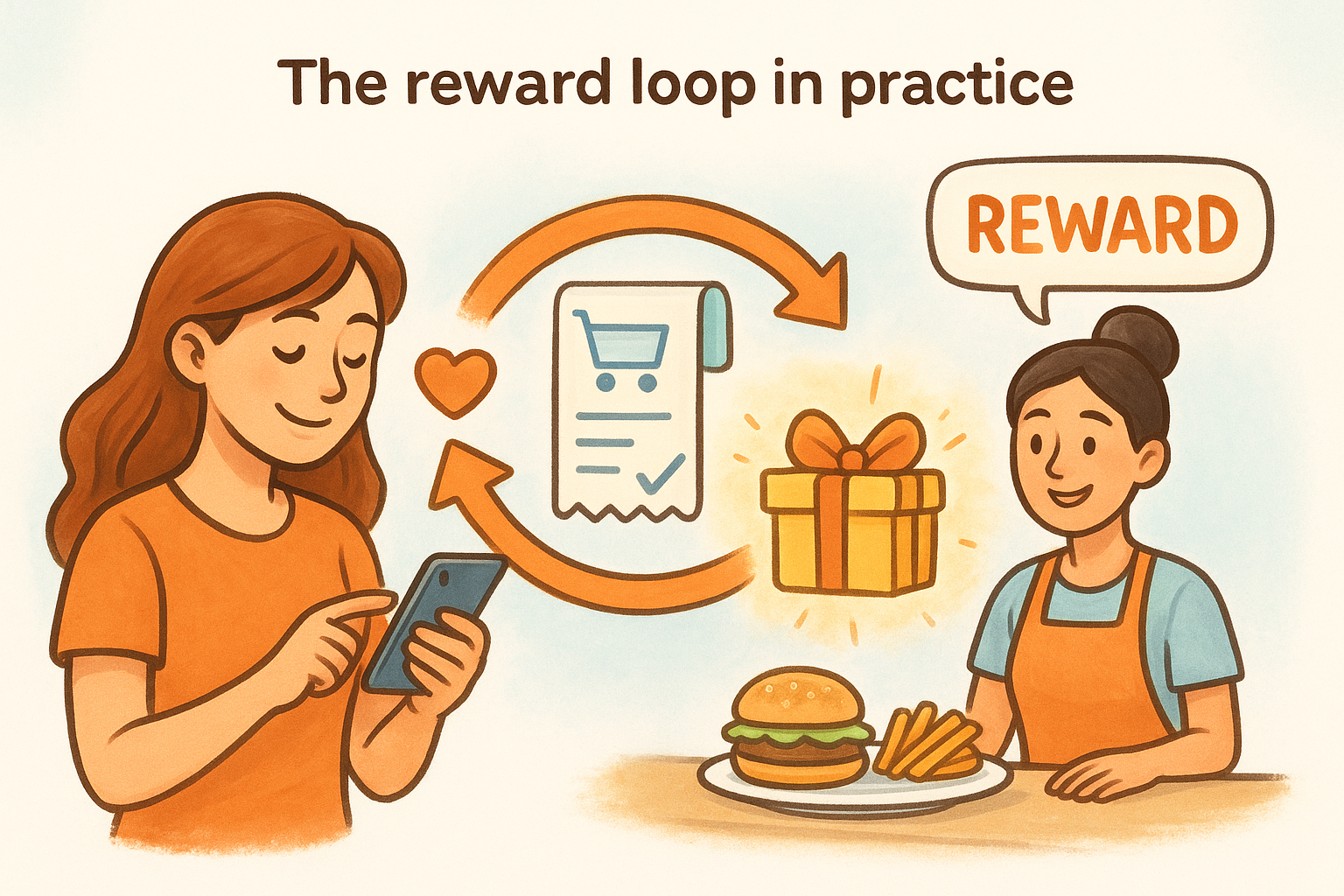
The restaurants that see the best results from loyalty programs are the ones that make earning and redeeming rewards as frictionless as possible for the customer.
The simpler your redemption process, the higher your participation rate. Customers who have to download a separate app, remember a card, or ask staff to manually apply a discount will drop out of the program quickly. Tying loyalty tracking directly to your online ordering system eliminates most of that friction because the system recognizes the customer automatically each time they order.
Why direct ordering channels matter here
Third-party delivery apps do not share customer order data with you, which means you cannot track purchase history or reward loyalty for orders that come through those platforms. When a customer orders through your own branded website, you capture everything: their contact details, order frequency, average spend, and preferred menu items. That data is what makes a loyalty program functional rather than theoretical.
Running orders through your own system also means you control the reward notifications entirely. You decide when to send a points update, when to announce a bonus reward, and how to personalize the offer based on what that specific customer actually orders.
Types of restaurant loyalty programs
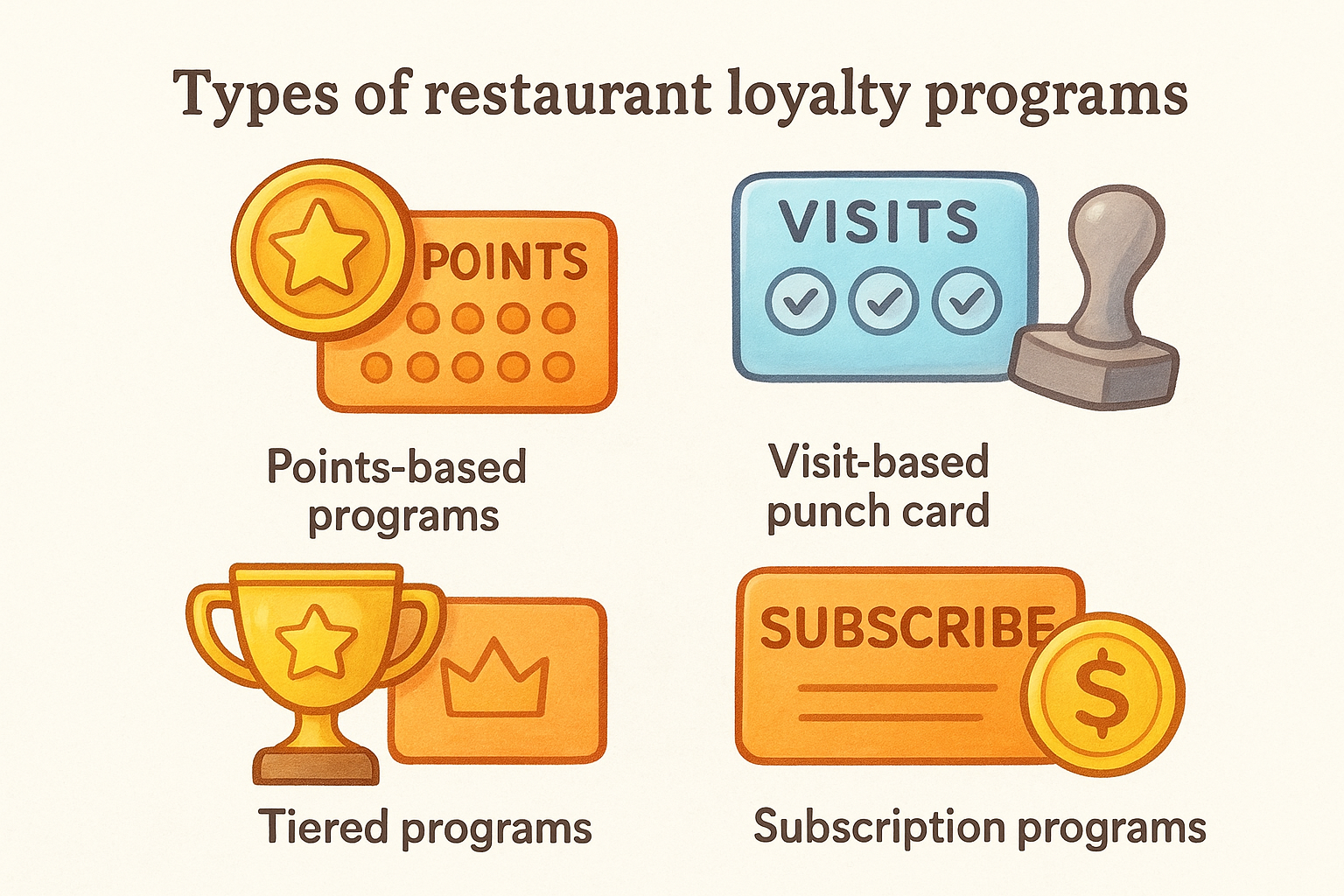
When you ask what is a restaurant loyalty program, the answer changes depending on which structure you choose. Each type handles the reward loop differently, and the right fit depends on your average order value, how often customers return, and how much complexity your team can manage. Knowing your options upfront saves you from building something that creates more friction than it resolves.
Points-based programs
Points-based programs assign a point value to every dollar spent, so customers accumulate points with each purchase and redeem them once they hit a set threshold. A customer who spends $10 might earn 10 points, and 100 points might unlock a free appetizer or a $5 discount. This structure works well for restaurants with varying order sizes because it rewards customers proportionally to what they actually spend.
Points-based programs tend to generate the highest engagement when the earning rate feels attainable and the reward feels worth the wait.
The main risk with points systems is complexity. If customers cannot quickly calculate how close they are to a reward, they disengage. Keep your points-to-dollar ratio simple and make the reward threshold visible every time a customer logs in or checks their order history.
Visit-based punch card programs
Visit-based programs reward frequency rather than spend amount. A customer earns one stamp or credit per visit, and after a set number of visits, they unlock a free item. Digital punch cards replicate this model without the physical card, tracking visits automatically through your ordering system. This structure suits high-frequency, lower-ticket restaurants like coffee shops, quick-service spots, or lunch counters where customers order regularly but spend less per transaction.
Tiered and subscription programs
Tiered programs assign customers to status levels based on cumulative spending or visit count. A customer who reaches a higher tier gets better rewards, faster point accrual, or exclusive menu access. Subscription programs take a different approach and charge customers a flat monthly fee in exchange for ongoing perks like free delivery or a weekly discount. Both models reward your most committed customers and create a strong financial incentive to stay loyal rather than drift toward a competitor.
Examples of loyalty rewards that drive repeat orders
Knowing what is a restaurant loyalty program in theory is one thing; seeing which specific rewards actually change customer behavior is another. The reward you choose determines whether customers feel genuinely motivated to return or barely notice the program exists. The most effective rewards share two traits: they feel attainable quickly enough to stay top of mind, and they connect directly to something the customer already orders and enjoys.
Free items after a threshold
Free food is the most straightforward reward, and it consistently outperforms discount codes in participation rates. Offering a free pizza after ten orders or a complimentary dessert after five visits gives customers a concrete goal they can track. The reward feels personal because it ties to actual food, not abstract dollar amounts. You also control the cost by choosing which items qualify, which means you can protect margin by offering high-perceived-value items that carry lower food costs, such as a side, a drink, or a signature appetizer.
Customers redeem free-item rewards at significantly higher rates than discount codes, which makes them one of the most cost-effective tools in your loyalty program.
Dollar credit and bonus point events
Dollar credit rewards add a set amount back to a customer's account after they hit a spending milestone. A customer who spends $100 cumulative earns $10 credit toward their next order, which pulls them back in rather than simply reducing the current bill. Bonus point events, like double points every Tuesday, work especially well for filling slower shifts because they give customers a specific, time-bound reason to order on a day they might otherwise skip.
Birthday and anniversary rewards
Personalized rewards tied to a customer's birthday or the anniversary of their first order generate strong emotional engagement at very low cost. Sending a free appetizer or a $5 credit that expires within two weeks of their birthday creates urgency without pressure. Customers respond because the offer feels like recognition rather than a generic promotion. You can automate this entirely through your direct ordering system once you have the customer's basic profile information.
How to start or improve your loyalty program
Understanding what is a restaurant loyalty program is the starting point, but turning that understanding into a working system takes a few deliberate decisions before you launch anything. Whether you are building from scratch or fixing a program that has stalled, the same foundational steps apply: know what you want customers to do, make it easy for them to do it, and connect the whole thing to your direct ordering channel so the data stays with you.
Start with a single clear goal
Trying to accomplish everything at once with your first loyalty program leads to a confusing structure that customers stop engaging with after a few weeks. Pick one behavior you want to reinforce before you build anything. Common starting goals for independent restaurants include:
- Increasing order frequency among existing customers
- Pulling customers away from third-party apps toward your own website
- Raising average order value through tiered rewards
Restaurants that launch with a single objective consistently see higher participation and cleaner data than those that reward every possible action simultaneously.
Choose a reward structure that matches your customers
Your reward structure should reflect how your customers already behave, not how you hope they will behave. If your customers order frequently and spend moderate amounts, a visit-based or points system gets them to a reward quickly and sustains engagement. If your customers place larger, less frequent orders, a dollar credit or tiered structure gives them a longer runway that still feels worth pursuing.
The fastest way to kill participation in a new loyalty program is to set the reward threshold so high that customers give up before they ever redeem anything.
Match the structure to your actual order data rather than a generic template borrowed from a chain restaurant with a completely different customer base.
Connect loyalty to your direct ordering channel
A loyalty program only works long-term if you own the customer data powering it. Running rewards through your own branded website means every order automatically builds the customer profile you need to send targeted offers and track redemptions. Direct ordering gives you the control that makes a loyalty program a sustainable revenue driver rather than a short-term promotion you eventually abandon.
How to measure ROI and profitability
One of the most practical answers to what is a restaurant loyalty program is this: it is a tool for turning customer behavior into measurable revenue. But most restaurants launch a program, watch participation grow, and never calculate whether the rewards they give out actually generate more revenue than they cost. Measuring ROI requires tracking three specific numbers: how much customers spend before and after joining your program, what each reward costs you, and how often reward redemptions lead to additional purchases beyond the free or discounted item.
Track customer lifetime value
Customer lifetime value (CLV) is the total revenue a single customer generates across their entire relationship with your restaurant. Before your loyalty program, pull your average order value and average order frequency from your direct ordering system. After your program has run for 90 days or more, compare those numbers for customers enrolled in the program against those who are not. A working loyalty program should show enrolled customers ordering more frequently and spending more per visit than non-enrolled customers.
If enrolled customers are not showing higher lifetime value than non-enrolled ones after 90 days, your reward threshold or reward type needs adjustment before you invest further.
Referrals also contribute to your real returns in ways that raw spend data will not capture automatically. Track referral-driven new customers by asking first-time visitors how they heard about you, so you can assign indirect value to the customers driving those introductions.
Calculate your cost per reward
Every reward you issue carries a real food cost, even when it feels like a generous gesture. If you offer a free appetizer with a $9 menu price but a $2.50 food cost, your actual cost per redeemed reward is $2.50, not $9. Divide your total reward redemption costs over a set period by the number of customers who redeemed, and you get your cost per redemption. Compare that figure against the average additional spend those customers made during the same visit. When a customer redeems a $2.50 food cost reward and spends $38 on that visit, your program is generating returns that justify the investment with room to spare.
Next steps for your restaurant
Now that you understand what is a restaurant loyalty program and how each type generates measurable returns, the next move is straightforward: pick one goal, choose a reward structure that fits your customers, and connect everything to your own direct ordering channel so you keep the data. Start with a 90-day window, track your enrolled versus non-enrolled customer spend, and adjust your threshold if participation stalls.
The biggest barrier most independent restaurant owners face is not the loyalty program itself - it is not owning the platform where customers order. Third-party apps block you from the customer data you need to make any reward system work. Building your loyalty program on top of your own branded, commission-free ordering system is the foundation that makes everything else possible. If you are ready to take that step, explore The Foody Gram's commission-free ordering plans and see what fits your restaurant.