


Local SEO for Restaurants: How to Rank on Google Maps 2026
Most people searching for a place to eat never scroll past the first few Google results. If your restaurant isn't showing up in that local map pack, you're losing customers to competitors who are, even if your food is better. Local SEO for restaurants is what bridges the gap between a great menu and a full dining room, and it's one of the most cost-effective ways to drive new business through your door.
The good news? You don't need a marketing degree or a big budget to make it work. Google rewards restaurants that keep their information accurate, earn genuine reviews, and maintain a strong online presence, which includes having your own website with direct ordering instead of relying solely on third-party apps. That's exactly what we help restaurants do at The Foody Gram: build branded websites with commission-free ordering that you actually own and control.
This guide breaks down every step to get your restaurant ranking on Google Maps in 2026. From optimizing your Google Business Profile to building local citations and earning backlinks, you'll walk away with a clear action plan you can start executing this week.
How Google Maps rankings work in 2026
Google uses three core factors to decide which restaurants show up in the local map pack: relevance, distance, and prominence. Understanding how each one works gives you a real advantage because most restaurant owners focus on the wrong things. Local SEO for restaurants isn't about gaming an algorithm; it's about giving Google accurate, consistent, and compelling information so it can confidently recommend your business to nearby searchers.
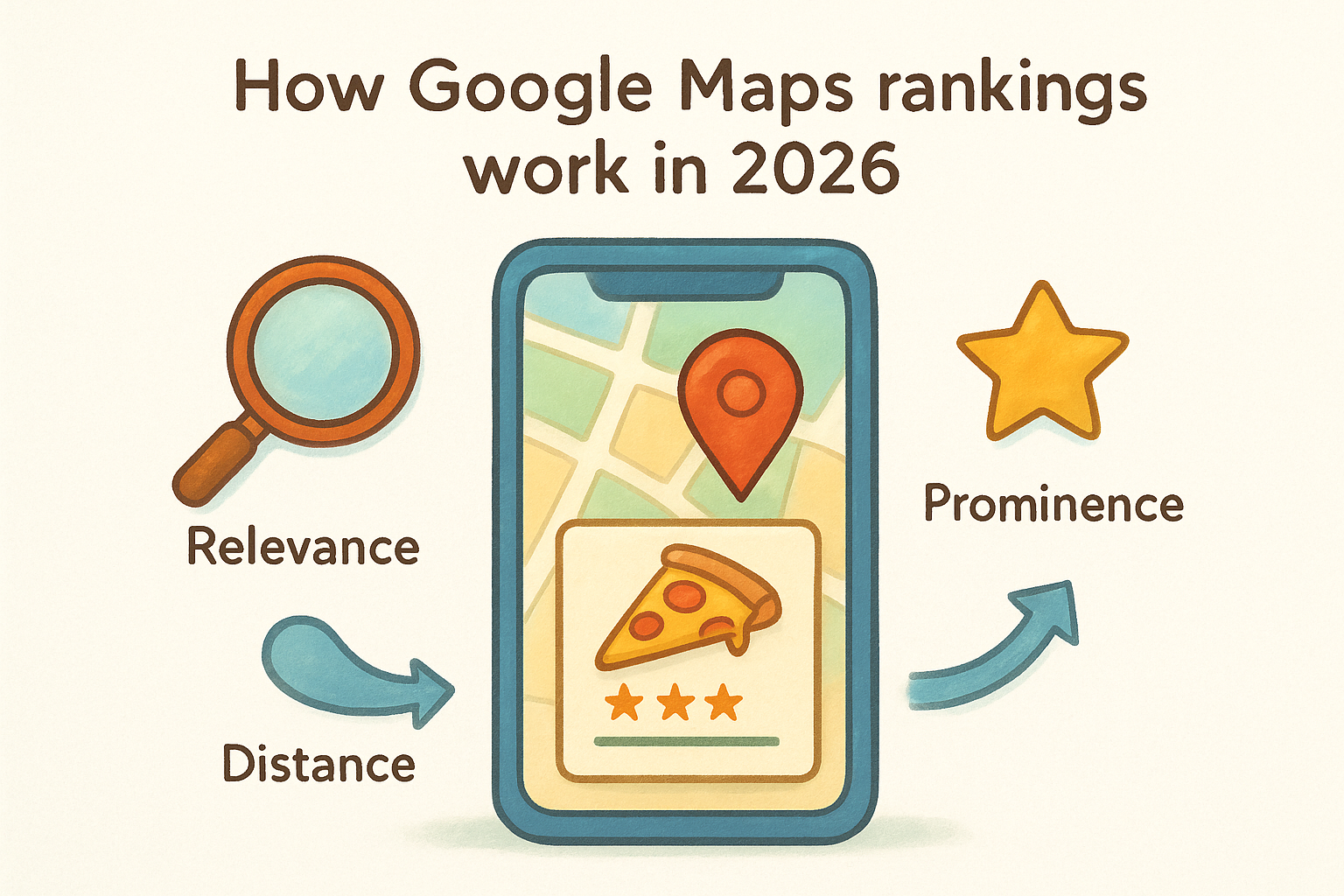
Relevance: matching what people actually search for
Relevance measures how well your Google Business Profile and website match what someone is searching for. If someone types "best pizza near me" and your profile lists your category as "Italian restaurant" but never mentions pizza, Google may skip you for a more relevant result. You improve relevance by filling out every section of your profile, choosing specific business categories, adding your menu items directly to your listing, and making sure your website content mirrors the exact dishes and cuisines your customers search for.
Distance: the factor you can't move
Distance is straightforward: Google measures how far your restaurant sits from the searcher or the location they specify in their query. You can't move your building, but you can influence how often Google shows you for searches in your immediate area by strengthening the other two factors. Restaurants that dominate on relevance and prominence regularly appear even when they're not the closest option, because Google weighs all three signals together rather than treating distance as the deciding factor.
Prominence: the factor that drives real results
Prominence is where most of your effort should go, and it's the factor that the best local SEO strategies are built around. Google calculates prominence based on how well-known and trusted your restaurant is across the web. This includes your review volume and star ratings, the number of quality backlinks pointing to your website, local citation consistency, and how accurately your business information appears on third-party directories.
The more consistent and widespread your online presence, the more Google trusts that your restaurant is a legitimate, active business worth recommending to nearby searchers.
In 2026, Google has also increased the weight it places on user engagement signals. Click-through rates on your Google Business Profile, photo views, direction requests, and website visits from your listing all influence where you rank. A well-maintained profile that people actively interact with regularly outperforms a neglected one, even if the neglected profile has been live for years. This shift means updating your photos, posting offers, and keeping your hours accurate aren't optional extras; they're direct ranking inputs that affect your visibility every single week.
Step 1. Build a Google Business Profile that wins
Your Google Business Profile (GBP) is the single most important asset in local SEO for restaurants. It feeds the information Google displays in the map pack: your hours, photos, menu, reviews, and contact details. If your profile is incomplete or unverified, Google has less confidence placing you in front of nearby customers, no matter how good your food is.
A fully optimized Google Business Profile can be the difference between appearing in the local map pack and being invisible to diners searching right down the street.
Claim and verify your listing
Before you optimize anything, claim and verify your listing through Google Business Profile. If your restaurant already appears on Google but you haven't claimed it, the information can stay outdated indefinitely. Verification typically happens via postcard, phone, or video call depending on your business location. Once verified, you control every detail and can push updates in real time.
After verification, confirm that your business name matches exactly what appears on your signage and legal documents. Adding extra keywords to your business name (such as "Best Pizza NYC") violates Google's guidelines and can get your listing suspended without warning.
Fill in every field completely
Google rewards complete, detailed profiles with stronger visibility, so treat every field as required. Set your primary category to the most specific match available, such as "Pizza Restaurant" rather than just "Restaurant," and add secondary categories for any additional cuisines or dining styles you offer. Work through this checklist:
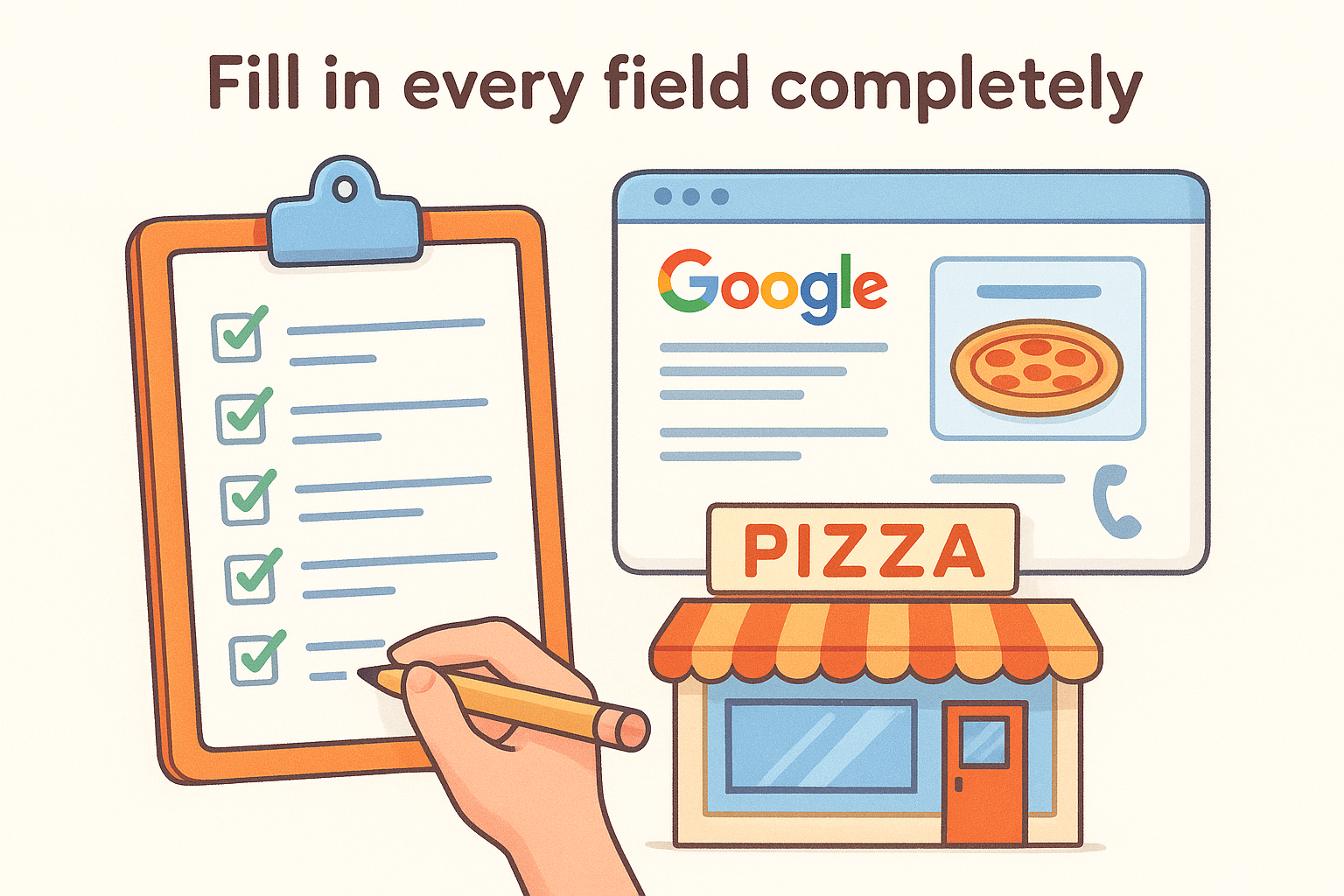
- Business name (exactly as it appears on signage)
- Primary and secondary categories
- Address, phone, and website URL
- Hours for every day, including holidays
- Menu link or direct menu upload
- At least 10 high-quality photos (interior, exterior, dishes)
- Business description (750 characters, lead with your specialty)
Posting weekly updates through the "Updates" feature also signals to Google that your business is actively managed, which feeds directly into the prominence ranking signals covered earlier.
Step 2. Fix listings and local trust signals
Your Google Business Profile can't do all the work alone. Citation consistency across the web tells Google that your restaurant is a real, stable business, and inconsistencies actively hurt your rankings. Every time your name, address, or phone number (NAP) appears differently across directories, Google loses confidence in your data and your local map pack position takes a hit.
Audit and fix your citations
Start by auditing the major directories where your restaurant already appears. Search your restaurant name on Google and review results from Yelp, TripAdvisor, Bing Places, Apple Maps, Facebook, and Foursquare. Your NAP information must match your GBP exactly across all of them, including punctuation and address formatting. If your GBP says "123 Main St" but Yelp says "123 Main Street," that counts as a mismatch.
Inconsistent NAP data is one of the most common reasons restaurants lose ground in local SEO for restaurants, and it's entirely fixable with a focused audit.
Use this checklist to track your corrections:
| Directory | Claimed? | NAP Matches GBP? | Menu Link Added? |
|---|---|---|---|
| Yelp | |||
| Bing Places | |||
| Apple Maps | |||
| TripAdvisor | |||
| Foursquare | |||
Add structured data to build trust with Google
LocalBusiness schema markup gives Google machine-readable confirmation of your restaurant's details directly from your website. Adding this code to your homepage strengthens the connection between your site and your GBP listing. Use this template as your starting point:
{
  "@context": "https://schema.org",
  "@type": "Restaurant",
  "name": "Your Restaurant Name",
  "address": {
    "@type": "PostalAddress",
    "streetAddress": "123 Main St",
    "addressLocality": "Your City",
    "addressRegion": "NY",
    "postalCode": "10001"
  },
  "telephone": "+1-555-000-0000",
  "url": "https://yourrestaurant.com",
  "servesCuisine": "Italian",
  "openingHours": "Mo-Su 11:00-22:00"
}
Paste this into your site's <head> tag, then validate your markup using Google's Rich Results Test before pushing it live. Catching errors before launch prevents Google from ignoring the markup entirely, which would defeat the purpose of adding it.
Step 3. Make your website and menu searchable
Your website is the second pillar of local seo for restaurants. Google cross-references your site with your GBP listing to confirm your legitimacy and relevance, so a poorly optimized website weakens all the work you've put into your profile and citations.
Optimize your pages for local keywords
Your homepage title tag, meta description, and H1 heading should all include your city name and cuisine type. A title tag like "Authentic Thai Food in Austin, TX | [Restaurant Name]" signals exactly what you serve and where. Beyond the homepage, create individual location pages if you run multiple locations, each with unique content specific to that neighborhood. Avoid copying the same text across location pages; Google treats duplicate content as a sign that your pages offer no additional value.
Embedding a Google Maps iframe on your contact page reinforces your location data and gives Google another confirmation point for your physical address.
Pair your page titles with a fast-loading, mobile-first design. Google uses mobile-first indexing, meaning it evaluates your mobile site before your desktop version. If your pages load slowly on a phone, your rankings take a hit regardless of how well your content is optimized.
Make your menu crawlable
Your menu is one of your highest-value SEO assets, yet most restaurants either upload it as a PDF or link out to a third-party app. Both approaches block Google from reading your content. Instead, publish your menu as live HTML text directly on your website so search engines can index every dish name, ingredient, and description.
Structure your menu with clear headings for each category, for example:
<h2>Appetizers</h2><h2>Main Courses</h2><h2>Desserts</h2>
This gives Google a clear content hierarchy to index and surfaces your individual dishes in relevant local searches like "chicken parmesan near me" or "gluten-free pizza Austin."
Step 4. Get reviews and local authority the right way
Reviews are one of the most direct ranking inputs in local SEO for restaurants. Google factors in your review volume, recency, and star rating when deciding which businesses to surface in the map pack. Restaurants with a steady flow of fresh reviews consistently outrank those with a large but stagnant review count, so your goal is a consistent stream rather than a one-time burst.
Asking for a review right after a positive experience, not days later, is when customers are most likely to follow through.
Ask for reviews without breaking Google's rules
Google's review policies prohibit offering incentives in exchange for reviews, so skip the discount-for-a-review approach. Instead, train your staff to ask satisfied customers directly before they leave, and place a short review request card on every table with a QR code linking straight to your Google review form. You can generate your direct review link through your Google Business Profile dashboard.
Use this as your review request message for follow-up receipts or order confirmation emails:
Subject: How was your meal at [Restaurant Name]?

Hi [First Name],

Thanks for ordering with us. If you enjoyed your experience, we'd love it if you shared a quick review on Google. It takes less than two minutes and helps other food lovers in [City] find us.

[Google Review Link]

Thanks, [Your Name]
Build local authority through backlinks
Local backlinks tell Google that your restaurant is a recognized part of the community, which boosts prominence directly. Reach out to local food bloggers, neighborhood news sites, and your city's chamber of commerce to ask for a listing or feature. Sponsoring a local event or partnering with a nearby business on a promotion also generates natural backlinks without paying for them.
Focus on a handful of genuine, locally relevant links rather than chasing volume. One mention from a respected neighborhood publication carries more weight than dozens of low-quality directory submissions.
Next steps for your restaurant
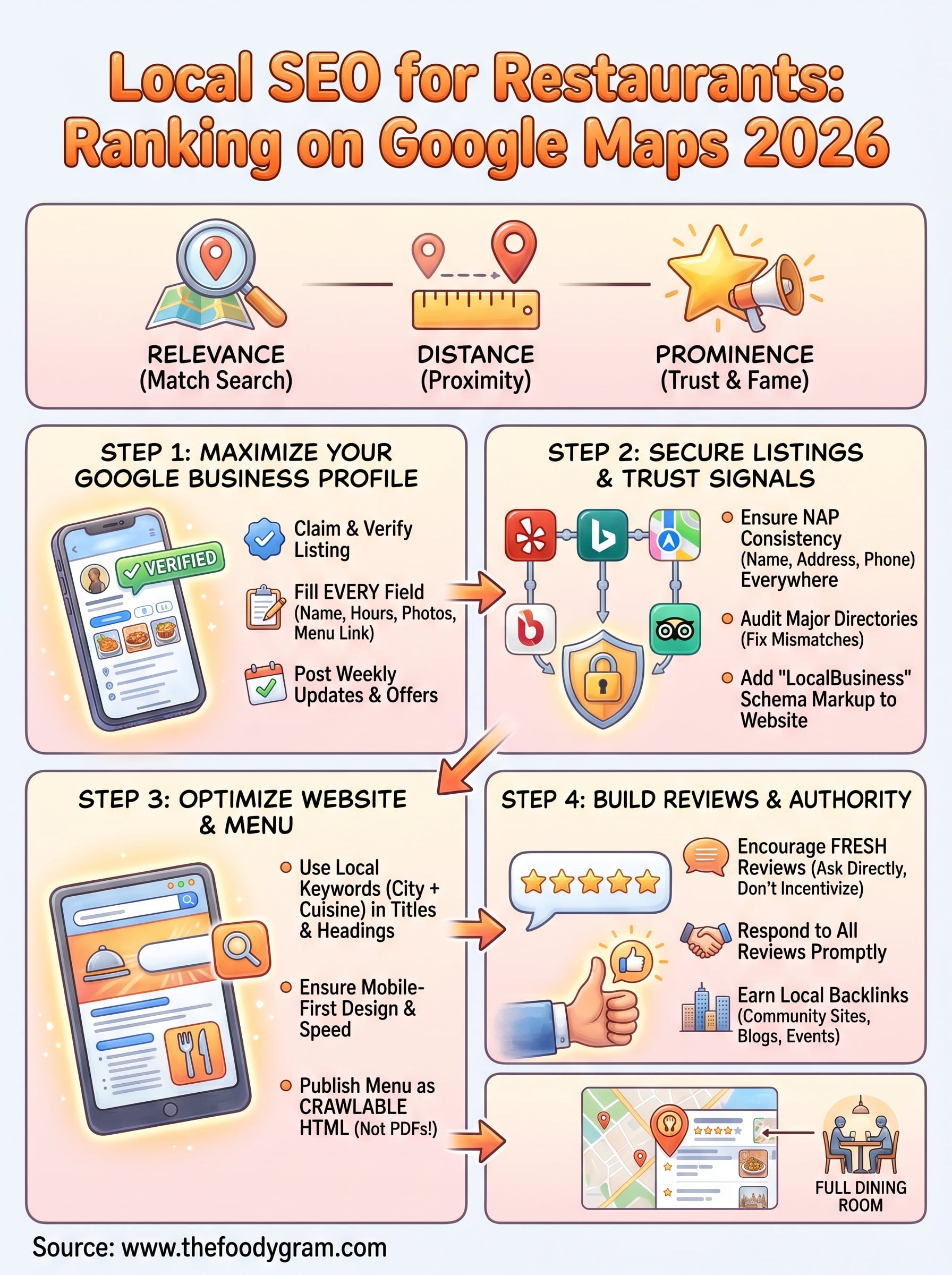
You now have a complete roadmap for local SEO for restaurants: claim and fully optimize your Google Business Profile, fix citation inconsistencies across every major directory, add structured data and crawlable menu content to your website, and build a steady review pipeline. Each step compounds on the others, so prioritize them in order rather than jumping to reviews before your profile is complete.
Start this week by pulling up your Google Business Profile and working through the checklist in Step 1. That single action produces faster results than any other step because it directly feeds Google's relevance and prominence signals. Once your profile is locked in, move to citations and your website.
If you want a branded website with commission-free online ordering already built and ready to support your local SEO efforts, check out our restaurant website and ordering plans and see what fits your operation.