


Why Are Restaurant Profit Margins So Low? 6 Key Reasons
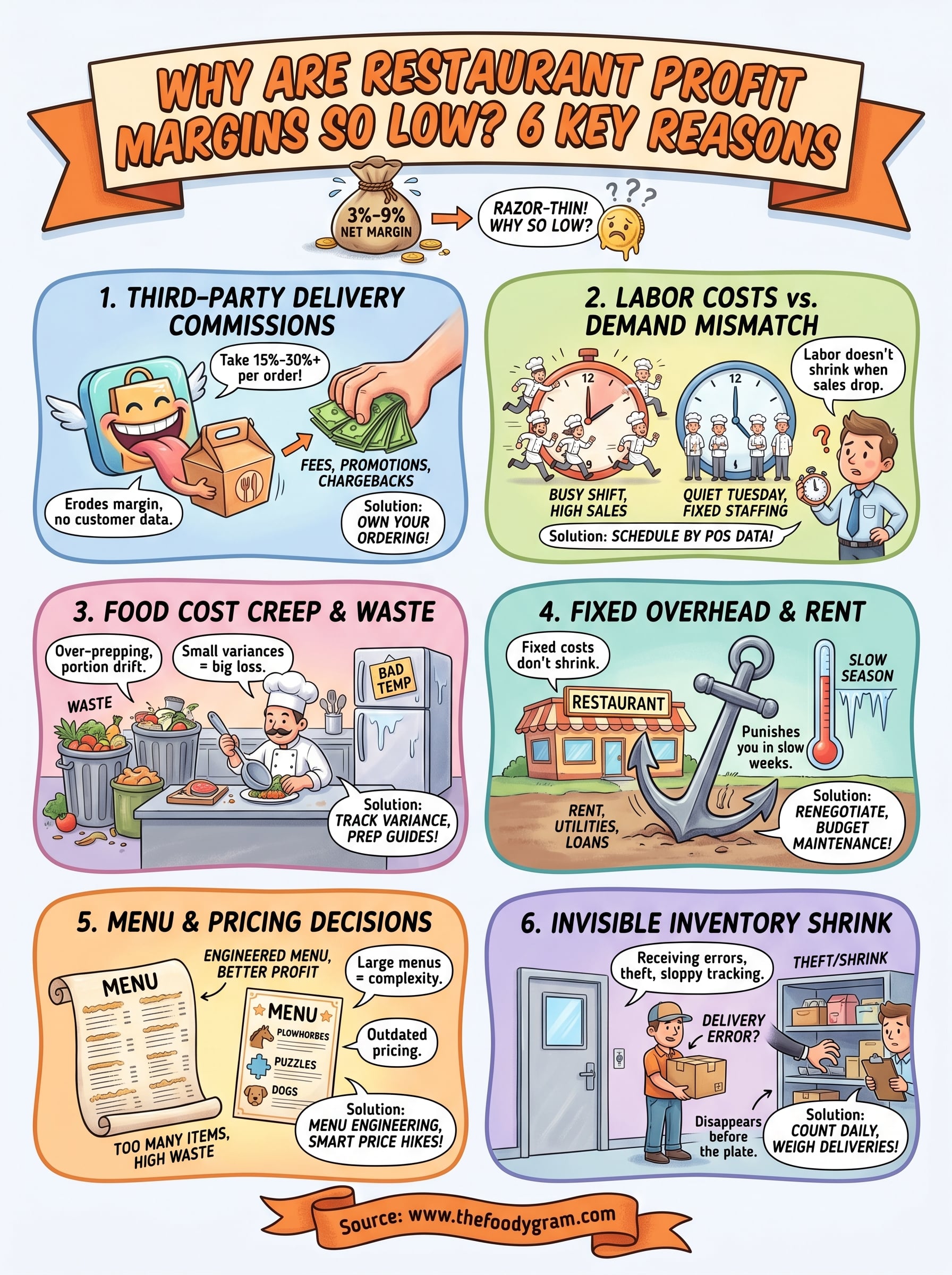
Most restaurants operate on margins between 3% and 9%. That's razor-thin compared to nearly every other industry. So why are restaurant profit margins so low, and what can owners actually do about it?
The answer isn't just one thing. It's a combination of rising food costs, labor expenses, rent, and, increasingly, the hefty commissions charged by third-party delivery apps like DoorDash and Uber Eats. These platforms can take up to 30% per order, which turns what should be profitable sales into break-even transactions at best.
At The Foody Gram, we work with independent restaurant owners every day who are tired of watching their revenue disappear into fees they can't control. Our commission-free online ordering platform exists specifically to help restaurants keep more of what they earn. That perspective gives us a front-row seat to the financial pressures squeezing this industry.
This article breaks down the six biggest reasons restaurant profit margins stay so low, and offers practical strategies you can use to start improving yours. Whether you run a single location or manage multiple spots, understanding these factors is the first step toward protecting your bottom line.
1. Third-party delivery commissions and fees
Third-party delivery apps look like a growth channel until you do the math. Platforms like DoorDash, Uber Eats, and Grubhub charge commissions of 15% to 30% per order, and that number often does not include marketing fees, payment processing, or chargeback costs. For a restaurant already running on a 5% net margin, a 25% commission on delivery orders means you are paying the app more than you keep.
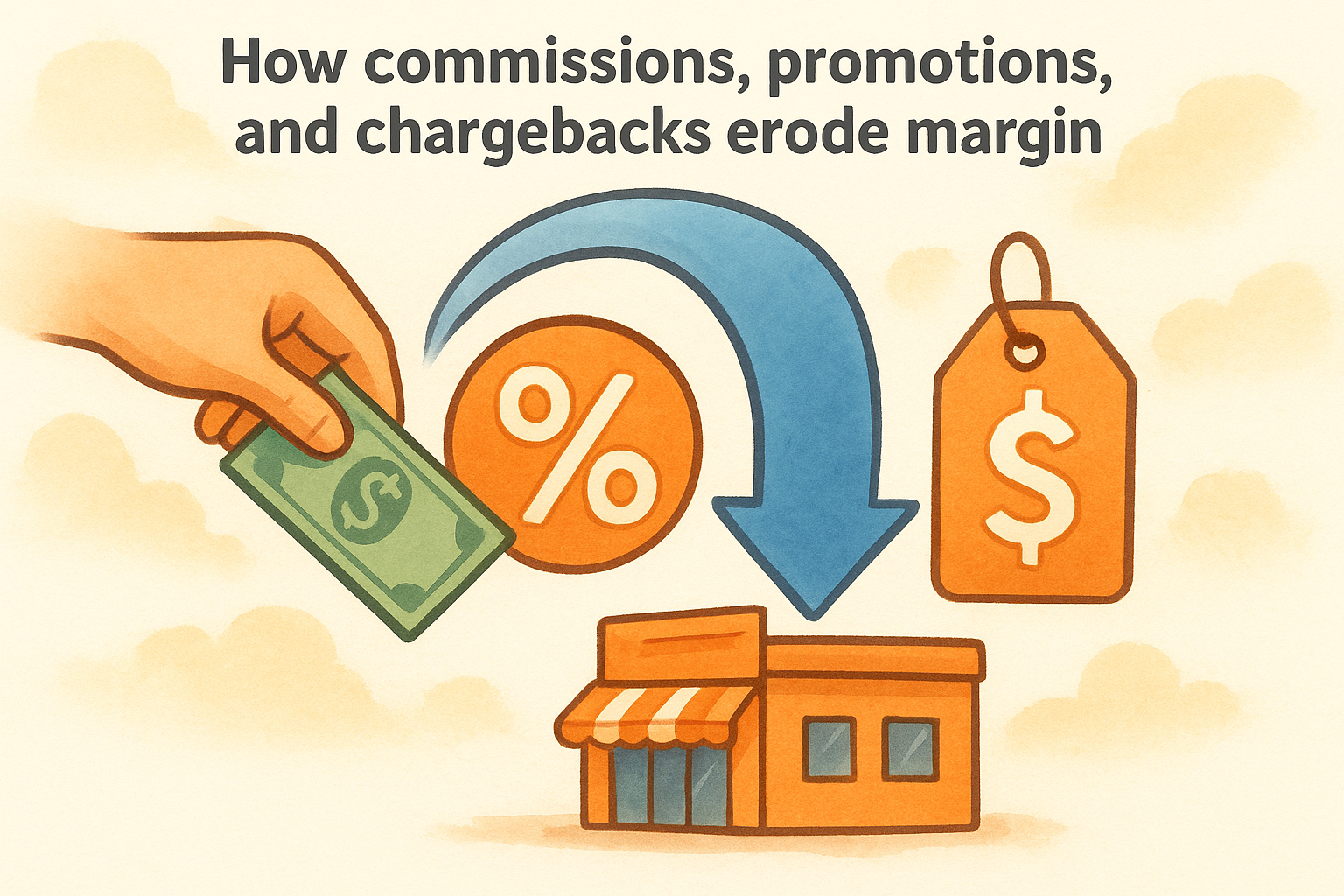
How commissions, promotions, and chargebacks erode margin
Every promotional campaign the app runs comes with a cost you share. If a customer gets $5 off their order, the app typically splits that discount with you. Add a chargeback when a customer disputes a charge, and you can lose the full order value plus a fee. These stacked costs compound fast and sit at the center of why restaurant profit margins so low is a frustration owners voice constantly.
When delivery apps still make sense and when they do not
Delivery apps can help you reach new customers in an unfamiliar market or test demand in an area where you have no brand recognition yet. They stop making sense when repeat customers who already know you keep ordering through the app instead of directly from your site. That repeat business is your most profitable segment, and you hand it to a third party every time.
How direct online ordering protects profit and customer data
When a customer orders directly through your website, you keep the full margin and collect their contact information. That data lets you run targeted email promotions and loyalty campaigns that bring customers back without paying another commission to anyone.
Owning your customer data is not just a privacy advantage - it is a direct revenue asset that third-party apps quietly take from you on every single order.
Benchmarks and quick math to measure true per-order profit
Take your average order value, subtract food cost (28-35%), labor allocation, and the platform commission. On a $40 order at 30% commission, you pay $12 to the app before accounting for any other operating cost.
Practical ways to shift customers to your own ordering channels
Small, consistent touchpoints move regulars off third-party apps over time:
- Print your direct ordering URL on every receipt and packaging insert
- Train staff to mention your website at every pickup interaction
- Offer a one-time incentive on the next direct order to break the app habit
2. Labor costs that do not match demand
Labor is typically the largest controllable cost in any restaurant, often running 25% to 35% of revenue. The problem is that your payroll does not shrink automatically when a Tuesday dinner shift goes quiet. This mismatch between staffing levels and actual demand is one of the most direct answers to why restaurant profit margins so low remains a persistent complaint across the industry.
Why labor swings faster than sales in restaurants
Restaurant revenue can drop 20% in a single slow week while your scheduled labor stays essentially fixed. Unlike food costs that fall naturally with fewer covers, labor commitments lock in days before you know how busy the shift will actually be.
Common scheduling mistakes that inflate payroll
Over-scheduling out of habit and keeping surplus staff on the floor when covers are light adds unnecessary payroll hours fast. Many operators also schedule by feel rather than data, ignoring POS history that shows exactly when traffic peaks and valleys occur each week.
Overtime, turnover, and training as hidden labor costs
Replacing a single line cook can cost $1,500 to $5,000 once you factor in recruitment, onboarding, and the productivity gap during training.
High turnover compounds labor inefficiency because new hires slow your kitchen down. Overtime at 1.5x pay can quietly push your weekly labor percentage well past your target without a single scheduling error.
Systems that keep staffing aligned with covers and ticket volume
Use your POS sales data by daypart to build schedules and stagger start times so staff arrive as volume builds, not all at once at open.
Labor KPIs to track weekly
- Labor cost percentage: total labor divided by total revenue, target 28-32%
- Sales per labor hour: revenue divided by hours worked that shift
- Overtime as a share of total hours: keep this below 5%
3. Food cost creep, waste, and portion drift
Food cost is one of the clearest answers to why are restaurant profit margins so low. Even small daily drift in portions or waste compounds into thousands of dollars lost each month before you notice a problem.
The difference between theoretical and actual food cost
Your theoretical food cost is what you calculate on paper using recipes and standard portions. Your actual food cost reflects what invoices and inventory counts show after real service weeks. The gap between the two numbers tells you precisely where money disappears, and most restaurants carry a variance of 3% to 8% without realizing it.
The biggest drivers of food waste in real kitchens
Over-prepping, poor stock rotation, and improper cold storage cause the most waste in working kitchens. A team that preps by habit rather than projected covers discards margin every single shift.
Closing just a 2% food cost gap on $500,000 in annual revenue puts $10,000 back in your pocket each year.
Portion control, prep standards, and line checks that work
Set written portion specs with visual references posted at each station. Run a daily line check before service to confirm your crew holds those standards before the first ticket drops.
Vendor pricing, substitutions, and how to protect your spec
Audit vendor invoices weekly against your agreed contract pricing. When a vendor substitutes an ingredient without notice, both your recipe cost and product consistency shift in ways you may not catch until the next inventory count.
Food cost KPIs and a simple weekly cadence
Track these three numbers every week:
- Food cost percentage: target 28-35% of revenue
- Waste log totals: logged daily, reviewed weekly
- Theoretical vs. actual variance: investigate any gap above 2%
4. Rent, utilities, and fixed overhead that will not flex
Fixed costs sit at the core of why are restaurant profit margins so low for so many operators. Unlike food or labor, these expenses do not shrink on a slow week, which means every slow season punishes you harder than it should.
Why fixed costs punish you during slow weeks and seasons
When revenue drops 20% in January, your rent, insurance, and loan payments stay exactly the same. That fixed burden forces your variable costs to carry an impossible load, which is why even a short slow stretch can wipe out a full month of profit.
A restaurant spending 12% of revenue on rent in peak season may see that same dollar amount jump to 18% during a slow month, without a single cost increasing.
The overhead line items most restaurants underestimate
Credit card processing fees and POS software subscriptions add up quietly. Many owners also underestimate equipment lease payments and annual permit renewals until those bills land at the worst possible time.
Smart renegotiations and operational fixes that reduce overhead
Ask your landlord for a revenue-based rent clause during lease renewals, especially if your location drives foot traffic to neighboring businesses. Audit utility usage by zone and cut HVAC hours in low-traffic areas.
Equipment and maintenance choices that protect cash flow
Deferred maintenance always costs more than preventive service. Budget a fixed monthly amount for equipment upkeep to avoid emergency repair invoices that destroy your cash position overnight.
Overhead ratios to watch by restaurant type
- Rent: 6-10% of revenue for full-service, 5-8% for fast-casual
- Utilities: 3-5% of revenue across most formats
- Total fixed overhead: keep below 20% of gross revenue
5. Menu and pricing decisions that leave money on the table
Your menu is a financial document before it is anything else. Poor item selection and outdated pricing are two of the most underappreciated reasons why restaurant profit margins so low stays a recurring problem even in busy locations.
How a big menu increases waste, labor, and complexity
A large menu forces you to stock more ingredients, increasing both waste and the cognitive load on your kitchen team. Every added item multiplies your prep requirements, slows ticket times, and raises your theoretical food cost because more low-selling items sit in your cooler past their prime.
Menu engineering basics: stars, plowhorses, puzzles, dogs
Menu engineering classifies every item by popularity and profitability. Stars are high on both. Plowhorses sell well but carry thin margins. Puzzles deliver strong margin but rarely sell. Dogs do neither. Cut your dogs, reprice your plowhorses, and promote your stars prominently through placement and photography.

Removing just three low-margin, low-volume items can simplify your prep list, reduce waste, and free up line space for items that actually build profit.
Pricing psychology and why small increases can matter a lot
A $0.75 increase on your ten best-selling items often goes unnoticed by regulars but adds meaningful revenue across thousands of annual transactions.
How to raise prices without losing regulars
Raise prices gradually across multiple items rather than dramatically on one. Lead with a menu refresh so the increase feels like added value, not a cutback.
Menu and pricing KPIs to monitor
- Item contribution margin: selling price minus food cost per item
- Menu mix report: percentage of sales each item represents weekly
- Price increase impact: revenue change week-over-week after any adjustment
6. Inventory, receiving, and shrink you cannot see
Invisible losses between your back door and the plate quietly answer why are restaurant profit margins so low in many kitchens. Shrink from receiving errors, theft, and sloppy tracking compounds daily without triggering any obvious alarm.
Where restaurants lose money between the back door and the plate
Product gets shorted on delivery, over-portioned by line staff, or taken outright before it ever hits a ticket. These losses rarely surface on a single report, which makes them nearly impossible to catch without a deliberate system in place.
Receiving controls that stop overcharges and missing product
Count and weigh every delivery against the invoice before signing anything. Log and dispute discrepancies the same day, because vendors rarely correct errors you raise after the fact.
A missing case of protein per week at $40 per case costs your restaurant over $2,000 annually without a single obvious incident.
Inventory counting routines that catch issues early
Count high-cost items daily and run a full inventory count weekly. Consistent timing gives you clean variance data to act on before losses stack up.
Theft, comps, and voids: how to reduce shrink without drama
Review void and comp reports weekly and look for patterns by shift or employee. Direct conversations about accountability reduce shrink more reliably than surveillance alone.
Inventory KPIs that link directly to margin
- Inventory variance: actual versus theoretical usage each week
- Shrink percentage: unaccounted losses divided by total purchases
- Comp and void rate: total comps divided by gross sales, target below 1%
Next Steps
Now you know exactly why are restaurant profit margins so low: commissions, labor mismatches, food cost drift, fixed overhead, weak pricing, and invisible inventory shrink all hit at once. No single fix solves everything, but addressing even two or three of these areas can move your net margin several percentage points in the right direction.
Start with the costs you control most directly. Audit your third-party delivery fees first, because that is where most independent restaurants bleed the most margin with the least awareness. Then work through your labor schedule, food cost variance, and menu mix using the KPIs outlined in each section above.
If delivery commissions are your biggest leak, switching to a direct ordering channel is the fastest way to protect your profit on every online order. Review our commission-free online ordering plans and see how much you could keep per month without changing a single thing on your menu.