


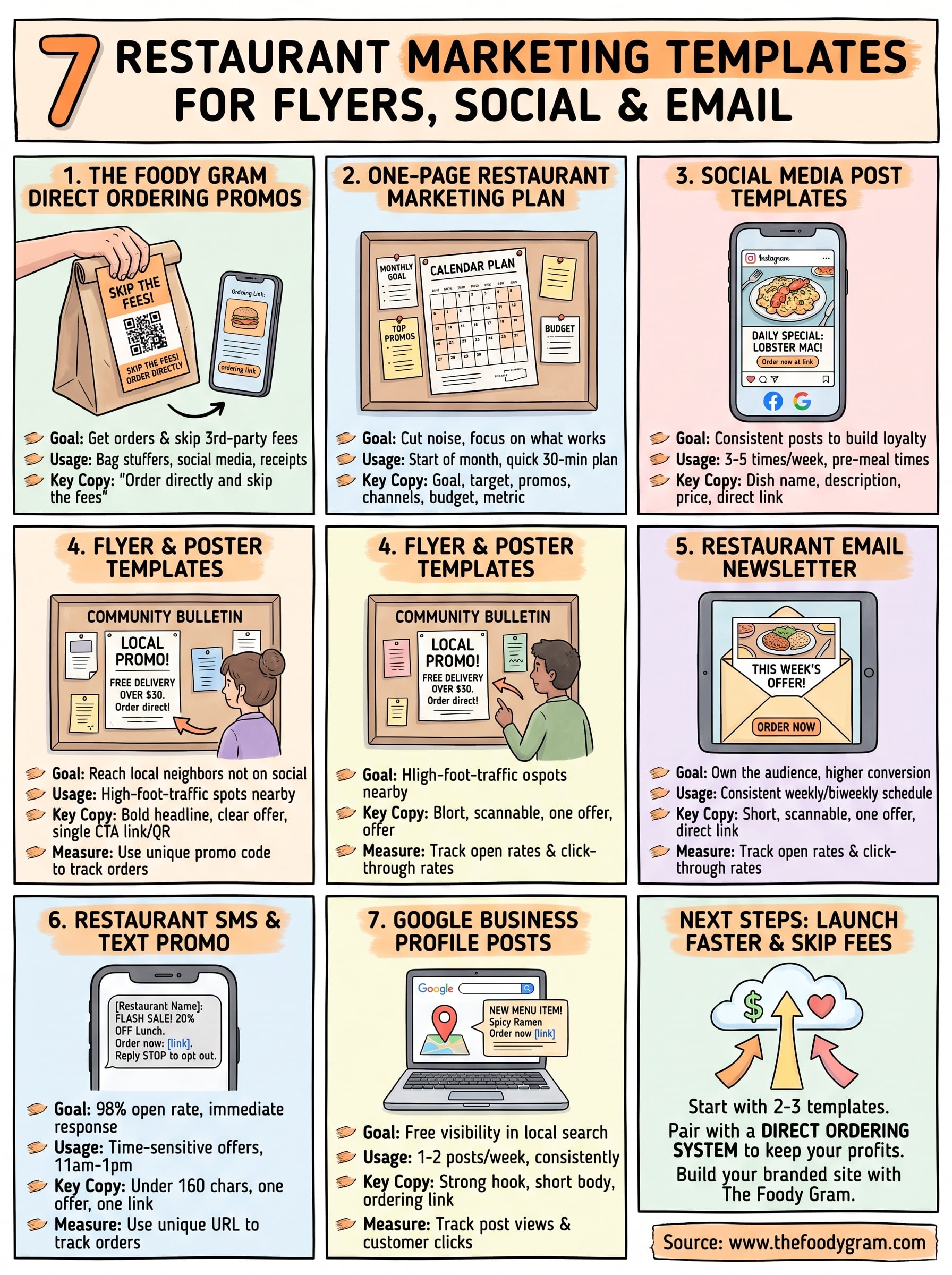
7 Restaurant Marketing Templates for Flyers, Social & Email
Most restaurant owners know they need to promote their business but stall at the blank page. Coming up with designs, writing copy, and formatting emails from scratch eats hours you don't have, especially when you're already running a kitchen. That's exactly where restaurant marketing templates come in. They give you a proven starting point so you can launch promotions faster without hiring a designer or guessing what works.
At The Foody Gram, we help restaurants build their own branded online ordering websites and cut out third-party commission fees. But driving orders to that website takes consistent marketing, flyers in the bag, posts on Instagram, emails to repeat customers. The templates below cover all of it, and they pair well with a direct ordering system where every sale goes straight to your bottom line.
This list breaks down seven ready-to-use templates spanning flyers, social media graphics, and email campaigns. Each one is editable, free or affordable, and built for restaurant use. Whether you're promoting a new menu item, filling slow weeknight tables, or announcing online ordering, you'll find a template that fits the job.
1. The Foody Gram direct ordering promo templates
The Foody Gram offers a set of branded promotional templates designed specifically to push customers toward your own online ordering page rather than a third-party app. These are practical restaurant marketing templates built around one goal: getting orders that skip the commission. You can use them across social, print, and in-store without starting from zero each time.
What you get
You get a small library of ready-made promotional assets including social media graphics, bag stuffers, and table cards. Each template is pre-formatted with a direct-order link placement, so your customers always know exactly where to place their next order. Fonts, colors, and layouts are already set up to match a professional look out of the box.
Where it works best
These templates work best when you place them at every customer touchpoint: the delivery bag, your Instagram feed, and the receipt. Customers who just had a good meal are the most likely to scan a QR code or tap a link. Putting a bag stuffer in every order is one of the highest-return moves you can make because it reaches people who already trust your food.
If you already have customers ordering through a third-party app, a well-placed bag stuffer can shift a meaningful percentage of them to your direct channel within 60 days.
Copy and layout you can reuse
Swap in your restaurant name, phone number, and ordering link, and the template does the rest. A reliable layout to follow:
- Headline: "Order directly and skip the fees"
- Subtext: "Same great food, same delivery, no middleman"
- CTA: Your website URL or QR code linking to your ordering page
- Offer (optional): "Get 10% off your first direct order"
How to measure results
Track results by comparing your direct order volume week over week after you roll out the templates. Most point-of-sale and online ordering dashboards, including The Foody Gram's order dashboard, let you see channel-by-channel order counts. If direct orders climb while third-party app orders fall, the templates are working.
2. One-page restaurant marketing plan template
A one-page marketing plan forces you to cut the noise and focus on what actually drives customers through the door. Most restaurant owners avoid formal planning because full marketing plans feel overwhelming, but a single-page format takes under 30 minutes to fill out and gives you a clear roadmap for the month ahead.
What you get
You get a structured document with dedicated sections for your target customer, monthly promotions, and budget. The one-page format keeps every decision visible at a glance, so you spend less time digging through notes and more time executing.
Where it works best
This is one of the most practical restaurant marketing templates to complete at the start of each month when you're building your promotional calendar. Pin it somewhere visible in your office, and reference it each week when you decide what to post, print, or send. Quarterly reviews of past plans help you identify which promotions drove the most orders.
A one-page plan you actually use beats a detailed strategy document that sits unopened on your desktop.
Copy and layout you can reuse
Structure your plan with these six core fields: goal for the month, target customer, top two promotions, channels, budget, and one metric to track. Keep each field to two or three lines so the whole plan stays on one page.
How to measure results
At the end of the month, compare your actual order volume and revenue against the goal you set. If you hit the target, repeat the same approach the following month with small adjustments.
3. Social media post templates for daily specials
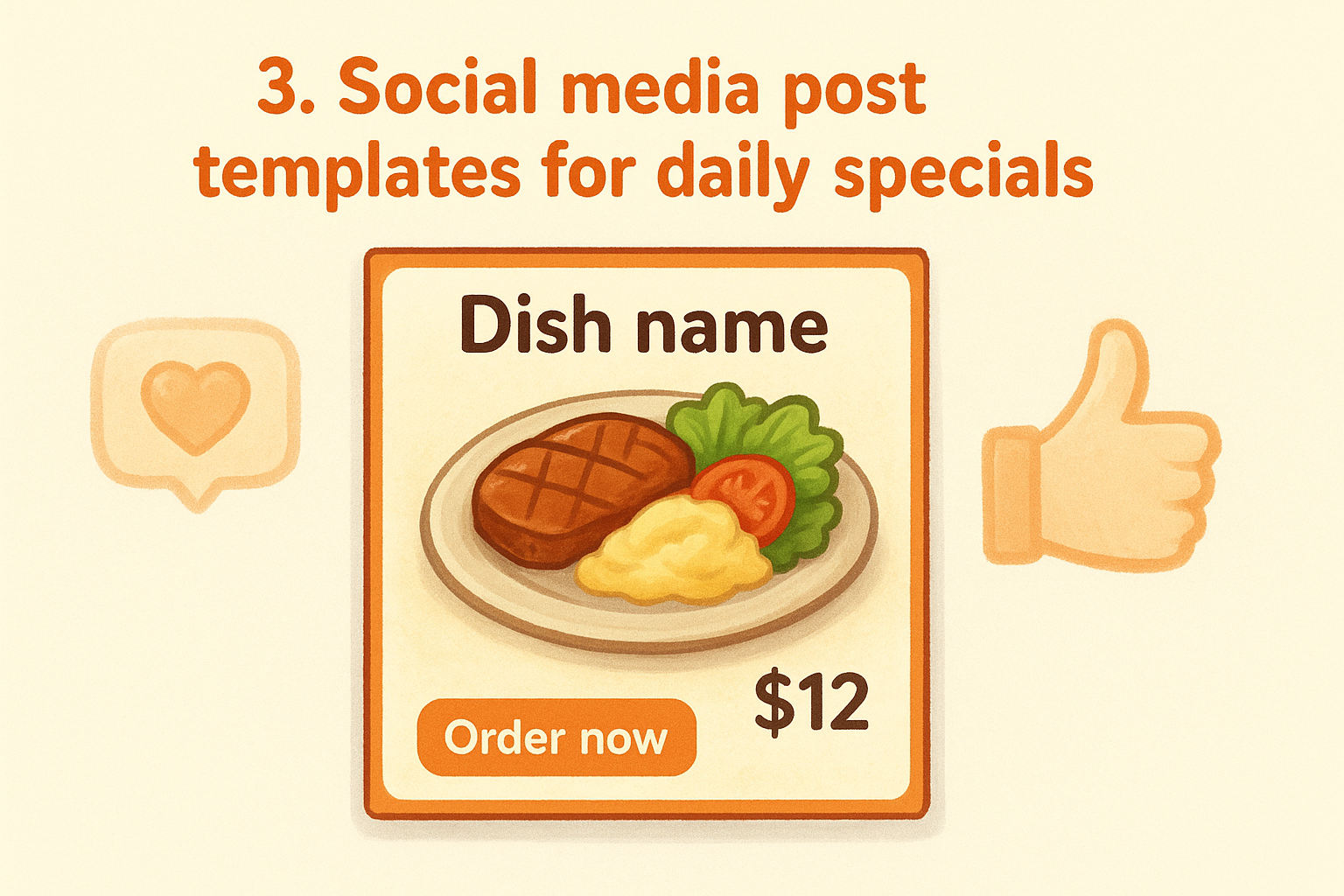
Posting consistently about your daily specials is one of the fastest ways to build a loyal local following, but staring at a blank canvas every morning is not realistic. Pre-built social media post templates solve that problem by giving you a repeatable format you can fill in under five minutes and publish before the lunch rush.
What you get
You get a set of image and caption frameworks sized for Instagram, Facebook, and Google Business Profile. Each template includes a placeholder for your food photo, dish name, price, and ordering link, so every post you publish has the same clean, recognizable structure your followers come to expect.
Where it works best
These restaurant marketing templates work best when you pair them with a consistent posting schedule, ideally three to five times per week. Posting at peak scroll times, typically late morning and early evening, puts your specials in front of customers right before they make a meal decision.
Restaurants that post daily specials consistently report that followers start asking about specials before the post even goes up.
Copy and layout you can reuse
Keep the caption short and direct. A strong formula is: dish name and one-sentence description, followed by your price and a single call to action like "Order now at [your link]." Avoid long paragraphs that get cut off in the feed.
How to measure results
Check your post reach and link clicks weekly inside Meta Business Suite or Google Search Console. Rising click numbers on your ordering link directly confirm the templates are converting attention into sales.
4. Flyer and poster templates for local promos
Physical flyers still work. A well-designed poster in a laundromat, barbershop, or community bulletin board puts your restaurant in front of neighbors who may never see your Instagram page. Pre-built flyer templates let you skip the layout work and focus on printing and distributing.
What you get
You get print-ready flyer and poster layouts in standard sizes like 4x6 inches and 8.5x11 inches, with placeholder sections for your logo, promotion details, and contact information. Most templates are available through tools like Google Slides or Microsoft Word, which means you can edit and print them without buying design software.
Where it works best
These restaurant marketing templates perform best in high-foot-traffic spots near your location: grocery stores, gyms, apartment lobbies, and school pickup areas. Neighborhoods within a two-mile radius are your primary audience since most local diners choose convenience.
A flyer placed inside a complementary business, like a local gym or hair salon, reaches customers who already spend money in your neighborhood.
Copy and layout you can reuse
Keep the design simple with a bold headline, one clear offer, and a single call to action. A reliable format looks like this:
- Headline: Your restaurant name and offer ("Free delivery on orders over $30")
- Supporting line: Your cuisine type or one standout dish
- CTA: Website URL or QR code
How to measure results
Add a unique promo code to each flyer batch so you can track exactly how many orders each distribution run generated inside your ordering dashboard.
5. Restaurant email newsletter templates
Email is one of the few channels where you own the audience. Unlike social media algorithms that decide who sees your posts, an email list delivers your message directly to customers who already chose to hear from you. Pre-built email newsletter templates remove the formatting headache so you can focus on writing the offer and hitting send.
What you get
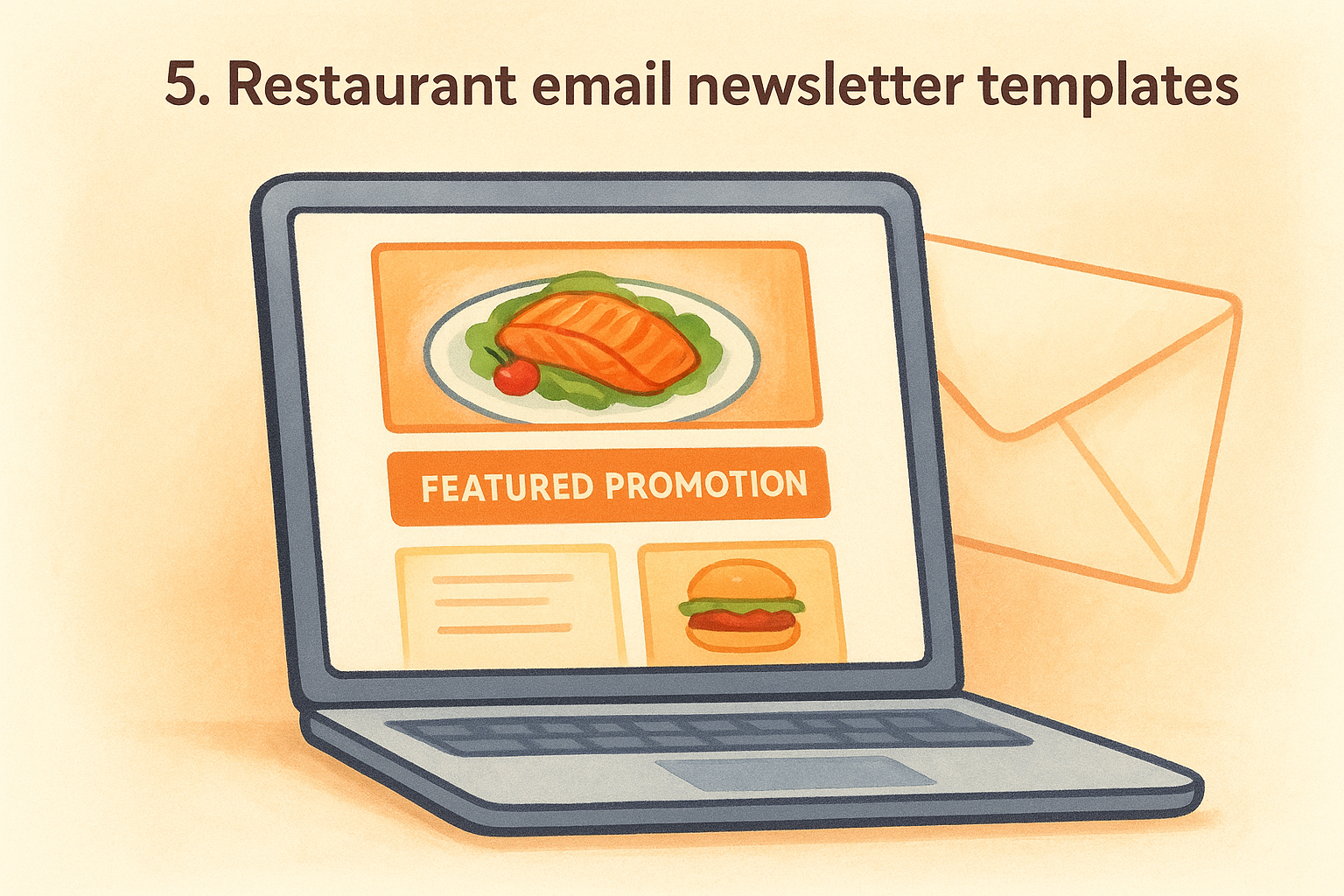
You get ready-made email layouts with sections for a header image, a featured promotion, a menu highlight, and a call-to-action button. Platforms like Google Workspace and free tiers of common email tools provide base templates you can customize with your branding, colors, and ordering link without touching any code.
Where it works best
These restaurant marketing templates perform best when you send them on a consistent weekly or biweekly schedule. Customers who signed up for your list expect to hear from you, and regular emails keep your restaurant top of mind when Friday night dinner planning starts.
Email subscribers convert at a significantly higher rate than cold social media audiences because they already trust your brand.
Copy and layout you can reuse
Keep the email short and scannable. Lead with one offer, support it with a single image, and close with a clear button that links directly to your ordering page. A subject line under nine words consistently outperforms longer ones.
How to measure results
Track your open rate and click-through rate after each send. If clicks on your ordering link increase month over month, your email cadence is working.
6. Restaurant SMS and text promo templates
Text messages have a 98% open rate, which makes them one of the most direct channels available to restaurants. When a customer opts into your SMS list, they're giving you direct access to their phone, and a well-timed promo message can generate orders within minutes of sending.
What you get
You get a set of short, pre-written message formats for common scenarios: flash specials, slow-night offers, and loyalty rewards. These restaurant marketing templates are designed to fit within 160 characters so they send as a single text without getting cut off or broken into multiple parts.
Where it works best
SMS works best for time-sensitive promotions where you need a fast response, like filling seats on a slow Tuesday or moving excess inventory before close. Texts sent between 11 a.m. and 1 p.m. reach customers right as they decide where to eat lunch.
Customers who receive a text promo are far more likely to act on it the same day than customers who see a social post.
Copy and layout you can reuse
Keep every message to one offer and one link. A reliable format is: "[Restaurant Name]: [Offer]. Order now: [link]. Reply STOP to opt out." Avoid multiple offers in a single text because they split attention and lower conversion.
How to measure results
Use a unique URL or promo code in each SMS campaign so your ordering dashboard shows exactly how many orders each message produced. Tracking this weekly shows you which offers drive the strongest response from your list.
7. Google Business Profile post templates
Google Business Profile shows up when someone searches for restaurants near them, making it one of the most valuable free marketing channels you have. Most restaurants upload photos and then ignore the post feature entirely, which means they're missing a direct line to customers who are already searching with intent to eat.
What you get
You get a collection of short post templates formatted for Google Business Profile's character limits, covering weekly specials, holiday hours, and new menu announcements. Each template includes a headline, two-sentence body, and a call-to-action button link pointing directly to your online ordering page.
Where it works best
These restaurant marketing templates work best when you post once or twice per week to keep your profile active in local search results. Google favors profiles that show consistent activity, so regular posting directly supports your visibility when nearby customers search for a place to eat.
An active Google Business Profile with regular posts can increase customer actions like clicks and direction requests by a significant margin compared to a dormant profile.
Copy and layout you can reuse
Lead with a strong one-line hook about the offer or dish, follow with one sentence of context, and close with your ordering link. Keep every post under 300 characters so the full message displays without a "read more" cutoff that buries your call to action.
How to measure results
Check your Google Business Profile Insights monthly to track post views and customer clicks. Rising click numbers tied to your ordering link confirm your posts are pulling in direct traffic from local searches.
Next steps
You now have seven restaurant marketing templates you can put to work this week across print, social, email, text, and search. The fastest path to results is picking two or three templates from this list rather than trying to launch all of them at once. Start with the channel where your customers already engage, then add more as each one becomes routine.
Every template in this list works harder when customers have a direct place to order that keeps money in your pocket instead of paying commissions to third-party apps. Building that direct channel is the logical next move after locking in your marketing approach. The Foody Gram sets up your branded ordering website in 48 to 72 hours with no contracts and no setup fees, so you can start capturing direct orders immediately. Check out our restaurant website and ordering plans to see which tier fits your operation.