


Food Cost Percentage for Restaurants: How To Calculate
Every dollar your restaurant spends on ingredients directly impacts your bottom line. Your food cost percentage for restaurants is one of the most critical numbers you can track, it tells you exactly how much of your revenue goes toward the food on each plate. Yet many restaurant owners either calculate it incorrectly or skip tracking it altogether, leaving profits on the table without realizing it.
The problem gets worse when third-party delivery apps take a 30% cut on top of already tight margins. That's why at The Foody Gram, we help restaurants keep more of their revenue through commission-free online ordering, but even with zero commissions, you still need to know your food costs inside and out.
This guide breaks down how to calculate your food cost percentage step by step, covers industry benchmarks so you know where you stand, and walks through proven strategies to bring that number down. Whether you're running a single pizzeria or managing multiple locations, getting this right can mean the difference between barely breaking even and building a profitable operation.
What food cost percentage is and why it matters
Food cost percentage measures how much of your revenue you spend on ingredients. It's a ratio that compares what you paid for food to what you earned from selling it. If you bring in $10,000 in sales and spend $3,000 on food, your food cost percentage is 30%. Simple math, but the implications for your restaurant's financial health run deep, and ignoring this number is one of the fastest ways to erode profit without noticing.
The basic definition
Food cost percentage is calculated by dividing your total food costs by your total food sales, then multiplying by 100. That gives you a clear picture of ingredient spending relative to revenue for any given period, whether that's a single week or a full month. Most operators track it monthly to catch trends before they turn into serious problems, though high-volume restaurants often review it weekly for tighter control.
Tracking food cost percentage for restaurants on a consistent schedule is the only reliable way to spot waste, theft, or pricing issues before they significantly damage your margins.
Industry benchmarks you should know
The restaurant industry generally targets a food cost percentage between 28% and 35%, but the right number for your operation depends on your concept. Fine dining often runs higher because of premium ingredients, while fast-casual and quick-service concepts stay leaner by design. Here's a breakdown of typical ranges by restaurant type:
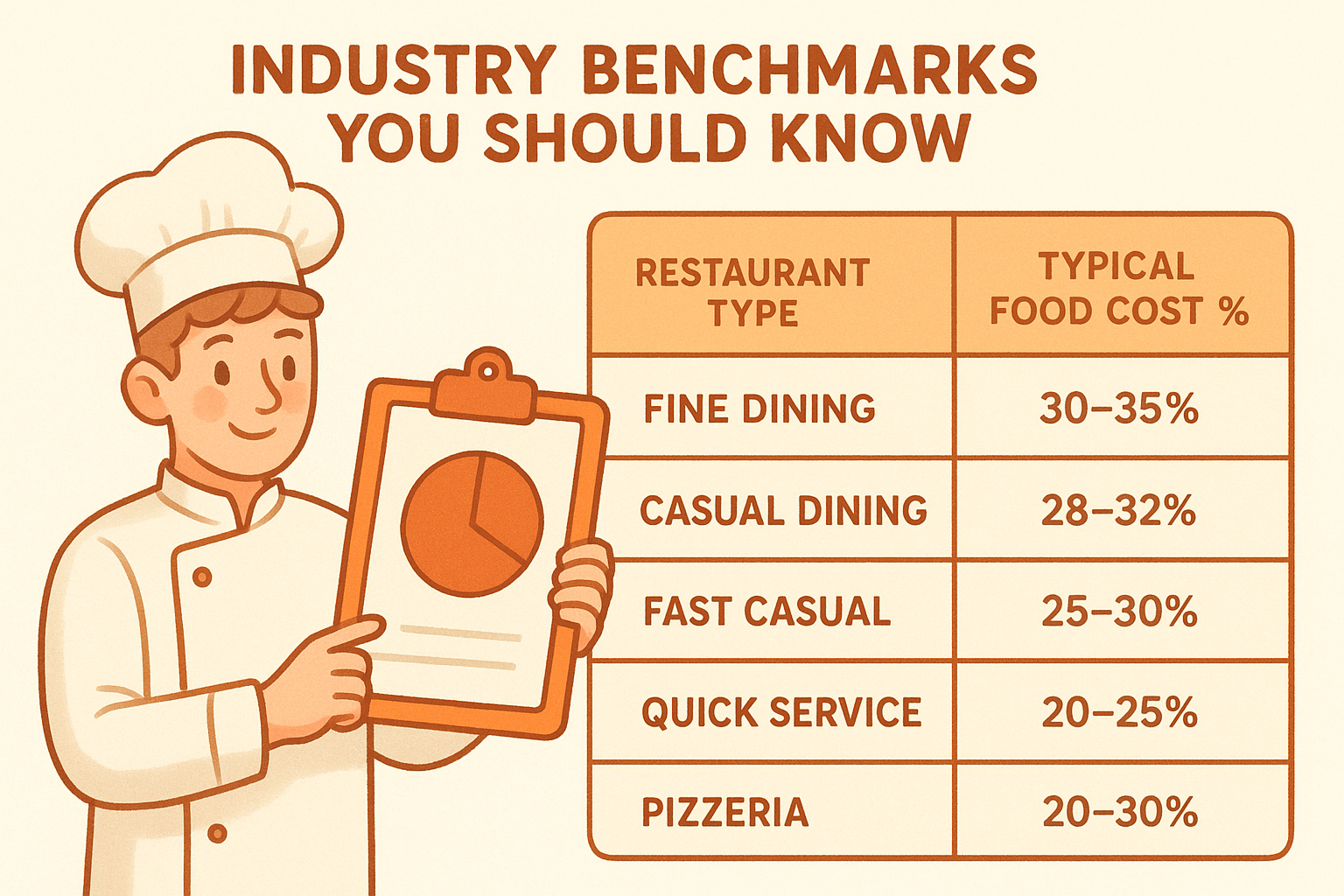
| Restaurant Type | Typical Food Cost % |
|---|---|
| Fine Dining | 30–35% |
| Casual Dining | 28–32% |
| Fast Casual | 25–30% |
| Quick Service | 20–25% |
| Pizzeria | 20–30% |
These ranges are targets, not guarantees. Your actual number tells you whether your pricing, purchasing, and portioning are working together or quietly pulling profits in the wrong direction.
Why it connects directly to profit
Your food cost percentage sits inside your prime cost, which combines food costs and labor costs. Together, prime cost typically accounts for 55–65% of total restaurant revenue. When food costs creep up, the window for profit narrows fast. A 2-point increase in food cost percentage on $50,000 in monthly sales equals $1,000 less profit per month, which adds up to $12,000 a year disappearing without a single obvious cause. Knowing your exact number puts you in a position to act early rather than react late, which is the difference between a profitable year and a stressful one.
Step 1. Gather the numbers you need
Before you run any calculation, you need three specific numbers from your records. Skipping this step or guessing at any of them will give you a food cost percentage that means nothing. Pull these figures for the same time period, typically a full week or a full month, so your calculation stays consistent and comparable across reporting periods.
The three numbers behind the formula
The formula for food cost percentage for restaurants relies on beginning inventory, purchases made during the period, and ending inventory. Beginning inventory is the dollar value of all food you had on hand at the start of the period. Purchases are everything you bought from suppliers during that same window. Ending inventory is what remains at the close of the period.
Getting all three numbers right is non-negotiable. An inaccurate ending inventory count is the single most common reason food cost calculations come back wrong.
Your formula for total food cost looks like this:
Total Food Cost = (Beginning Inventory + Purchases) - Ending Inventory
How to take an accurate inventory count
Walk every storage area, including your walk-in cooler, freezer, dry storage, and prep stations, and count physical quantities on hand. Assign a dollar value to each item based on what you actually paid, not the current market price. Then multiply quantity by unit cost and add everything up. Use a consistent counting sheet each time so nothing gets missed.
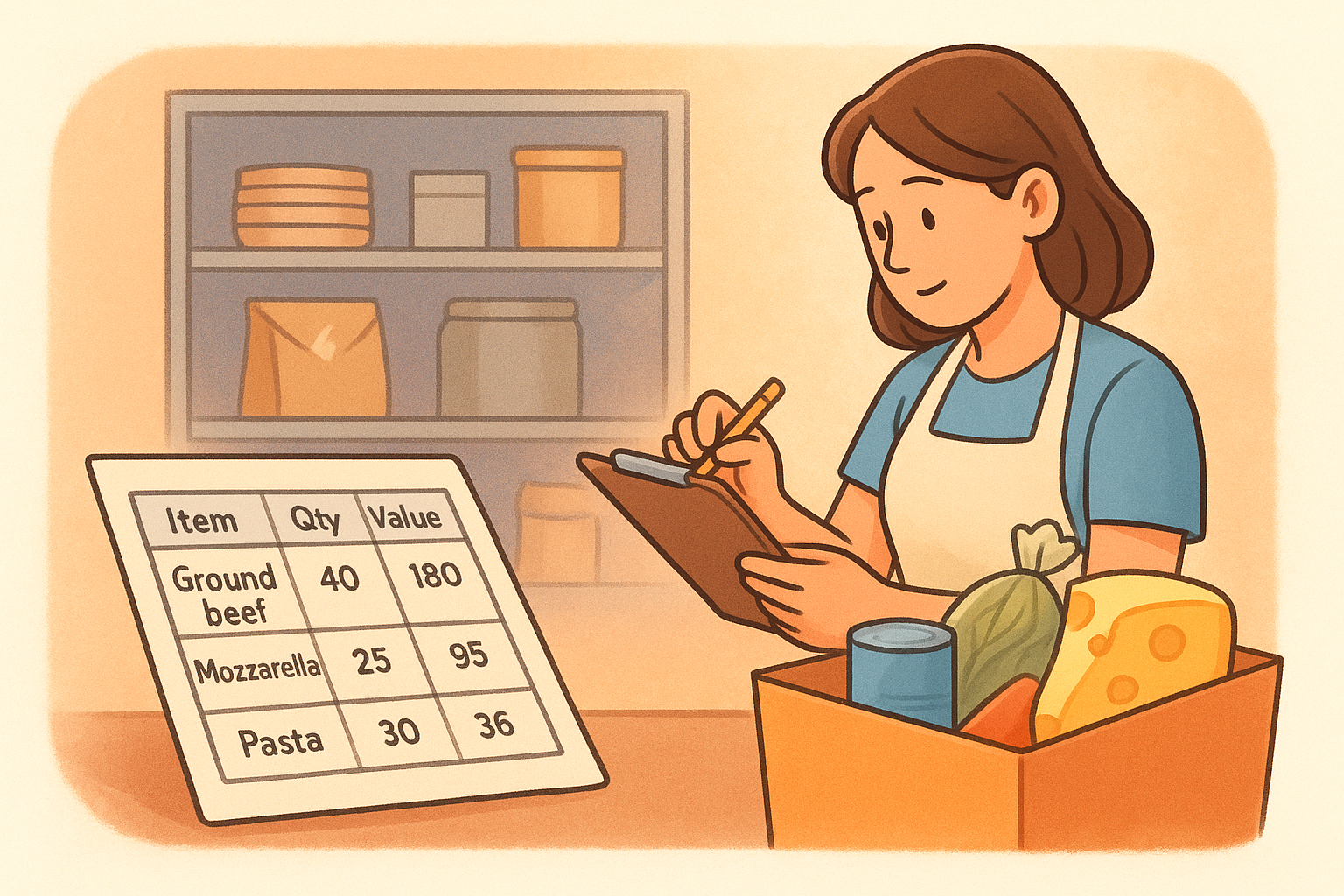
Here is a simple template to guide your count:
| Item | Unit | Quantity on Hand | Unit Cost ($) | Total Value ($) |
|---|---|---|---|---|
| Ground beef | lb | 40 | 4.50 | 180.00 |
| Mozzarella | lb | 25 | 3.80 | 95.00 |
| Pasta | lb | 30 | 1.20 | 36.00 |
Fill this out at the start and end of every period to keep your numbers reliable.
Step 2. Calculate your actual food cost percentage
Once you have your three numbers, the rest is straightforward arithmetic. Plug your beginning inventory, purchases, and ending inventory into the formula you used in Step 1 to get your total food cost, then divide that figure by your total food sales for the same period and multiply by 100.
Run the formula
Your complete food cost percentage formula looks like this:
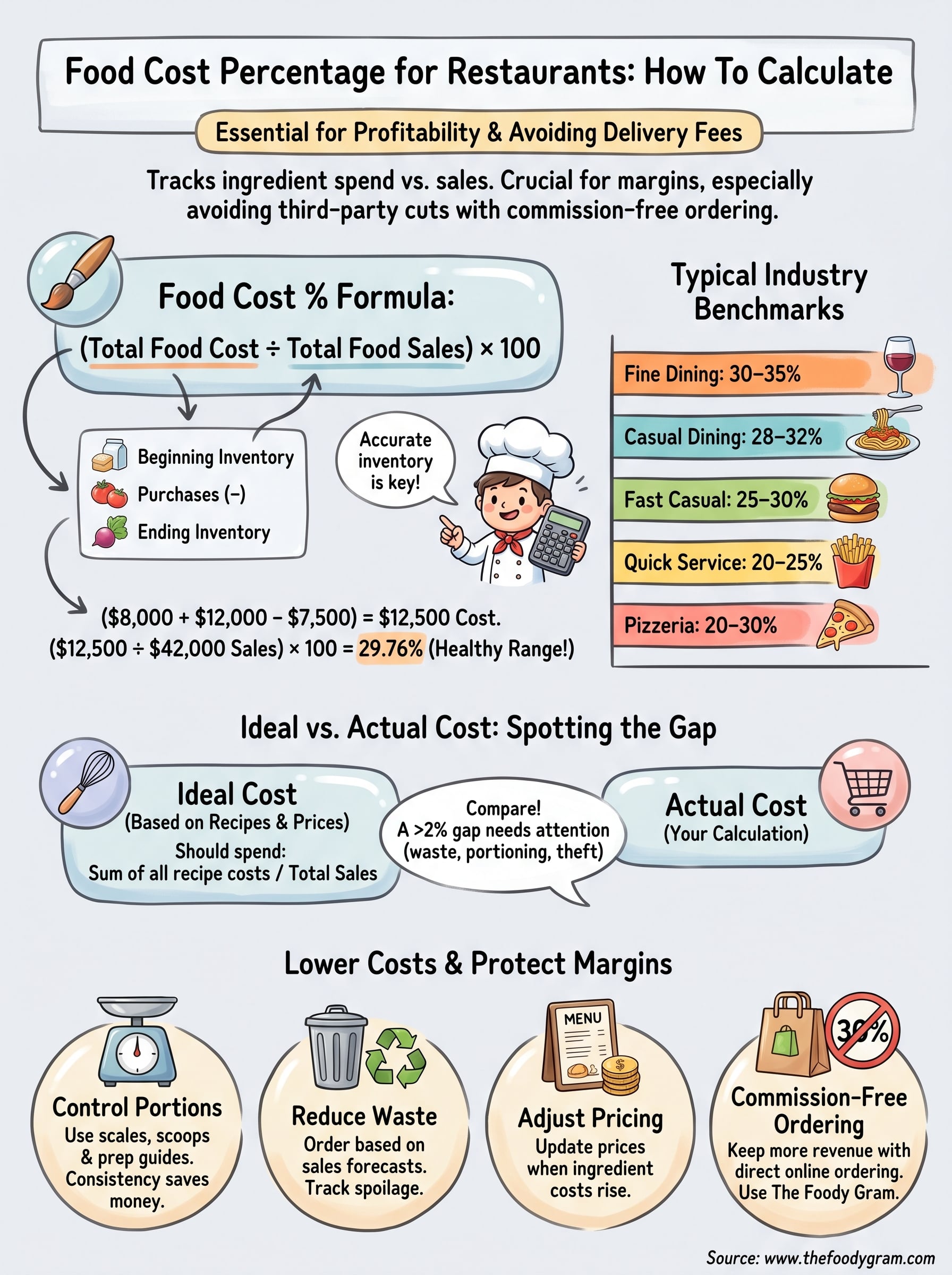
Food Cost % = (Total Food Cost ÷ Total Food Sales) × 100
Here is a concrete example using real numbers. Say you start the month with $8,000 in inventory, add $12,000 in purchases, and end the month with $7,500 remaining. Your total food cost is $12,500. If your food sales for that month are $42,000, divide $12,500 by $42,000, then multiply by 100.
($8,000 + $12,000 - $7,500) ÷ $42,000 × 100 = 29.76%
Your actual food cost percentage for restaurants is 29.76%, which puts you inside the healthy range for most casual and fast-casual concepts.
Record this number along with the time period it covers so you can track changes month over month rather than treating each calculation in isolation.
Put your numbers into context
A single data point tells you where you stand right now, but it does not tell you whether things are improving or getting worse. Compare your current food cost percentage against your previous two or three months to identify a trend. If your percentage is climbing steadily, that signals a problem in purchasing, portioning, or waste worth investigating immediately. If it holds steady or drops, your controls are working and you can shift your focus to optimizing further.
Step 3. Calculate ideal food cost and spot gaps
Your actual food cost percentage tells you what you spent. Your ideal food cost tells you what you should have spent based on what you actually sold. Comparing the two reveals exactly where money is leaking, whether through over-portioning, waste, spoilage, or theft. This step turns your food cost calculation from a simple report card into a direct action plan.
Build your ideal food cost from your menu
Ideal food cost starts at the individual menu item level. For each dish, add up the cost of every ingredient in the recipe using your actual purchase prices. Then divide that ingredient cost by your menu price and multiply by 100. That gives you the ideal food cost percentage for that item.
Ideal Item Food Cost % = (Ingredient Cost ÷ Menu Price) × 100
For example, if a pasta dish costs $4.20 to make and sells for $16.00, its ideal food cost percentage is 26.25%. Multiply each item's ideal percentage by the number of units sold during the period, then add everything up and divide by total sales to get your overall ideal food cost percentage for that same window.
Compare ideal versus actual to find the gap
If your actual food cost percentage for restaurants runs more than 2 to 3 points above your ideal, something in your operation needs immediate attention.
Once you have both numbers, subtract your ideal percentage from your actual percentage. A gap of 1 to 2 points is normal and manageable. A gap of 5 points or more signals a specific problem worth investigating, such as portioning drift, untracked waste, or supplier price increases that you have not yet passed on to customers through adjusted menu prices.
Step 4. Lower food costs and protect margins
Once you know your actual food cost percentage and the gap between ideal and actual, you can take direct steps to close it. Most improvements come from a handful of high-impact areas: portioning, purchasing, waste reduction, and menu pricing. Tackling all four systematically gives you far more control than fixing one in isolation.
Control portions and reduce waste
Inconsistent portioning is the most common driver of a rising food cost percentage for restaurants. Set a written portion standard for every menu item and give your kitchen team the tools to follow it, including portioning scales, labeled scoops, and prep guides. When a cook free-pours cheese or eyeballs a protein serving, the cost adds up fast across hundreds of covers.
A single extra ounce of protein on 200 plates per week can cost you thousands of dollars annually without a single complaint or warning sign.
Reduce waste by ordering based on forecasted sales rather than habit. Review your sales history for the previous two to four weeks before placing supplier orders. Track spoilage separately in your inventory count so you can see which items expire before you use them and adjust order quantities accordingly.
Adjust pricing to reflect actual costs
When ingredient costs rise, your menu prices need to keep pace. Run your ideal food cost calculation any time a key supplier raises prices. If a price increase pushes an item above your target margin, you have two options: raise the menu price or reformulate the dish to bring ingredient cost back in line.
Here is a quick decision template:
| Situation | Action |
|---|---|
| Ingredient cost rises 10%+ | Raise menu price or swap ingredient |
| Food cost gap exceeds 3 points | Audit portioning and waste logs |
| Spoilage is climbing | Reduce order quantities or adjust prep schedule |
Next steps to keep it under control
Tracking food cost percentage for restaurants is not a one-time project. You need to run your inventory counts and cost calculations on a fixed schedule every month so you can catch problems early and respond before they compound. Set a recurring reminder, assign ownership to a specific person on your team, and store your numbers in a spreadsheet where you can compare them month over month.
Beyond food costs, look at how much revenue you actually keep per order. If third-party delivery apps are taking a 30% commission on top of your ingredient costs, your margins have almost no room to breathe. Moving customers to a direct ordering channel removes that commission entirely and puts more money back into your operation with every single order.
If you want to stop paying commissions and keep more of what you earn, check out The Foody Gram's commission-free online ordering plans and see what fits your restaurant.