


How Much Does DoorDash Charge Restaurants? Fees Explained
DoorDash takes a cut from every order a restaurant fills through its platform, and that cut adds up fast. If you've been searching for how much does DoorDash charge restaurants, the short answer is anywhere from 15% to 30% per order, depending on the plan. But the full picture includes marketing fees, tablet rentals, payment processing charges, and other costs that most restaurant owners don't see coming until they're already locked in.
We built The Foody Gram specifically because we watched restaurants hand over thousands of dollars each month in delivery app commissions, money that should have stayed in their pockets. As a commission-free online ordering platform, we've helped restaurants keep more of their revenue by replacing percentage-based fees with a flat monthly subscription. So we know exactly how DoorDash's pricing works, and where it hits hardest.
This article breaks down every fee DoorDash charges restaurant partners in 2026, from its three main commission tiers to the hidden costs buried in the fine print. By the end, you'll have a clear understanding of what you're actually paying and whether those costs make sense for your bottom line.
Why DoorDash pricing matters for restaurants
When you run a restaurant, every percentage point of margin matters. DoorDash's commission model pulls a share of your gross revenue on every single order, which means the more business you do through the platform, the more you pay. If you've ever asked how much does DoorDash charge restaurants and why it matters so deeply, the answer starts with understanding how quickly small percentages turn into large dollar amounts when multiplied across hundreds of monthly transactions. A fee that looks manageable in isolation often looks devastating once you run it against your actual cost structure.
Your margin is the first thing at risk
Restaurants already operate on thin margins. The typical independent restaurant clears between 3% and 9% net profit on every dollar of revenue, according to widely cited industry estimates. That means when DoorDash charges you a 25% or 30% commission on an order, you are not just giving up profit. You are potentially selling food at a loss once you factor in your food cost, labor, rent, and utilities.
A restaurant with a 5% net margin and a 25% DoorDash commission is likely losing money on every single order it fills through the platform.
To put this in concrete terms, if your food cost runs 30% of the menu price, labor another 30%, and overhead another 25%, you are already at 85% in costs before any platform fee touches the equation. Add a 25% commission on top of that, and you have handed over more than you earned. The only lever most restaurants use to compensate for this is raising menu prices on the app, which introduces its own risks around demand and customer trust.
Volume does not automatically save you
A common assumption is that higher order volume through DoorDash will offset the commission cost. More revenue should mean more profit, right? That logic breaks down fast because DoorDash takes a percentage of every transaction, so your fee exposure scales directly with your volume rather than shrinking as a share of it. A restaurant processing $50,000 per month through DoorDash at a 25% commission rate pays $12,500 in platform commissions alone, before any additional fees are counted.
More order volume through a percentage-based platform does not lower your effective cost. Your fee grows in direct proportion to your revenue. The only real path to improving your margin on delivery orders is to either cut your operating costs, raise your platform prices, or shift customers toward a lower-cost ordering channel that you control. Each of those options has trade-offs, but the first step is recognizing that volume alone will not fix the math.
What gets lost beyond the dollars
The commission cost is visible and measurable, but there are losses that go beyond the line items. When a customer orders through DoorDash, that customer belongs to DoorDash. You do not get their email address, their phone number, or any way to reach them directly. You cannot send a promotion, reward a repeat visit, or simply follow up. DoorDash owns that customer relationship, and the platform actively uses it to surface competing restaurants right alongside yours.
This dynamic means every order you fill through a third-party app is a missed opportunity to build your own customer base. Over time, restaurants that lean heavily on DoorDash find themselves in a position of real dependency: reliant on a platform that can adjust its commission structure, change its algorithm, or alter your listing visibility with little warning. Your [customer data](https://www.thefoodygram.com/blogs/news/commission-free-online-ordering-the-future-of-the-restaurant-business) is one of the most valuable assets your business can own, and every order that runs through a platform you do not control is an order that adds nothing to it.
DoorDash plans and commission rates in 2026
DoorDash structures its pricing around three merchant plans, each tied to a different commission rate and feature set. Understanding how much does DoorDash charge restaurants starts with knowing which plan a restaurant is on, because the difference between tiers can add up to tens of thousands of dollars per year. All three plans charge a percentage of gross order value, not a flat fee, so your costs rise directly with your revenue.
The three DoorDash commission tiers
DoorDash offers the Basic, Plus, and Premier plans. Each tier unlocks different visibility features on the platform in exchange for a higher commission rate. Here is how they break down:
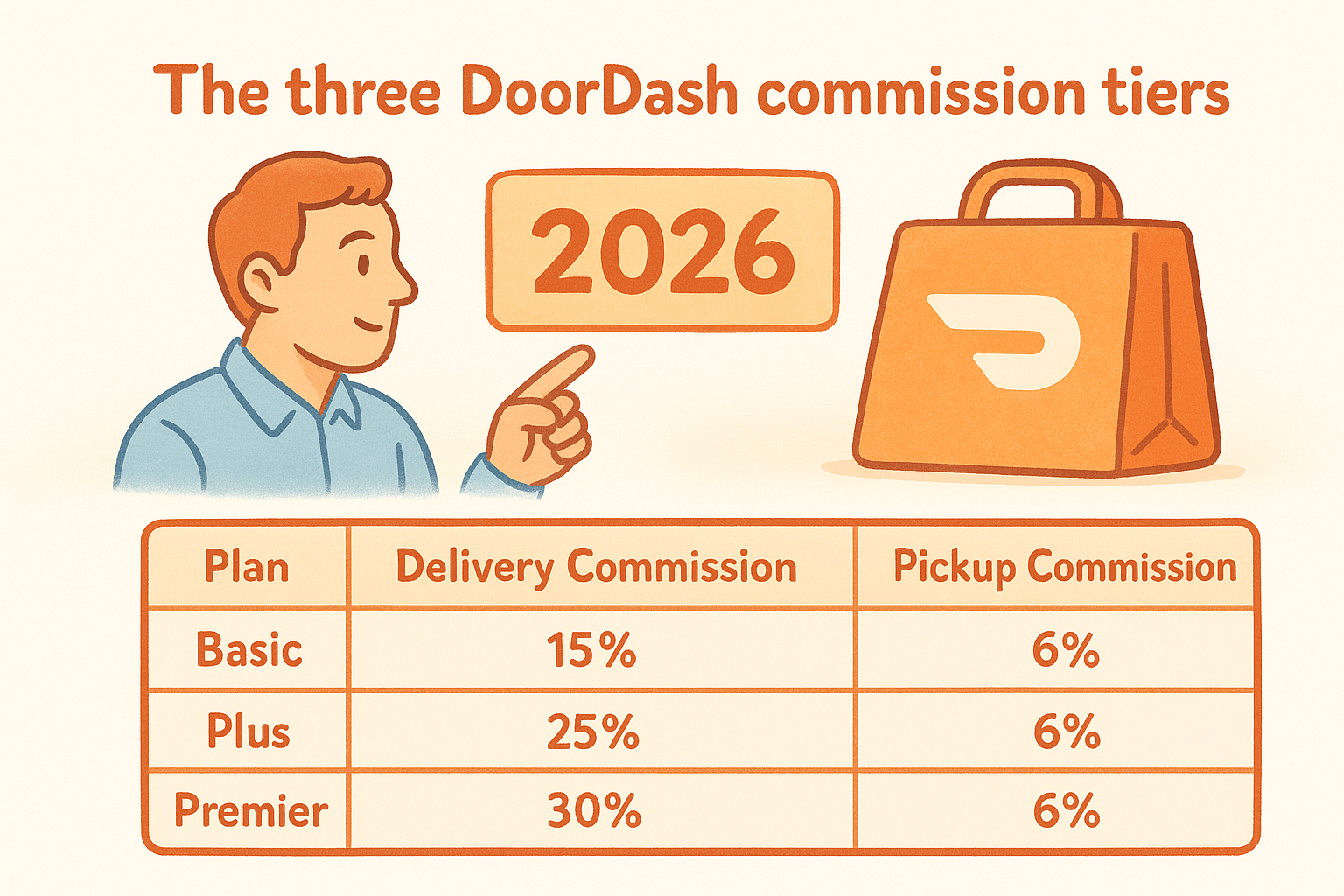
| Plan | Delivery Commission | Pickup Commission |
|---|---|---|
| Basic | 15% | 6% |
| Plus | 25% | 6% |
| Premier | 30% | 6% |
The Basic plan at 15% is the entry-level option. It gives you access to DoorDash's delivery network and marketplace listing, but it limits your visibility compared to higher tiers. Your restaurant will appear in the app, but without the DashPass badge or priority placement that Plus and Premier members receive.
Choosing a lower commission tier does not mean your restaurant gets equal exposure. DoorDash's algorithm visibly favors higher-tier merchants.
What Plus and Premier plans add
The Plus plan at 25% includes placement for DashPass subscribers, DoorDash's membership program for customers who pay a monthly fee for reduced delivery fees. Since DashPass members order more frequently, Plus listing gives you access to a higher-volume segment of the customer base. You also get access to expanded delivery radius, which means reaching customers farther from your location.
The Premier plan at 30% is the top tier and comes with additional marketing tools, including featured placement and promotional opportunities within the app. DoorDash also offers a delivery count guarantee under Premier, which promises a minimum number of orders per month or provides a credit toward your fees. It sounds attractive, but at 30% commission, the guarantee rarely offsets the additional cost for most independent restaurants. Unless your average order value is high enough to absorb that cut, Premier is often the most expensive choice relative to actual profit impact.
How pickup orders are priced
Pickup orders carry a flat 6% commission across all three plans, which is notably lower than delivery. If your customers are willing to come in and grab their order, routing them toward pickup through DoorDash reduces your fee exposure significantly. Many restaurants use this strategically to lower their blended commission rate without fully leaving the platform.
Extra merchant fees beyond commission
Commission is the biggest line item, but understanding how much does DoorDash charge restaurants means looking past the percentage. DoorDash layers several additional fees on top of its commission rates, and these charges apply whether you are on Basic, Plus, or Premier. Knowing what they are before you sign up helps you build a realistic picture of your total cost per order.
Payment processing fees
Every order processed through DoorDash runs through its own payment infrastructure, and you pay for that separately. DoorDash charges a payment processing fee of approximately 2.5% to 3% of the transaction total on top of whatever commission rate your plan carries. This fee covers credit card processing and is non-negotiable regardless of tier. On a $40 order at the Premier rate, you are already paying $12 in commission before processing adds another dollar or more on top.
Payment processing fees are charged in addition to commission, not included within it, which means your real cost per order is consistently higher than the listed commission percentage alone.
Tablet and hardware costs
DoorDash requires most restaurant partners to use its merchant tablet to receive and manage incoming orders. The tablet rental typically runs $6 per month per device. If you operate multiple stations or locations, that cost multiplies quickly. Some restaurants integrate DoorDash orders directly into their existing point-of-sale system, which can eliminate the tablet fee, but third-party POS integrations often carry their own connection or setup costs depending on your provider.
These hardware fees are fixed monthly charges that hit you whether you process one order or five hundred. When you stack tablet rental on top of commission and processing fees, your effective cost on a slower month becomes a noticeably larger percentage of what you actually earned through the platform.
Marketing and promotional fees
DoorDash offers optional in-app tools designed to boost your restaurant's visibility. While these are technically voluntary, the algorithm tends to favor restaurants that actively use them, so many owners end up spending to stay competitive. Common paid promotional options include:
- Sponsored listings that push your restaurant higher in search results
- Item-level discounts funded by the merchant rather than DoorDash
- Free item promotions where the cost is split or fully absorbed by the restaurant
Each of these fees is billed separately from your commission, making it harder to track your true monthly spend on the platform in a single number.
Real-world cost math for a typical order
Abstract percentages are easy to dismiss. When you run the actual numbers on a single order, the impact of knowing how much does DoorDash charge restaurants becomes impossible to ignore. The math below uses realistic figures, not worst-case scenarios, and what it shows is that a commission structure built on percentages quietly consumes a much larger share of your profit than the listed rate suggests.
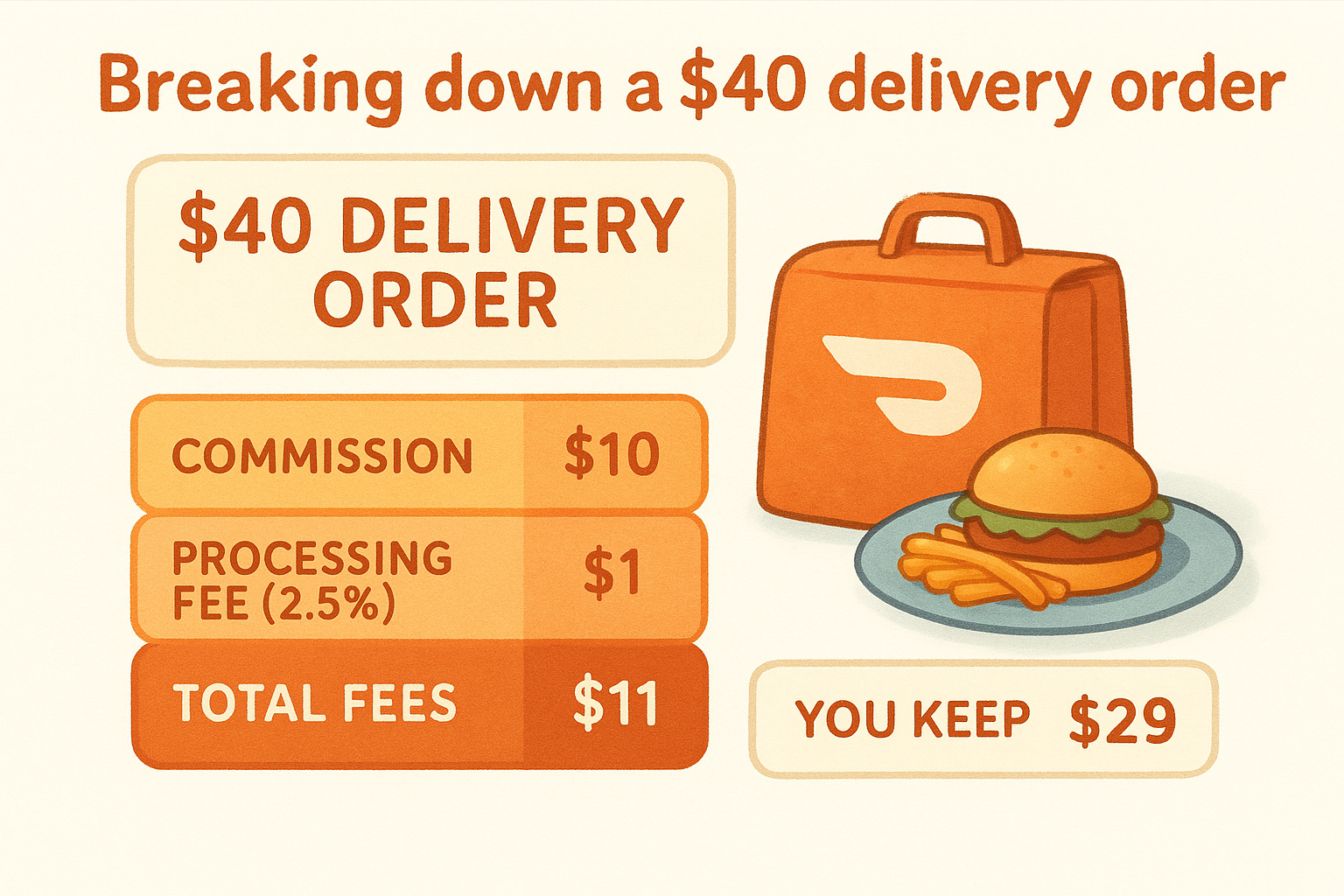
Breaking down a $40 delivery order
A $40 delivery order is a reasonable baseline for most casual dining or fast-casual restaurants. Here is what the cost breakdown looks like under each DoorDash plan, before you account for the cost of producing the food itself:
| Plan | Commission Rate | Commission Cost | Processing Fee (2.5%) | Total Fees | You Keep |
|---|---|---|---|---|---|
| Basic | 15% | $6.00 | $1.00 | $7.00 | $33.00 |
| Plus | 25% | $10.00 | $1.00 | $11.00 | $29.00 |
| Premier | 30% | $12.00 | $1.00 | $13.00 | $27.00 |
On the Premier plan, you net $27 from a $40 order before a single ingredient is accounted for. If your food cost on that order runs $14, your labor cost runs $8, and your overhead share of that ticket is $5, you have spent $27 to produce a meal that brought you exactly $27. That is a break-even transaction at best, and on a slower night with higher labor costs, it is a loss.
On a $40 Premier plan order with typical food, labor, and overhead costs, most independent restaurants break even or lose money after the DoorDash commission clears.
How costs stack up month to month
The single-order view is striking, but the monthly picture is where the damage really accumulates. Consider a restaurant doing 300 delivery orders per month at an average ticket of $40, running on the Plus plan at 25% commission:
- Gross delivery revenue: $12,000
- DoorDash commission (25%): $3,000
- Payment processing (2.5%): $300
- Tablet rental: $6
- Total platform cost: $3,306
That is over $3,300 per month leaving your business before you have paid for a single item of food, one hour of labor, or one utility bill. Across a full year, that figure reaches nearly $40,000 paid to DoorDash alone. For most independent restaurants operating at a 5% net margin, that amount represents a significant portion of what would otherwise be annual take-home profit.
How to cut DoorDash costs without losing sales
Understanding how much does DoorDash charge restaurants gives you the information you need to start reducing that cost without abandoning the platform entirely. The goal is not necessarily to quit DoorDash overnight. The goal is to reduce your dependency on it while keeping the revenue it generates flowing in a more sustainable direction.
Shift customers toward pickup
Pickup orders carry a 6% commission on all three DoorDash plans, compared to 15% to 30% for delivery. That difference is significant. If you can train a portion of your customer base to select pickup instead of delivery, your blended average commission rate drops without any change to your overall order volume. You can nudge customers toward pickup by offering a small discount for in-store collection or by promoting it directly on your receipts and packaging.
Moving just 20% of your delivery orders to pickup can cut your total DoorDash commission bill by a meaningful amount each month.
Raise your in-app menu prices
Most restaurants price their DoorDash menus higher than their in-store menus to offset the commission cost. This is standard practice and something DoorDash does not prohibit. If you are not already doing this, you are effectively subsidizing the platform out of your own margin. Review your menu pricing on the app and apply a 15% to 25% markup across your items.
Some customers will notice the price difference, but many will not, and your per-order profitability improves immediately without any reduction in volume. Pair this adjustment with a review of your lowest-margin items and consider removing any dishes that simply cannot absorb the platform fee and still generate a profit.
Build a direct ordering channel
The most effective long-term move is to route repeat customers away from DoorDash and toward a channel you own and control. A commission-free ordering system, whether through your own website or a platform like The Foody Gram, lets you capture the same order without losing 25% to 30% of the ticket to fees. You keep the customer's contact information, and you build a direct relationship that gives you real marketing leverage over time.
This approach works best when you combine it with a small incentive. Offer returning customers a discount or loyalty reward for ordering directly on your next interaction. Place that offer on your packaging, your receipts, or a simple card included with each delivery. Over several months, you shift a meaningful share of your volume to a channel that keeps far more revenue inside your business.
Bottom line
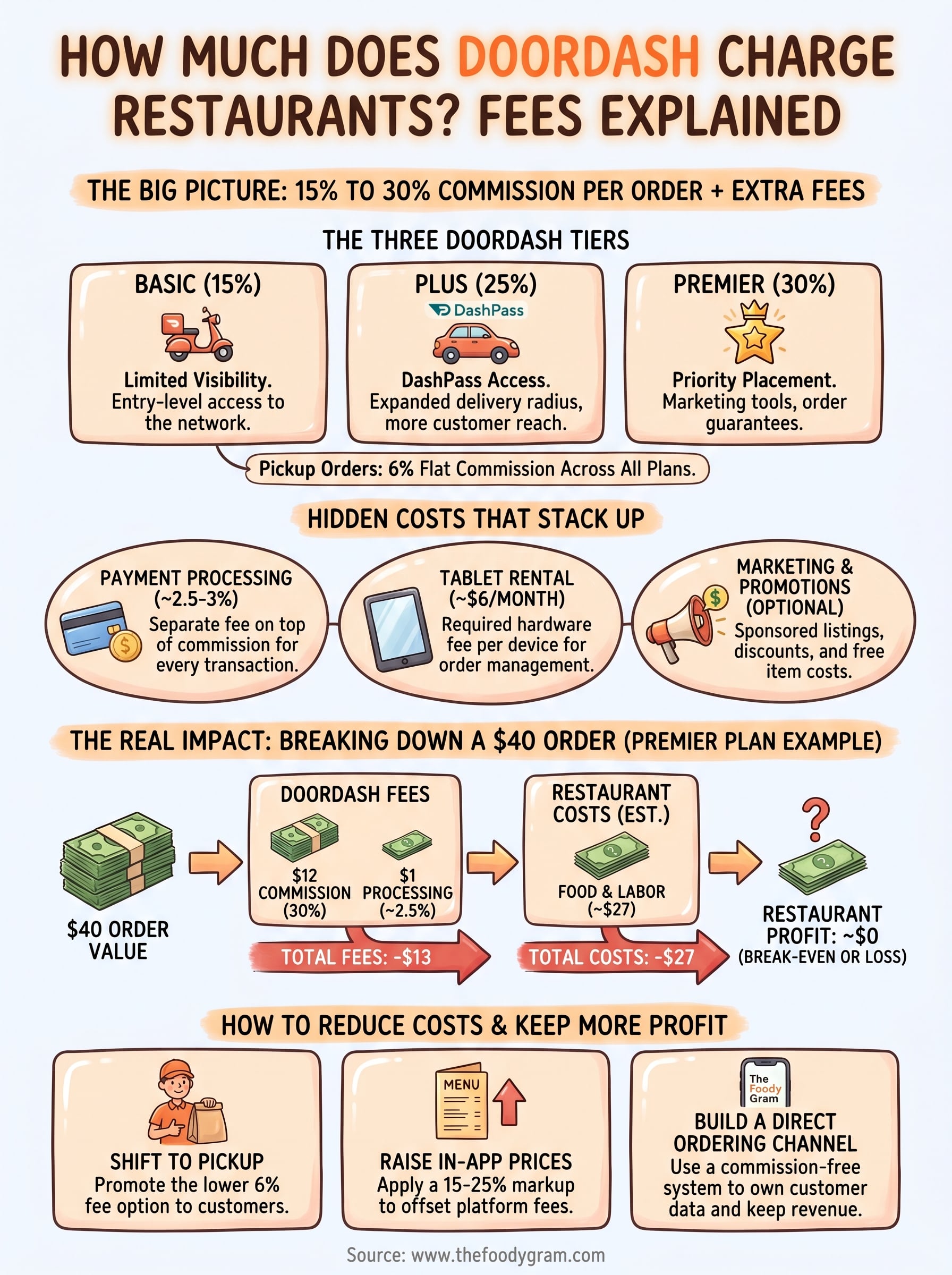
How much does DoorDash charge restaurants comes down to a simple but costly reality: between 15% and 30% commission per delivery order, plus payment processing fees, tablet rental, and optional marketing spend, most restaurants pay far more than the listed rate suggests. When you run those numbers against your actual food cost, labor, and overhead, many orders break even at best and lose money at worst.
Your best path forward is to reduce how much revenue you send through commission-based platforms and build a direct ordering channel that you own. Shifting even a portion of your loyal customers to a commission-free system puts real money back into your business every single month. If you want to see exactly what that looks like in practice, check out The Foody Gram's commission-free pricing plans and find out what you could keep instead of paying to a third-party platform.