


6 Best Restaurant Technology Services to Streamline Operations
Running a restaurant today means juggling a POS system, a kitchen display, an online ordering platform, and a handful of apps that barely talk to each other. Finding the right restaurant technology services shouldn't add another headache to your day, but with dozens of vendors making the same promises, it's hard to know which tools actually move your numbers.
This list cuts through the noise and points you toward platforms that solve real operational problems, from order management to kitchen automation to payment processing. Each one earned its spot because it either saves restaurant owners money, cuts down on order errors, or frees up staff time during a rush.
We've included options for pickup and delivery, table management, and yes, commission-free ordering systems like The Foody Gram that let you keep your customer data and your margins instead of handing 30% to a third-party app. Whether you run a single pizzeria or manage multiple locations, you'll find a tech stack here that fits your budget and your kitchen's pace.
1. The Foody Gram for commission-free online ordering
The Foody Gram builds you a branded restaurant website with direct ordering baked in, so every order goes straight to your kitchen and your bank account instead of routing through a third-party app that takes a cut. It's built specifically for owners tired of watching commission fees eat 30% off every online order, and it replaces that model with one flat monthly bill.
Pay one flat monthly fee instead of losing 30% of every order to a delivery app.
How it works
You send over your menu, logo, and branding preferences, and The Foody Gram's team designs and launches a mobile-optimized ordering site within 48 to 72 hours. Customers order directly from your site or your social pages, payments deposit straight to your account, and your kitchen gets a printed ticket the moment the order comes in. There's no app to download and no middleman logging your customer's phone number or email before you ever see it.
Who it's for
This fits independent pizzerias, casual dining spots, fast-casual counters, and ethnic restaurants that already have a loyal customer base ordering online or through delivery apps. It also works well for restaurant groups running two or three locations that want centralized menu control without hiring an in-house developer. If your technical comfort level is low and you'd rather call a support line than debug a plugin, this managed setup removes that burden entirely.
Key features
- Custom branded website with mobile optimization
- Direct deposit payment processing, no commission per order
- Pickup, delivery, pre-orders, and reservation scheduling
- Real-time order dashboard with kitchen ticket printing
- Multi-location management for growing restaurant groups
- Managed menu updates handled by the support team
- 24/7 customer support
Pricing
Standard plans run $159 to $199 per month with no setup fees, no contracts, and a 45-day money-back guarantee if it doesn't work out. There's no per-order fee and no cap on order volume, so a busy Friday night doesn't cost you more than a slow Tuesday. For restaurants processing even a modest volume of online orders, the savings versus a 30% commission model typically pay for the subscription within the first week.
2. Point-of-sale systems for order and payment management
A point-of-sale system is the backbone of your daily operations, handling everything from ringing up a table to closing out the register at night. Modern POS platforms have grown far beyond a cash drawer and receipt printer, now syncing with kitchen displays, inventory counts, and even your online ordering tool.
How it works
Staff enter orders on a tablet or terminal, the ticket routes straight to the kitchen display or printer, and the system processes payment on the same screen. Most platforms sync sales data in real time, so you can check revenue, void rates, and labor costs from your phone without walking back to the office.
Who it's for
Any restaurant with a dine-in or counter-service component needs a reliable POS system, from single-location diners to multi-unit franchise groups. Owners who want tighter control over payment reconciliation and staff accountability benefit most, since these systems log every transaction by employee.
A POS system that doesn't talk to your kitchen display is just an expensive cash register.
Key features
- Table and tab management
- Split checks and tip handling
- Integrated card and mobile payment processing
- Sales reporting and labor cost tracking
- Kitchen display or printer integration
Pricing
Expect hardware costs between $800 and $1,500 per terminal, plus monthly software fees ranging from $60 to $165 depending on features. Payment processing typically adds 2.3% to 2.9% per transaction on top of the subscription, according to guidance from the U.S. Small Business Administration.
3. Automated kitchen oil delivery and filtration systems
Frying oil management eats more staff hours than most owners realize, between hauling jugs, filtering grease, and hauling used oil back out the door. Automated oil systems pump fresh oil into your fryers and filter or remove used oil without a single employee lifting a hot, heavy jug.
How it works
A back-of-house tank connects directly to your fryer battery through sealed tubing, so fresh oil pumps in on a schedule or with the push of a button. Built-in filtration units strain out food particles between fry cycles, extending oil life, and a separate line pulls spent oil out to a storage tank for pickup instead of manual disposal.
Who it's for
High-volume fryers, think fried chicken chains, fish houses, and any kitchen running multiple fryers through a dinner rush, see the fastest payback. Kitchens burning through oil costs and worried about employee burns or slips near hot grease are the clearest candidates for this upgrade.
Cutting oil waste by even 20% often pays for the filtration hardware within a year.
Key features
- Automated fresh oil delivery to fryers
- In-line filtration extending oil lifespan
- Automated spent oil removal and storage
- Reduced burn and slip risk for kitchen staff
- Usage tracking and oil quality alerts
Pricing
Installation runs several thousand dollars upfront, often $5,000 to $15,000 depending on fryer count, plus a service contract for oil pickup and filter maintenance. Many restaurants recover the cost through reduced oil purchases and lower labor spent on manual filtering within 12 to 18 months.
4. Reservation and waitlist management software
Guests hate waiting without knowing how long, and hosts hate guessing table turns during a Friday rush. Reservation software solves both problems by putting real-time table status and guest wait estimates on one screen instead of a paper list and a walkie-talkie.
How it works
Guests book online, through your website, or via a phone call your host logs manually, and the system slots them into open tables based on party size and turn time. Walk-ins join a digital waitlist that texts them updates, so nobody's stuck hovering by the host stand. The floor plan updates live as servers seat and clear tables, giving your host accurate wait times instead of a shrug.
Who it's for
Full-service restaurants with steady weekend traffic, plus any spot that takes reservations for date nights or group dinners, get the most value here. Fine dining and busy brunch spots especially benefit, since table turn times directly affect revenue on their busiest shifts.
A digital waitlist that texts guests beats a paper list every single time.
Key features
- Online and phone reservation booking
- Digital waitlist with text notifications
- Live floor plan and table status tracking
- Guest profiles with visit history and preferences
- Automated reminder texts to cut no-shows
Pricing
Most platforms charge $100 to $400 per month per location, with some charging per-cover fees on top during high-volume months. Higher-end systems with CRM features and marketing tools push toward the top of that range.
5. Restaurant IT support and managed technology services
Every piece of tech in your building, from the POS to the kitchen display to your Wi-Fi router, breaks eventually, usually during a Saturday rush. Managed IT services give you a support line to call instead of a panicked group text to your nephew who "knows computers."
A restaurant running five different systems needs one number to call when something breaks, not five.
How it works
A managed provider monitors your network, POS, and payment terminals remotely, flagging problems before a router reboot turns into a lost dinner service. When something does fail, you call or submit a ticket, and a technician either fixes it remotely or dispatches someone on-site depending on the issue. Most providers also handle software updates and security patches overnight, so you're not troubleshooting a frozen terminal during lunch.
Who it's for
Multi-location groups juggling different POS vendors, kitchen displays, and Wi-Fi setups across sites need this most, since one outage can ripple across every location's ordering flow. Single-location owners without in-house IT staff also benefit, especially if a slow network or payment processing outage has ever cost them a night's revenue.
Key features
- 24/7 remote monitoring and helpdesk support
- On-site dispatch for hardware failures
- Network security and firmware updates
- Vendor coordination across POS, Wi-Fi, and payment systems
- Uptime reporting and outage alerts
Pricing
Managed IT contracts typically run $200 to $600 per month per location, scaling with device count and support hours guaranteed in the service agreement.
6. Loyalty and guest engagement platforms
Guests who feel forgotten don't come back, and a punch card taped to your register doesn't cut it anymore. Loyalty platforms track visits, spending, and preferences automatically, then trigger the kind of personalized offer that actually pulls someone back in on a slow Tuesday.
How it works
Customers sign up at checkout or through a QR code on the table, linking their phone number or email to every future purchase. The platform logs each visit, calculates reward points or punches automatically, and sends targeted texts or emails, a birthday discount, a "we miss you" offer after 30 days of silence. Some systems tie directly into your POS so cashiers never have to ask if someone's a member.
Who it's for
Restaurants with repeat customers and a decent email or text list get the most value, especially casual dining spots, coffee shops, and pizzerias with weekly regulars. Owners trying to build direct relationships with guests, instead of renting that relationship from a delivery app, find this especially useful.
A birthday text with a free appetizer brings someone back faster than any ad ever will.
Key features
- Points or visit-based rewards tracking
- Automated email and SMS campaigns
- POS integration for seamless sign-up
- Customer segmentation by spend or visit frequency
- Performance dashboards showing redemption rates
Pricing
Most loyalty platforms charge $50 to $300 per month, depending on your guest list size and how many automated campaigns you run. Some add per-message fees for SMS campaigns once you exceed a monthly text allotment.
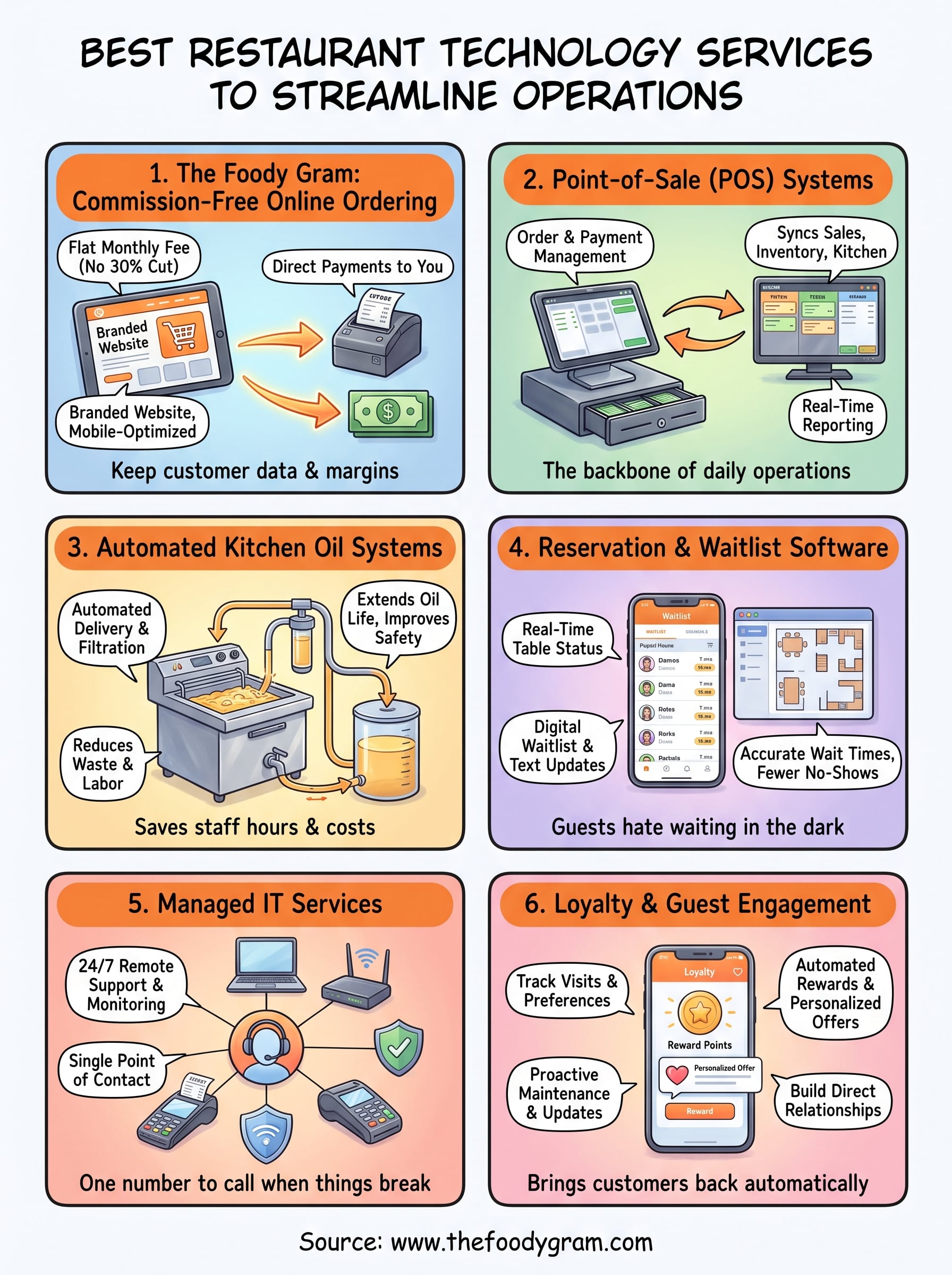
Building the right tech stack for your restaurant
You don't need all six of these tools on day one. Start with the piece that fixes your biggest pain point, whether that's a POS system that's crashing during dinner rush or a delivery app quietly draining 30% off every order, then build outward from there. Most successful owners layer tools gradually: ordering and payments first, then reservations, then loyalty, then whatever back-of-house automation pays for itself fastest.
If commission fees are the wound that's bleeding your margins right now, that's the one to close first. Online ordering built around a flat monthly fee instead of a per-order cut puts real money back in your pocket every week, not just on paper. Compare that math against what you're currently paying third-party apps, and the decision usually makes itself. Check out our pricing to see exactly what a commission-free setup would cost your restaurant and how fast it pays for itself.