


7 Proven Ways on How to Increase Restaurant Sales Fast
Restaurant revenue doesn't just dip overnight. It erodes slowly, a few fewer covers here, a drop in average ticket there, until one day, you're staring at numbers that don't add up. If you've been searching for how to increase restaurant sales, you're already doing the right thing: looking for solutions before the problem gets worse. The good news? Most sales leaks are fixable, and they don't require a complete overhaul of your operation.
The strategies that actually move the needle aren't complicated, but they do require intention. Things like reclaiming revenue lost to third-party commissions, building a direct line to your customers, and making it ridiculously easy for people to order from you. Some are operational tweaks. Others are marketing plays. All of them compound over time when you commit to execution.
That's exactly what we help restaurants do at The Foody Gram. Our commission-free online ordering platform gives you a branded website with direct ordering, so every dollar your customers spend goes to you, not a middleman charging 30% per order. We've seen firsthand what works for independent restaurants and multi-location groups across the country, and we've distilled it into this guide.
Below, you'll find seven proven strategies to boost your restaurant's revenue starting this week. No theory, no fluff, just actionable steps you can put to work immediately. Let's get into it.
1. Sell direct with commission-free online ordering
Third-party delivery apps are convenient for customers but costly for you. Uber Eats, DoorDash, and similar platforms charge 15-30% per order, which means you're giving away a significant chunk of revenue before the food even leaves the kitchen. When you think about how to increase restaurant sales, the first move is often not to sell more, but to stop losing what you already earn.
What this solves and why it lifts sales fast
Every order you process through a third-party app shrinks your margin before you cook a single dish. Switching even 30-40% of those orders to a direct channel can meaningfully shift your bottom line. If you average $5,000 in monthly third-party sales, recovering 25% in fees puts an extra $1,250 back in your pocket each month, with no increase in volume required.
Commission fees are not a fixed cost of doing business. They are a choice, and switching to direct ordering turns that choice into profit.
How to set it up on your website and social channels
You need a mobile-optimized website with an embedded ordering button that customers can find and use in under 30 seconds. Add your direct ordering link to your Instagram bio, Facebook page, and Google Business Profile. Platforms like The Foody Gram handle the entire setup, including menu uploads and branded design, so you're live in 48-72 hours without writing any code.
How to reduce third-party app dependence without losing volume
Don't cut apps off cold. Instead, redirect your regulars first by promoting your direct link through receipts, packaging inserts, and social posts. Offer a small incentive, like a free drink or a discount on a first direct order, to shift the habit. Once your loyal customers move over, you can scale back your third-party presence without a meaningful drop in total order volume.
Numbers to watch so you know it works
Track direct order revenue as a percentage of total online sales each week. Also watch your average order value on direct versus app orders, since direct tends to run higher. Set a target of 50% of online orders coming directly within 90 days and use that as your starting benchmark.
2. Win more local searches with Google and SEO
Most restaurant customers search online before they order or walk in. If your restaurant doesn't show up in those results, you're losing sales to competitors who do. Local search visibility and a well-optimized Google presence are two of the fastest ways to drive more revenue without spending money on ads.
Fix your Google Business Profile to drive calls and orders
Your Google Business Profile is often the first thing a customer sees when they search for food nearby. Keep your hours, address, phone number, and menu link current. Add food photos regularly, respond to reviews, and enable the ordering button that links directly to your website.
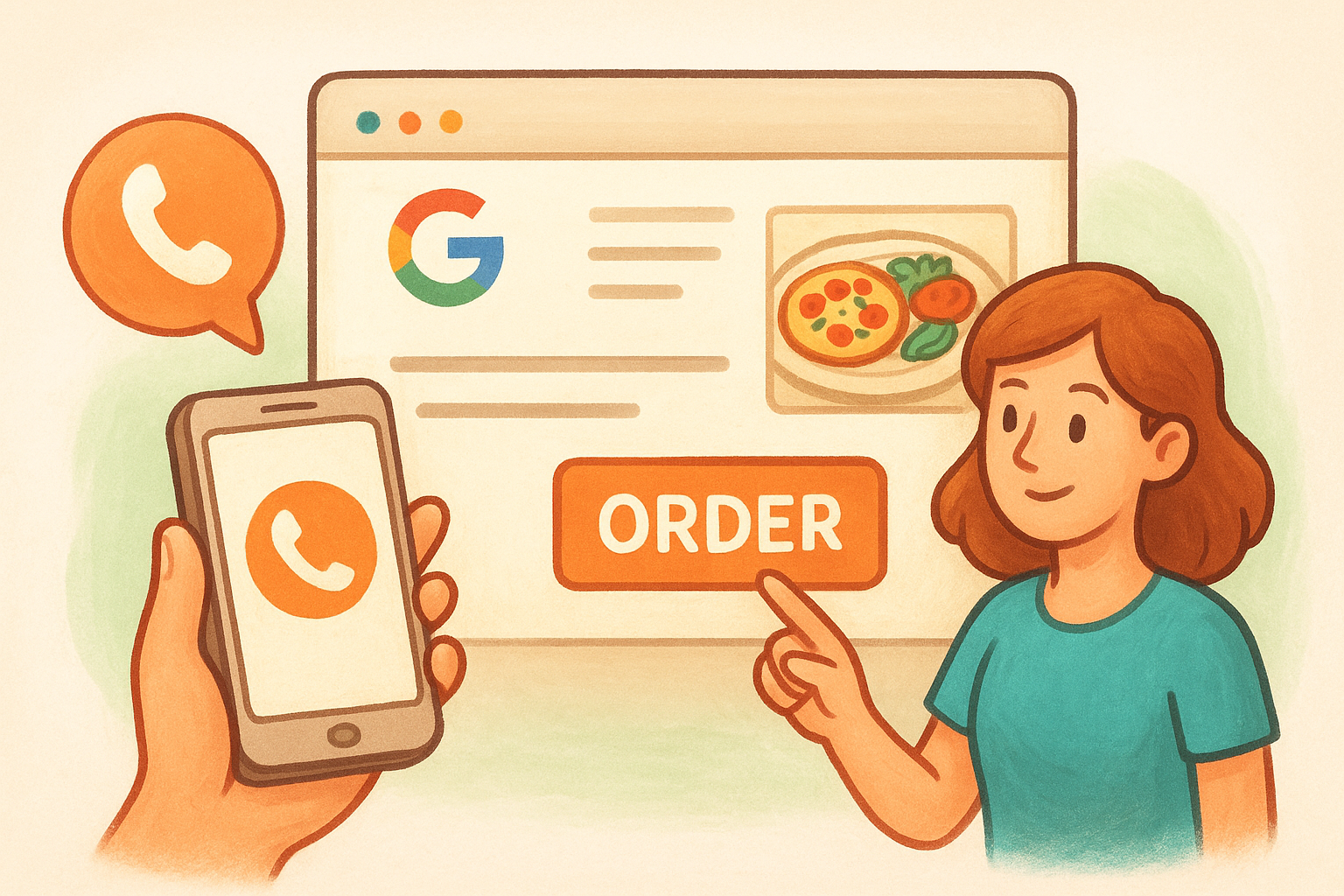
A complete and active Google Business Profile can significantly increase the number of customers who call, visit, or place orders directly with you.
Build local SEO pages that capture "near me" searches
Create dedicated landing pages on your website for your cuisine type and city, such as "best pizza in [your city]." Use your city and neighborhood names naturally throughout your content. This is one of the more overlooked answers to how to increase restaurant sales because it brings consistent, free traffic without ongoing ad spend.
Turn website traffic into orders with clear paths to purchase
Every page on your site should make it easy for visitors to place an order or make a reservation within two clicks. Put your ordering button above the fold on every page and confirm your site loads fast on mobile.
Numbers to watch for local visibility and conversions
Track Google Business Profile views, click-to-call actions, and website clicks monthly. Also monitor your order conversion rate, meaning how many site visitors actually complete an order, and work to improve it each month.
3. Engineer your menu for profit and speed
Your menu is a sales tool, and most restaurants underuse it. Knowing which items make you the most money and which ones slow down your kitchen helps you make smarter decisions about what to push, what to cut, and what to price differently. This is one of the most direct ways to think about how to increase restaurant sales without adding a single new customer.
Find your best sellers and best margins
Pull your sales data and sort items by volume and profit margin. Items that sell often and carry strong margins are your stars. Items that sell poorly and cost a lot to make are candidates for removal. Focus your menu energy on the top 20% of items that drive 80% of your profit, and stop giving equal real estate to everything else.
Reprice and resize portions without upsetting regulars
Small price adjustments on high-demand items rarely push customers away. A $1-2 increase on your top sellers often goes unnoticed, especially if you frame it around a quality improvement or portion update. Test one or two changes at a time so you can measure the impact without disrupting your whole menu.
Portion right-sizing on low-margin dishes can recover hundreds of dollars per week in food cost without changing your prices at all.
Create bundles and family meals that raise average tickets
Bundle deals and family meal packages give customers a convenient choice while naturally increasing the order total. Pair a popular main with high-margin sides and a drink, then price the bundle to feel like a deal while protecting your margin.
Numbers to watch for mix, margin, and throughput
Track your food cost percentage weekly and review your item-level sales mix monthly. Watch for shifts in your average ticket size after any menu or pricing change to confirm it moved in the right direction.
4. Raise average ticket with upsells and add-ons
Upselling is one of the simplest answers to how to increase restaurant sales because it works on customers you already have, without spending a dollar on acquisition. Raising your average ticket by even $2-3 per order across hundreds of weekly transactions adds up to real money by the end of the month.
Train staff to sell without sounding pushy
The difference between a pushy upsell and a helpful one comes down to specificity and timing. Train your team to recommend one or two relevant additions rather than asking a generic "do you want anything else?" Customers respond better when a suggestion feels personal and connected to what they already ordered.
The best upsell doesn't feel like a sales pitch. It feels like a recommendation from someone who knows the menu well.
Add high-margin modifiers to dine-in and online ordering
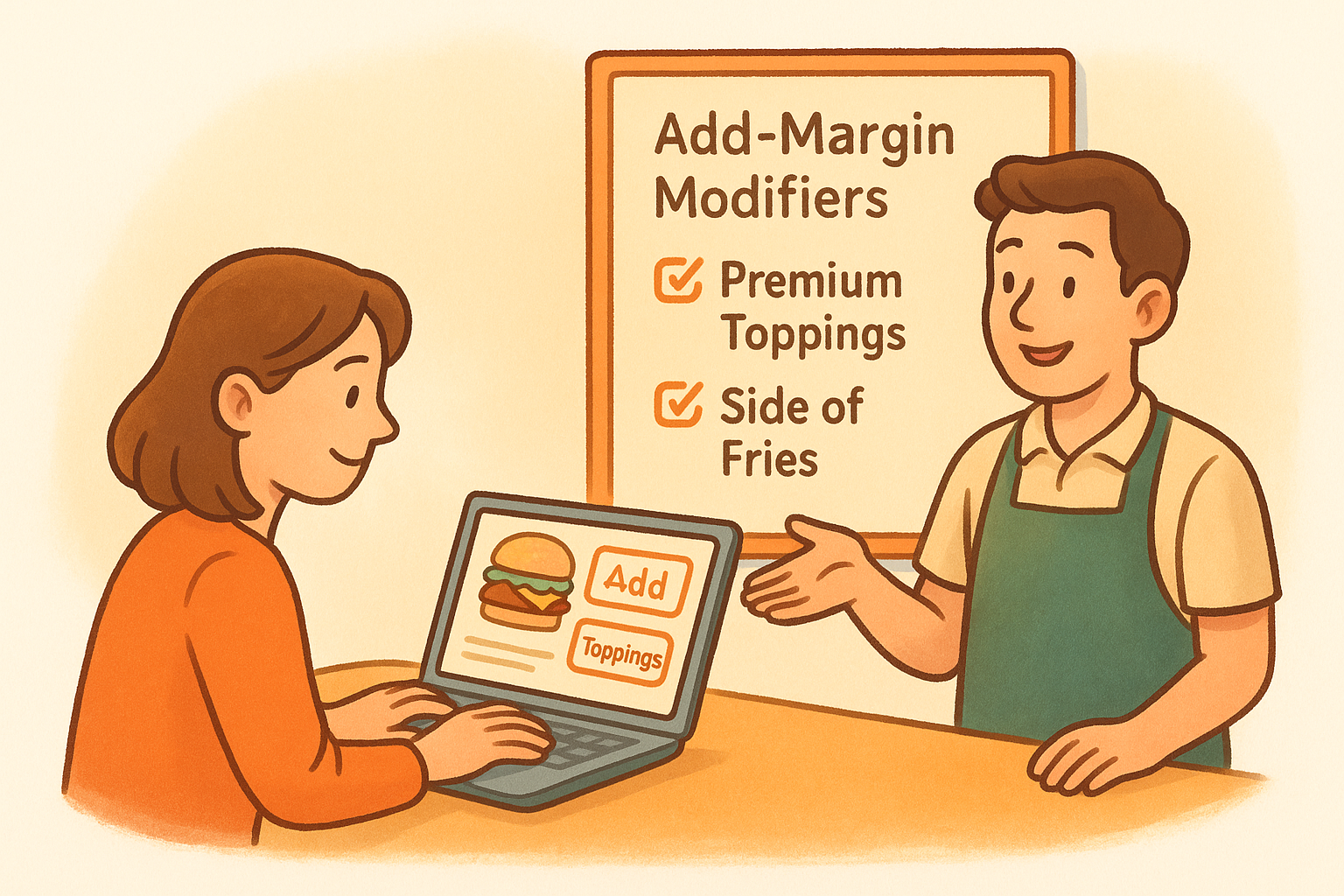
Your online ordering system should include modifier options on every item, such as premium toppings, sauce upgrades, or add-on sides. These small choices carry strong margins and require no extra labor to sell. Build them into the ordering flow so customers see them automatically.
Use simple scripts that improve check size at the register
Give your staff two or three go-to phrases for common upsell moments, like pairing a side with an entree or suggesting a dessert. Keep each script short and conversational so it sounds natural, not rehearsed.
Numbers to watch for average order value and attachment rate
Track your average order value weekly and measure your add-on attachment rate, meaning how often an order includes at least one modifier or upsell item. Set a monthly target and adjust your scripts based on what moves the number.
5. Bring customers back with owned marketing
Acquiring a new customer costs significantly more than keeping an existing one. One of the most underused answers to how to increase restaurant sales is building a direct line to customers you've already served, so you can bring them back without paying for ads every single time.
Collect customer data the right way at checkout
Every order is an opportunity to capture a customer's name, phone number, and email address. Build this into your checkout flow, whether online or in-person, and keep the ask simple. Direct ordering platforms like The Foody Gram collect this data automatically at checkout, giving you a list you actually own rather than one controlled by a third-party app.
Run SMS and email that drive repeat orders this week
Once you have customer contact information, use it consistently. A short SMS with a limited-time offer or a weekly email featuring a menu highlight gives customers a direct reason to order again.
Your customer list is one of the most valuable assets your restaurant owns, and most restaurants never activate it.
Text messages convert especially well for restaurants because most people read them within minutes of receiving them.
Use the 4 Ps to plan promos that do not wreck margins
Keep promotions grounded in price, product, place, and promotion so each campaign has a clear purpose and a defined end date. Discount only high-margin items so every promo drives revenue without destroying your food cost.
Numbers to watch for repeat rate and revenue per customer
Track repeat customer rate monthly and measure revenue per customer over 90 days. These two numbers tell you whether your marketing is building real loyalty or just producing one-time orders.
6. Fill slow hours with smarter offers and events
Slow periods drain your labor efficiency without reducing your fixed costs. Learning how to increase restaurant sales during off-peak hours is one of the highest-leverage moves available, because you're adding revenue against a cost base that's already running.
Pick the right dayparts to target so promos stay profitable
Pull your sales data by hour and day to identify your three slowest windows. Target those specific dayparts rather than running blanket discounts. Promotions tied to underperforming hours protect your peak-period margins while putting idle kitchen capacity to work.
Use limited-time offers, pre-orders, and reservations to smooth demand
Limited-time offers with a hard end date create urgency that open-ended discounts don't. Pre-orders and reservations let you staff and prep with precision, which cuts waste and overtime costs.
Pre-orders give you demand visibility before the shift starts, so you can schedule correctly and avoid both over-staffing and last-minute scrambles.
Use these tools to pull customers into slow windows rather than discounting across every daypart indiscriminately.
Add catering and large orders as a separate sales channel
Catering and group orders bring larger ticket sizes without proportional labor increases. Promote this option to local businesses, schools, and community organizations through a dedicated page on your ordering website and direct outreach to nearby offices and event coordinators.
Numbers to watch for capacity, labor efficiency, and promo ROI
Track revenue per labor hour during targeted dayparts and compare promo periods against your baseline weeks. Also monitor your promo redemption rate to confirm your offers convert without cutting into margins.
7. Tighten operations to protect sales you already earned
When you're focused on how to increase restaurant sales, it's easy to overlook the revenue already slipping through cracks in your operation. Lost orders, wrong items, and slow ticket times cost you real money and damage the customer relationships you worked hard to build.
Fix the top causes of lost orders and bad reviews
Most lost revenue traces back to a short list of repeatable mistakes: wrong orders, missing items, and long wait times that push one-time customers to leave bad reviews and never return. Audit your refund requests and negative reviews over the past 30 days to identify patterns, then address the top two or three causes directly before they compound.
One bad experience shared publicly can cost you far more than the refund itself.
Speed up kitchen flow and order accuracy across channels
Clear ticket sequencing and labeled station responsibilities reduce errors and keep your kitchen moving at peak hours. When dine-in, pickup, and delivery orders all feed into the same preparation flow without clear prioritization, accuracy drops. Set channel-specific protocols so every order type has a defined path from receipt to handoff.
Make delivery and pickup reliable with clear zones and timing
Set realistic prep time estimates in your ordering system and update them during busy periods. Define clear pickup zones so customers and drivers aren't waiting at the wrong door. Consistent handoff experiences turn first-time orders into repeat business.
Numbers to watch for refunds, wait times, and order errors
Track your refund rate and average ticket fulfillment time weekly. Also log order error frequency by channel so you can see whether dine-in, pickup, or delivery is your biggest accuracy problem and fix it first.
Next steps
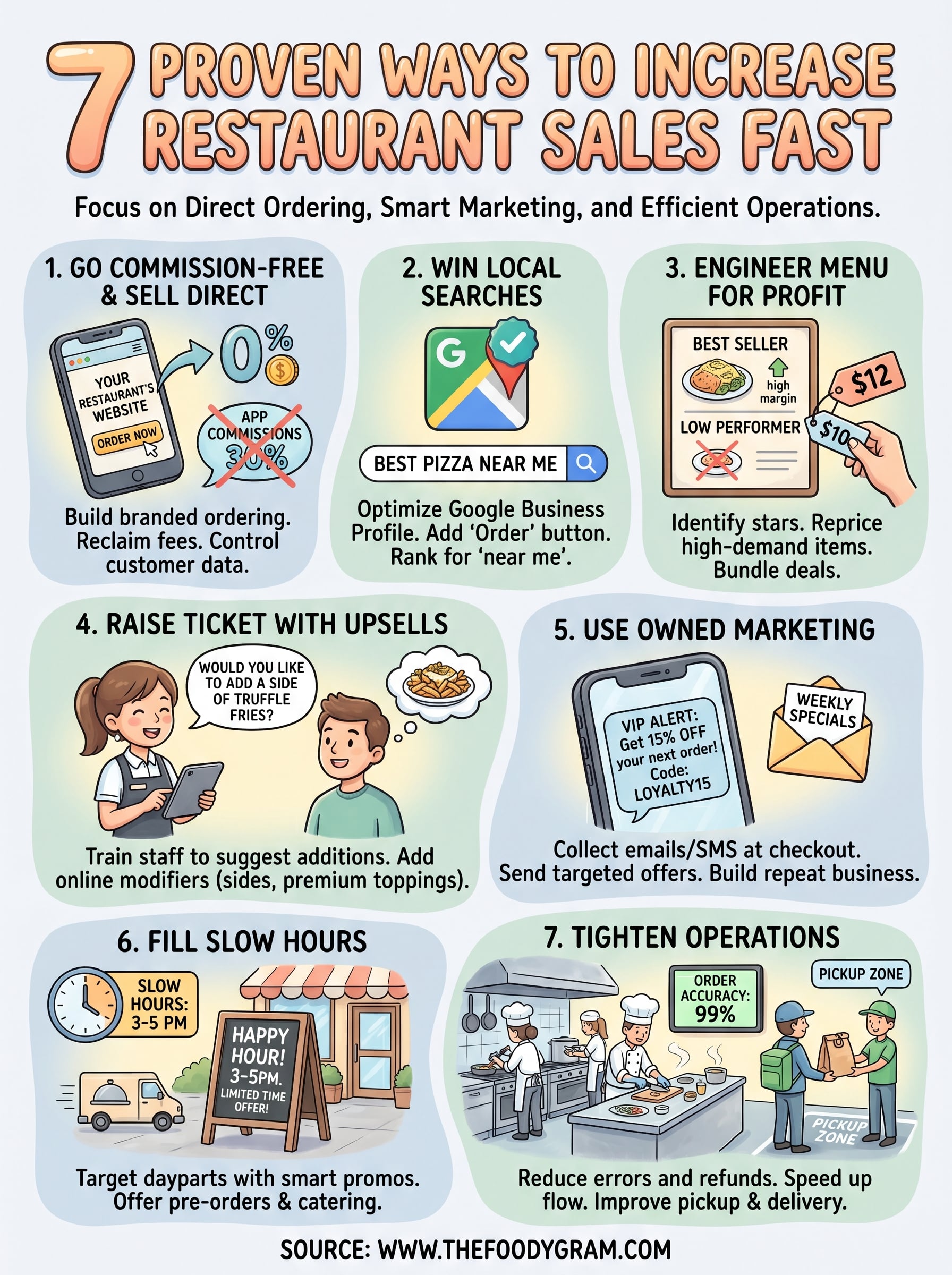
Every strategy in this guide answers the same question: how to increase restaurant sales in a way that's sustainable and doesn't require you to work twice as hard for the same result. The biggest wins come from stopping revenue leaks first, specifically the commissions you're handing to third-party apps on every single order, then layering in the marketing and operational improvements that compound over time.
You don't need to implement all seven strategies at once. Start with direct online ordering since it pays for itself immediately, then work through the list as your capacity allows. The restaurants that grow consistently are the ones that take one focused action at a time and measure what changes.
If you're ready to stop paying commissions and start owning your customer relationships, see what The Foody Gram's commission-free ordering plans include and pick the tier that fits your operation.