


Best Camera For Food Photography: 11 Picks For Any Budget
Great food photos sell more meals, it's that simple. Whether you're shooting dishes for your restaurant's online menu, building a food blog, or growing your social media presence, the right camera makes a noticeable difference. A smartphone can only take you so far before lighting limitations and image quality hold you back. That's where investing in the best camera for food photography becomes a smart move that pays for itself through better engagement and more orders.
At The Foody Gram, we build branded restaurant websites with commission-free online ordering, and we see firsthand how high-quality food images boost conversion rates on those platforms. Restaurants that invest in strong visuals consistently outperform those relying on quick phone snapshots. Your menu photos are often the first impression a hungry customer gets, they need to look the part.
This guide breaks down 11 cameras across every budget, from affordable entry-level options under $500 to professional-grade bodies built for commercial work. We cover specs, pros, cons, and real-world performance so you can pick the right tool without overspending or underbuying.
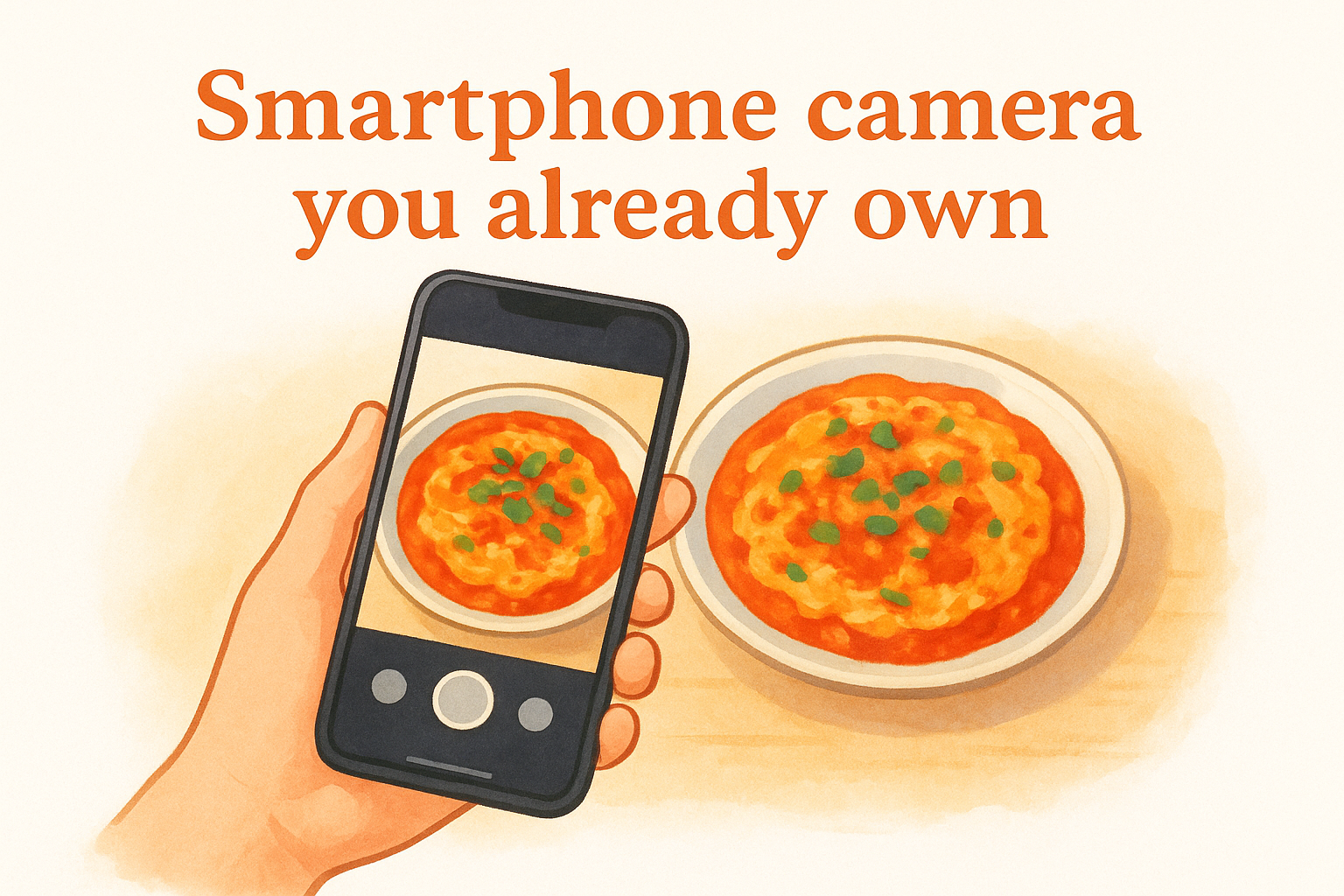
1. Smartphone camera you already own
Before spending a dollar on new gear, check what's already in your pocket. Modern flagship smartphones from Apple, Google, and Samsung now shoot 48MP to 200MP images with computational photography that can rival entry-level mirrorless cameras in good light. If you're just starting out with food photography, your current phone may be enough to produce menu-worthy shots without any upfront investment.
What it does well for food photography
Smartphones shine in a few specific situations. Overhead flat-lay shots are where phone cameras genuinely excel, since shooting straight down from arm's length keeps the subject in sharp focus without needing extra equipment. Most recent flagships also include a dedicated macro or portrait mode that creates a shallow depth-of-field effect, blurring the background and drawing attention to the dish.
Natural window light combined with a clean background is the single biggest upgrade you can make to smartphone food photos, no new camera required.
Built-in processing on phones like the iPhone 16 Pro, Google Pixel 9 Pro, and Samsung Galaxy S25 Ultra handles noise reduction and color balancing automatically, which means less editing time after the shoot. These devices also connect instantly to social platforms, making it easy to post directly without transferring large RAW files.
Who it suits best
When most people first ask what the best camera for food photography is, they overlook what they already own. A smartphone works best if you fall into one of these categories:
- Restaurant owners who need quick, consistent menu photos without hiring a photographer
- Food bloggers in the early stages of building an audience across Instagram or TikTok
- Anyone shooting daily specials or seasonal updates where speed matters more than technical precision
- Creators who post primarily to mobile-first platforms where ultra-high resolution is unnecessary
Typical price range
You're likely already paying for a phone, so the effective cost for food photography purposes is zero additional dollars if you own a flagship model from the past two or three years. If you want to upgrade specifically for better camera performance, flagship smartphones range from $800 to $1,300 new, with older flagship models available refurbished for $400 to $600.
| Option | Approximate cost |
|---|---|
| Phone you already own | $0 additional |
| Refurbished flagship | $400 to $600 |
| New flagship | $800 to $1,300 |
2. Canon EOS R50
The Canon EOS R50 is one of the most beginner-friendly mirrorless cameras available today and a strong contender for the best camera for food photography at an entry-level price. It packs a 24.2MP APS-C sensor with Canon's Dual Pixel CMOS AF, giving you fast, accurate autofocus that locks onto dishes reliably even when you reposition plates between shots.
What it does well for food photography
Canon's color science consistently renders warm food tones in bread, sauces, and proteins in a way that looks natural rather than oversaturated, and the R50 benefits directly from that reputation. You get sharp, detailed images in both natural window light and artificial restaurant lighting without heavy manual adjustment between each frame.
Canon's JPEG output on the R50 is reliable enough that many food photographers skip heavy post-processing and shoot straight to finished images ready for a menu or social post.
The fully articulating touchscreen lets you frame overhead flat-lays or low-angle close-ups without awkward contortions, and the compact body stays comfortable during extended handheld sessions when you're cycling through multiple dishes.
Who it suits best
The R50 is a practical fit for restaurant owners and beginner food bloggers who want a meaningful upgrade from a smartphone without facing a steep learning curve. It performs best for still food photography rather than fast-paced video work, making it a solid everyday tool for menu shoots and weekly content creation.
Typical price range
The R50 body sells for approximately $630 to $700 new. Kit packages that include an 18-45mm lens typically land between $750 and $800, giving you a capable starting lens that covers most standard food photography distances right out of the box.
3. Sony ZV-E10 II
The Sony ZV-E10 II is Sony's latest APS-C mirrorless camera aimed squarely at content creators, and it earns a spot on this list of the best camera for food photography for good reason. It packs a 26.1MP sensor with Sony's fast hybrid autofocus into a compact, lightweight body that you can bring into a small kitchen or tight restaurant setup without any hassle.
What it does well for food photography
The ZV-E10 II handles color accuracy and skin-tone rendering with the same quality Sony's full-frame lineup is known for, which translates directly into rich, appetizing food tones that look natural in both RAW files and processed JPEGs. The wide dynamic range preserves highlight detail in bright sauces and texture in dark proteins, reducing the amount of editing you need to do afterward.
Sony's Creative Look modes let you dial in a specific color tone for your brand before you shoot, cutting post-processing time significantly.
A fully articulating LCD screen makes it easy to frame low-angle shots of layered burgers or tall drinks without guessing what the camera sees, and the compact Sony E-mount lens ecosystem gives you affordable prime and macro lens options that work perfectly for close-up dish photography.
Who it suits best
The ZV-E10 II fits food bloggers and restaurant content creators who prioritize both photo and video output. It's an especially good match if you already own Sony E-mount lenses and want a lighter, more affordable body without sacrificing image quality.
Typical price range
The ZV-E10 II body sells for approximately $700 to $750 new. Kit versions bundled with a 16-50mm lens typically run $800 to $850.
4. Nikon Z50 II
The Nikon Z50 II is a 24.5MP APS-C mirrorless camera that brings Nikon's decades of optical engineering into a compact, accessible body. It sits comfortably in the mid-range category and earns consideration as one of the best camera for food photography options if you want reliable image quality with a straightforward shooting experience.
What it does well for food photography
Nikon's color rendering has always leaned toward accurate, natural tones, and the Z50 II continues that tradition. Food images come out with realistic texture detail in crusts, sauces, and garnishes without the oversaturated look that some competing sensors produce. The improved autofocus system over the original Z50 tracks subjects quickly, which matters when you're repositioning plates mid-session and need the camera to reacquire focus without hunting.
The Z50 II's tilting touchscreen covers most shooting angles you'll need for food photography, including overhead flat-lays and low table-level perspectives.
The Nikon Z lens ecosystem gives you access to sharp, compact prime lenses that pair well with this body for close-up dish work.
Who it suits best
The Z50 II suits restaurant owners and food content creators who prefer a no-fuss camera that delivers consistent results without requiring advanced technical knowledge. It's also a strong fit for anyone already invested in Nikon glass who wants a capable second body.
Typical price range
The Z50 II body sells for approximately $900 to $950 new. Kit bundles that include a 16-50mm Z-mount lens typically run between $1,000 and $1,050, covering standard food photography focal lengths from the start.
5. Fujifilm X-S20
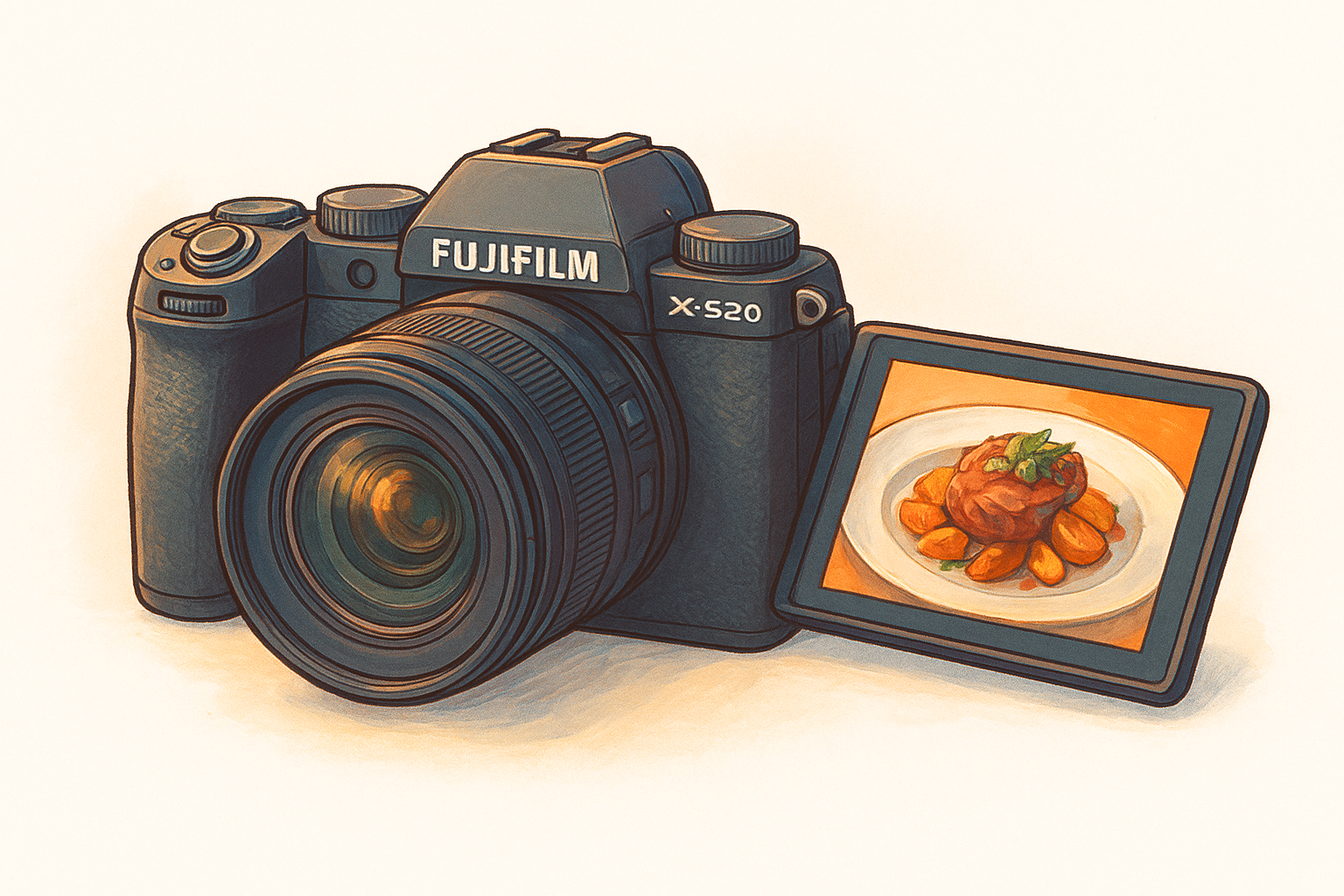
The Fujifilm X-S20 pairs a 26.3MP APS-C sensor with Fujifilm's legendary color science in a body that handles both photo and video work without compromise. If you're searching for the best camera for food photography that delivers striking color out of the camera with minimal editing, the X-S20 makes a compelling case at its price point.
What it does well for food photography
Fujifilm's film simulation modes are the defining feature here. Velvia deepens reds and yellows to make spicy dishes and roasted vegetables pop, while Classic Chrome adds a muted, editorial tone that works well for rustic or artisan food content. You can lock in a simulation that matches your brand identity and shoot consistently across every session without spending extra time in post-production.
Selecting a single film simulation and sticking with it across all your menu photos creates a cohesive visual identity that customers recognize immediately.
The fully articulating touchscreen and in-body image stabilization give you flexibility to shoot handheld in dimly lit restaurant environments without introducing blur, which matters when natural light isn't an option.
Who it suits best
The X-S20 fits food bloggers and restaurant content creators who want a distinctive visual style baked into their workflow from the start. It's especially well suited if you shoot both photo and video content regularly and want one camera that handles both without significant trade-offs.
Typical price range
The X-S20 body sells for approximately $1,299 new. Kit bundles that include a 15-45mm XC lens typically run between $1,399 and $1,449, giving you a practical starting focal range for food work right away.
6. Fujifilm X-T5
The Fujifilm X-T5 is the highest-resolution APS-C camera Fujifilm makes, built around a 40.2MP sensor that captures extraordinary detail in every dish you photograph. If you want the best camera for food photography within Fujifilm's lineup and you prioritize still image quality above all else, the X-T5 delivers results that hold up at large print sizes and heavy cropping without losing sharpness.
What it does well for food photography
The X-T5 gives you the same film simulation modes that make the X-S20 so appealing, but pairs them with significantly more resolving power. At 40.2MP, you can crop tightly into a macro shot of a garnish or sauce drizzle and still have enough resolution left for a full-size menu banner or editorial spread. The seven-stop in-body image stabilization lets you shoot handheld in low-light restaurant settings without adding blur, which saves you from setting up a tripod between every dish.
The X-T5's resolution advantage means one well-composed shot can be cropped multiple ways, giving you both a wide hero image and a close-up detail from a single frame.
Who it suits best
The X-T5 fits food photographers and bloggers who shoot primarily stills and want the absolute best image quality from an APS-C body. It works best if you already own Fujifilm X-mount lenses or plan to invest in the ecosystem long-term.
Typical price range
The X-T5 body sells for approximately $1,699 new. No standard kit bundle is available, so budget an additional $300 to $500 for a quality prime or macro lens to complete your food photography setup.
7. Sony a7 IV
The Sony a7 IV is a 33MP full-frame mirrorless camera that marks Sony's entry into the professional tier without the price tag of their higher-end bodies. It gives you significantly more resolving power and low-light capability than any APS-C option on this list, making it a strong contender for the best camera for food photography when you're ready to invest in full-frame performance.
What it does well for food photography
The a7 IV's full-frame sensor captures more light per pixel than APS-C alternatives, which shows immediately in how it handles low-light restaurant environments. Shadows in a dimly lit dining room stay clean and detailed rather than turning grainy, and the wide dynamic range preserves bright highlight details in glossy sauces and reflective dishware without clipping.
Sony's Real-time tracking autofocus locks onto a dish accurately and holds focus even as you shift your shooting angle between frames.
The 33MP resolution gives you enough detail for commercial food photography, including large-format menu prints and editorial work, without requiring a 50MP body that produces enormous file sizes.
Who it suits best
The a7 IV fits professional food photographers and serious content creators who shoot in varied lighting conditions and need reliable full-frame performance across both photos and video. It suits you best if you're already working with Sony FE lenses and want a versatile body that handles any assignment you take on.
Typical price range
The a7 IV body sells for approximately $2,498 new, making it the first full-frame investment on this list.
| Option | Approximate cost |
|---|---|
| Body only | ~$2,498 |
| + Macro or prime lens | $500 to $900 |
8. Nikon Z6 III
The Nikon Z6 III is a 36.1MP full-frame mirrorless camera built around a partially stacked CMOS sensor, a design Nikon hasn't offered before at this price point. That architecture delivers faster readout speeds and noticeably better low-light performance than the Z6 II it replaces, making it a strong contender for the best camera for food photography at the professional full-frame tier.
What it does well for food photography
The Z6 III resolves fine texture detail across food surfaces, from the crust on a sourdough loaf to the glaze on a roasted duck, with exceptional clarity. Nikon's color rendering stays neutral and accurate, giving you clean files that you can push toward warmer or cooler tones in post-production without fighting the camera's built-in processing.
Accurate color at the capture stage means less time correcting food tones in editing and more time refining your composition.
Shooting handheld in dim restaurant environments stays sharp thanks to six-stop in-body image stabilization, which cuts motion blur without requiring a tripod between dishes. The partially stacked sensor's faster readout also delivers sharper handheld results than you'd expect from comparable full-frame bodies at this price.
Who it suits best
The Z6 III works best for professional food photographers and advanced content creators who need a full-frame body that handles both stills and video without compromise. It suits you well in these specific situations:
- Commercial food photography for restaurant brands, editorial clients, or advertising campaigns
- Projects that require both photos and video in the same session without switching camera systems
- Existing Nikon Z-mount users who are ready to step up from an APS-C body
Typical price range
The Z6 III body sells for approximately $2,499 new. Budget an additional $400 to $800 for a quality prime or macro lens to complete your food photography kit.
| Configuration | Approximate cost |
|---|---|
| Body only | ~$2,499 |
| + Prime or macro lens | $400 to $800 |
9. Canon EOS R6 Mark III
The Canon EOS R6 Mark III is a full-frame mirrorless camera that refines everything Canon built into the R6 Mark II, with improved sensor performance, faster autofocus, and better stabilization across the board. It sits comfortably in the professional tier without pushing into the bulk and price of Canon's R5 line, making it a practical full-frame option for serious food photography work.
What it does well for food photography
Canon's color science produces warm, accurate food tones that render naturally in JPEGs and RAW files alike, with particular strength in the yellows, oranges, and deep reds that show up in roasted proteins, baked goods, and rich sauces. The Dual Pixel CMOS AF reacquires focus quickly when you reframe between dishes, so you spend less time hunting for sharpness and more time composing.
Canon's in-camera JPEG output is polished enough that many food photographers use it directly for social posts and menu content without additional editing.
Who it suits best
The R6 Mark III is a strong fit for the best camera for food photography at the professional level if you fall into one of these situations:
- Professional food photographers who shoot on assignment for restaurant brands or editorial clients
- Creators running both photo and video in the same session without switching systems
- Existing Canon RF lens users ready to move from APS-C to a full-frame body
Typical price range
The R6 Mark III body sells for approximately $2,699 new. Plan to add an additional $400 to $700 for a quality RF prime or macro lens to build a complete food photography kit.
| Configuration | Approximate cost |
|---|---|
| Body only | ~$2,699 |
| + RF prime or macro lens | $400 to $700 |
10. Sony a7R V
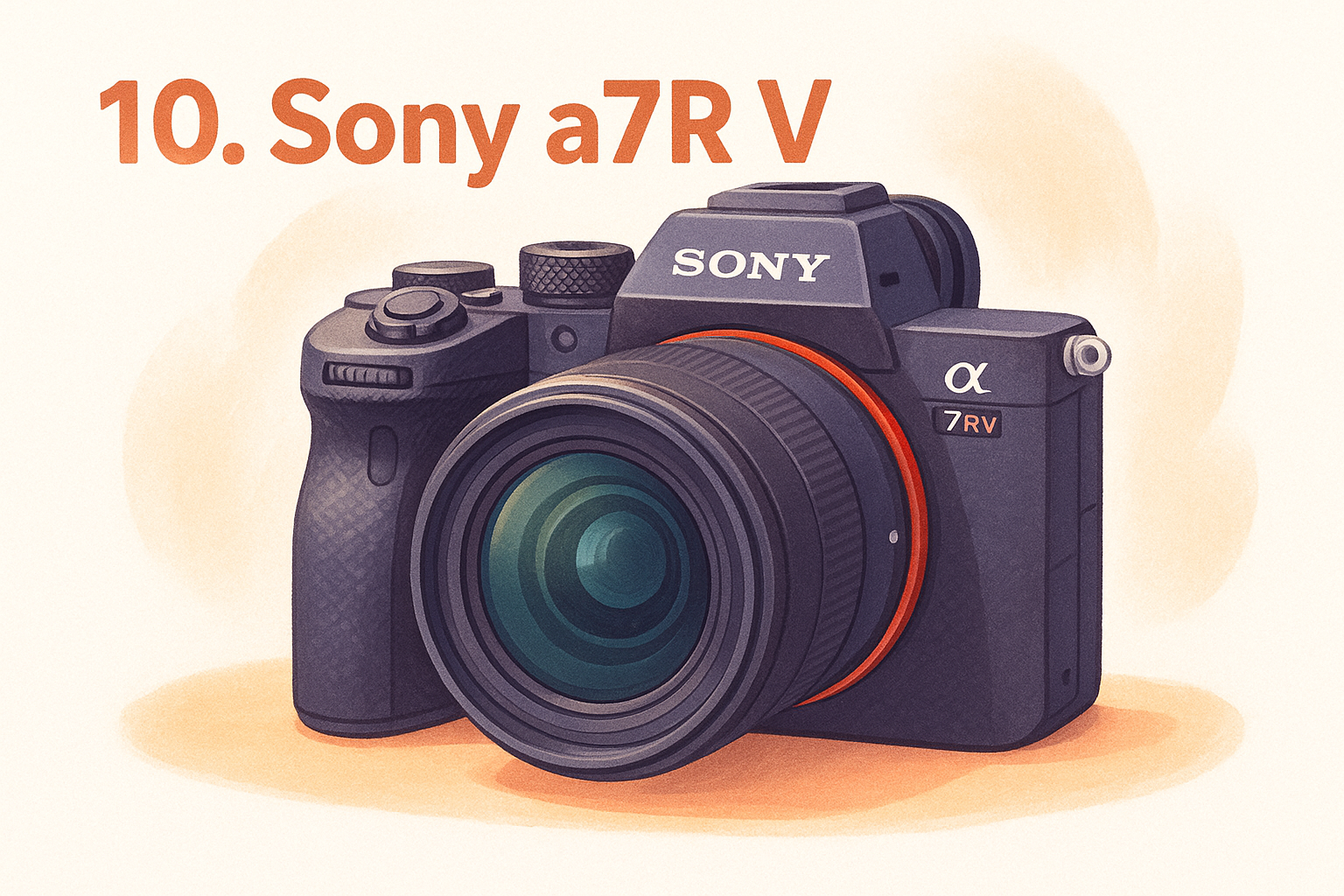
The Sony a7R V is built around a 61MP full-frame BSI-CMOS sensor, making it the highest-resolution camera on this list and one of the most capable tools available for professional food photography. When you need to capture every grain of salt on a pretzel crust or every thread of pulled pork in perfect detail, this body gives you resolution that no APS-C or standard full-frame camera can match.
What it does well for food photography
At 61MP, the a7R V delivers extraordinary detail that holds up at any output size, from a full-screen website banner to a large-format printed menu displayed in a restaurant lobby. Sony's latest AI-based autofocus system tracks your subject accurately as you reframe, so focus stays locked even when you shift the camera between dishes mid-session.
The a7R V's eight-stop in-body image stabilization lets you shoot sharp handheld images in dim restaurant lighting without introducing motion blur.
The wide dynamic range handles challenging lighting situations, including bright window light falling directly on a dish alongside a dark background, by capturing detail in both extremes simultaneously. That reduces the time you spend fixing exposure problems in editing.
Who it suits best
The a7R V is the best camera for food photography if you're doing commercial work that demands maximum resolution, including advertising campaigns, packaging photography, or high-end editorial shoots where the final image gets printed large or cropped heavily.
Typical price range
The a7R V body sells for approximately $3,499 new. Budget an additional $500 to $1,000 for a quality Sony FE prime or macro lens to complete your setup.
11. OM System OM-1 Mark II
The OM System OM-1 Mark II is a 20.4MP Micro Four Thirds mirrorless camera that takes a different approach from every other option on this list. Rather than competing on raw resolution, it wins on weather sealing, computational photography, and in-body stabilization that few cameras at any price can match. If you shoot food photography in unpredictable environments or need a rugged body that travels well, this camera deserves serious attention.
What it does well for food photography
The OM-1 Mark II's 7.5-stop in-body image stabilization is among the best available in any mirrorless system, letting you shoot sharp handheld images in poorly lit kitchens, outdoor markets, or candlelit restaurants without a tripod. Its computational photography modes, including focus stacking, automatically merge multiple frames shot at different focus distances into a single image with edge-to-edge sharpness across the entire dish, a feature particularly useful for macro food work.
Focus stacking on the OM-1 Mark II produces a level of front-to-back sharpness in close-up food shots that would otherwise require a specialized macro rail and significant editing time.
Who it suits best
The OM-1 Mark II works best for food photographers who shoot in challenging or varied environments where weather sealing matters, such as outdoor food festivals, open-air markets, or humid commercial kitchens. It also suits anyone doing detailed macro food photography who wants in-camera focus stacking without adding complex post-processing steps to their workflow.
Typical price range
The OM-1 Mark II body sells for approximately $2,199 new. Add $300 to $600 for a compatible macro or prime lens to get the most out of its computational photography capabilities when searching for the best camera for food photography at this level.
Pick your camera and start shooting
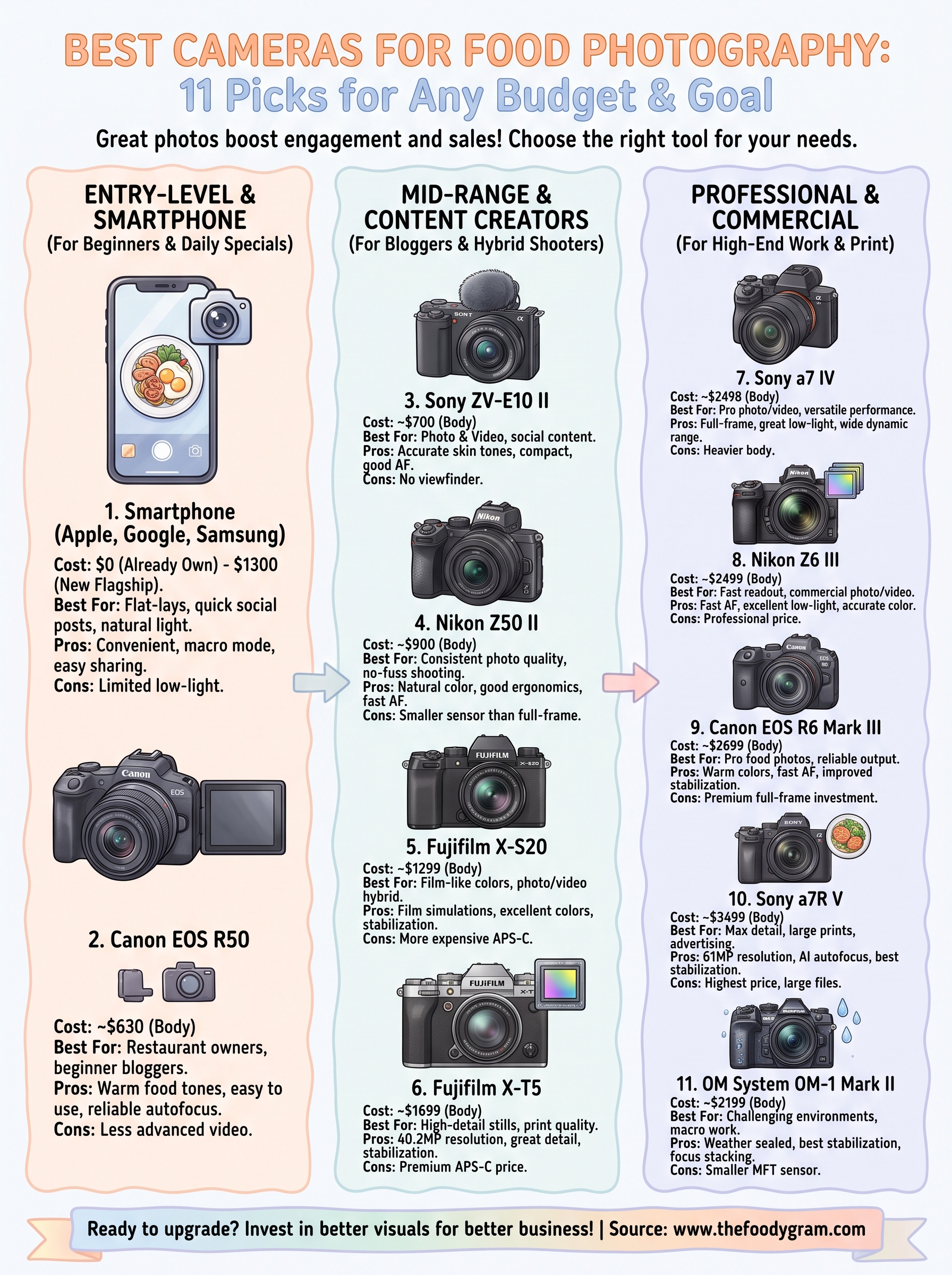
The best camera for food photography is the one that matches your current skill level, budget, and output goals. If you're a restaurant owner shooting weekly specials, a smartphone or Canon R50 gets the job done. If you're producing commercial work for print or advertising, the Sony a7R V or Nikon Z6 III gives you the resolution and dynamic range to deliver at that level. Start with what you can afford, learn it well, and upgrade when your output demands it.
Strong food photos drive real results, especially when they live on a well-designed restaurant website that converts hungry visitors into paying customers. Your images deserve a platform that shows them at their best. If you're ready to build that platform and stop paying commission fees to third-party apps, check out our commission-free online ordering plans and see which tier fits your restaurant.