


How To Use SMS Marketing For Restaurants To Boost Orders
Most restaurant owners already have a direct line to their customers, they just aren't using it. SMS marketing for restaurants is one of the most underused tools for driving repeat orders, and it works because text messages get opened. We're talking open rates above 90%, compared to email's roughly 20%. That's not a marginal difference; it's a completely different ballgame.
The challenge is knowing how to do it right. Blasting random discounts to your contact list isn't a strategy, it's a fast way to get people to unsubscribe. Effective restaurant SMS campaigns are built around timing, relevance, and a clear call to action that makes ordering easy. And when those messages link directly to your own online ordering system (not a third-party app skimming 30% off the top), every text you send protects your margins instead of padding someone else's.
At The Foody Gram, we give restaurants their own commission-free ordering website, the kind of destination that makes SMS marketing actually profitable. This guide breaks down how to build an SMS strategy that fills your queue with orders, from collecting phone numbers to crafting messages that convert. You'll also get platform recommendations and real examples you can put to work this week.
Why SMS works for restaurant orders and loyalty
Text messages get read. That's the foundational truth behind SMS marketing for restaurants: people check their phones constantly, and a text from a business they already know takes about three seconds to read. Unlike social media posts buried in algorithms or emails that pile up unread, a text lands directly in someone's pocket and demands almost no effort to consume. That immediacy is what separates SMS from every other marketing channel available to you right now.
The average person reads a text message within three minutes of receiving it, which means your Tuesday lunch special can drive orders before the rush even starts.
The numbers behind SMS engagement
Restaurant marketing lives and dies on response rates and timing, and SMS wins both categories. Open rates for text messages consistently land between 90 and 98 percent, while click-through rates on links inside texts average between 19 and 36 percent depending on the offer. Compare that to email's average 20 percent open rate and under 3 percent click-through, and the gap becomes obvious.
| Metric | SMS | |
|---|---|---|
| Average open rate | 90 to 98% | 15 to 20% |
| Average click-through rate | 19 to 36% | 2 to 3% |
| Average time to open | Under 3 minutes | 6 to 12 hours |
How SMS builds repeat customers, not just one-time orders
Loyalty grows from consistent, well-timed contact, and SMS gives you a low-friction way to stay in your customers' awareness without being intrusive. A well-placed text on a slow Wednesday afternoon, a birthday discount, or an early heads-up about a weekend special keeps your restaurant at the front of someone's mind when hunger hits. The goal is to make ordering directly from you the obvious first move before a customer even thinks about opening a third-party delivery app out of habit.
You do not need a massive contact list to generate real results. Restaurants with a few hundred opted-in subscribers often produce meaningful revenue from a single campaign because the audience is warm and self-selected. A customer who gave you their phone number already likes your food. SMS keeps that relationship active on your terms, through a direct channel with no algorithm deciding who sees your message and no commission eating into the order they place after reading it.
Step 1. Build a compliant SMS list
Before you send a single text, you need explicit written consent from every person on your list. In the United States, the Telephone Consumer Protection Act (TCPA) requires that customers opt in voluntarily before receiving any marketing texts. Skipping this step exposes your restaurant to serious legal liability and will get your messages flagged as spam fast.
Consent must be documented, meaning you need a record showing when and how each customer agreed to receive texts from your restaurant.
Where to collect opt-ins
You have several practical options for growing your list the right way. A sign-up form on your restaurant's website is the easiest starting point, especially if that site also hosts your online ordering. You can also collect numbers at the point of sale with a simple paper sign or a digital prompt on a tablet. QR codes placed on tables, receipts, and takeout bags are another effective touchpoint because customers scan them when they already have their phones in hand.
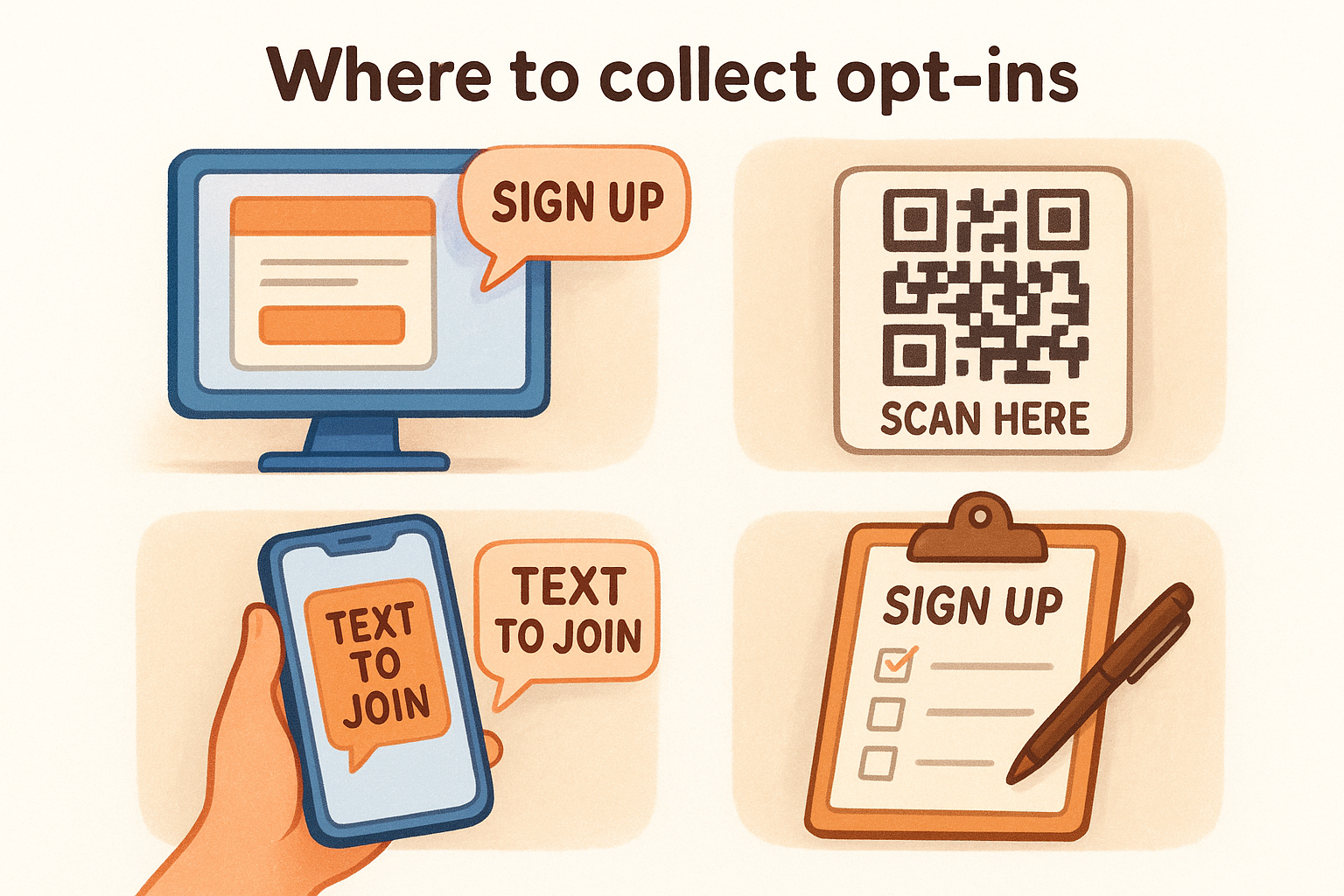
Here are the most reliable opt-in methods ranked by ease of setup:
- Website pop-up or embedded form paired with a discount offer
- QR code linking to a dedicated opt-in landing page
- Text-to-join keyword (customer texts "PIZZA" to your number)
- In-person sign-up sheet at the register
Your first opt-in confirmation text
Once someone signs up, send a confirmation message immediately. This double opt-in approach protects you legally and sets clear expectations. Here is a template you can adapt:
[Restaurant Name]: You're in! Expect exclusive deals and early specials.
Reply STOP anytime to unsubscribe. Msg & data rates may apply.
Keep your sms marketing for restaurants list clean by removing anyone who replies STOP without delay.
Step 2. Choose tools and connect your channels
Picking the right SMS platform determines how much work your sms marketing for restaurants strategy requires day to day. You want a tool that handles compliance, scheduling, and basic automation without requiring a developer to set it up. The right platform lets you focus on writing good messages rather than debugging integrations.
What to look for in an SMS platform
Your SMS tool needs to check a few non-negotiable boxes before you commit to it. Look for TCPA-compliant opt-in and opt-out management built directly into the platform, not bolted on as an afterthought. You also want two-way messaging, list segmentation by order behavior, and a simple scheduling interface so you can queue campaigns in advance instead of scrambling last minute.
The best SMS platforms connect directly with your point-of-sale or online ordering system, which lets you trigger messages based on actual customer actions rather than guessing at timing.
Well-regarded options that independent restaurants use include Klaviyo, SlickText, and Podium, all of which offer restaurant-friendly plans with list segmentation and automation workflows. Compare their pricing against your average monthly order volume before committing to a contract.
Connect SMS to your ordering system
Texts only drive profit when they link directly to your own ordering page, not to a third-party marketplace. Most SMS platforms let you add a trackable link inside every message and monitor clicks per campaign, so you can see which messages drove real orders and which ones missed.
Use a dedicated short URL for each campaign so your data stays clean and your analytics stay campaign-specific. This habit gives you clear performance data that makes every future message sharper and easier to improve.
Step 3. Send texts people want to read
Content is where most sms marketing for restaurants efforts fall apart. A compliant list and a solid platform mean nothing if the message itself makes people reach for the unsubscribe button. Every text you send should give the reader one clear reason to act, whether that means placing an order, claiming a deal, or simply remembering your restaurant exists when dinner time rolls around.
What makes a restaurant text work
A strong restaurant text follows a tight structure: a hook in the first sentence, a specific offer or piece of news, and a direct link to your ordering page. Keep the character count under 160 so the message arrives as a single text. Avoid vague language like "check us out" and replace it with specific action words like "order now" or "claim your discount." Timing matters as much as the words themselves, so send lunch offers around 10:30 AM and dinner deals around 4:00 PM, when decisions are still forming.
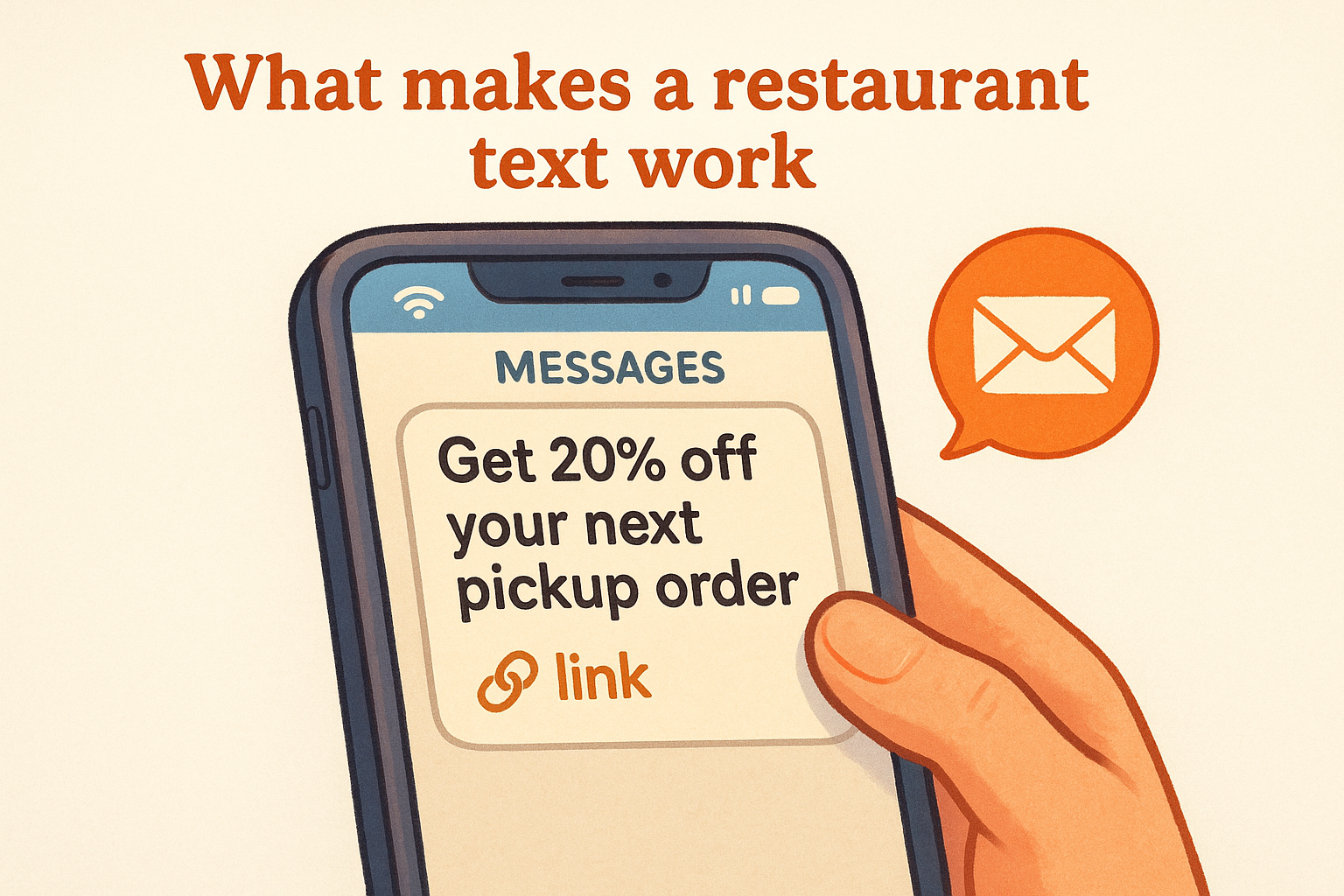
A text with a named offer ("Get 20% off your next pickup order") consistently outperforms a generic "we have a deal" message because specificity builds trust and reduces hesitation.
Templates you can use today
These templates are ready to adapt with your restaurant's name, offer, and link:
[Name]: Slow Tuesday? Not for you. Get a free order of [Item]
with any pickup over $25 today only. Order here: [link]
Reply STOP to opt out.
[Name]: Your [Day] special is here. [Dish] for $[Price],
available until close. Grab yours: [link]
Reply STOP to opt out.
Rotate your offers and vary the wording so repeat subscribers don't feel like they're reading the same message on a loop.
Step 4. Automate, measure, and improve
Manual texting works when you're starting out, but automation is what makes SMS marketing for restaurants scale without adding hours to your week. Once you set up trigger-based messages tied to customer behavior, your campaigns run in the background while you focus on the kitchen.
Set up automated triggers
Automation works by connecting your SMS platform to real customer actions like a first order, a lapsed visit, or a birthday. You define the rule once, and the platform sends the right message at the right time without any manual work on your end. Here are the triggers worth setting up first:
- Welcome message sent within 60 seconds of opt-in
- Win-back text sent to customers who haven't ordered in 30 days
- Birthday discount sent on the customer's birthday with a direct order link
- Post-order follow-up sent 24 hours after a completed order to request a review
Automated win-back messages sent 30 days after a customer's last order consistently recover a portion of lapsed customers who simply forgot you exist.
Track the metrics that matter
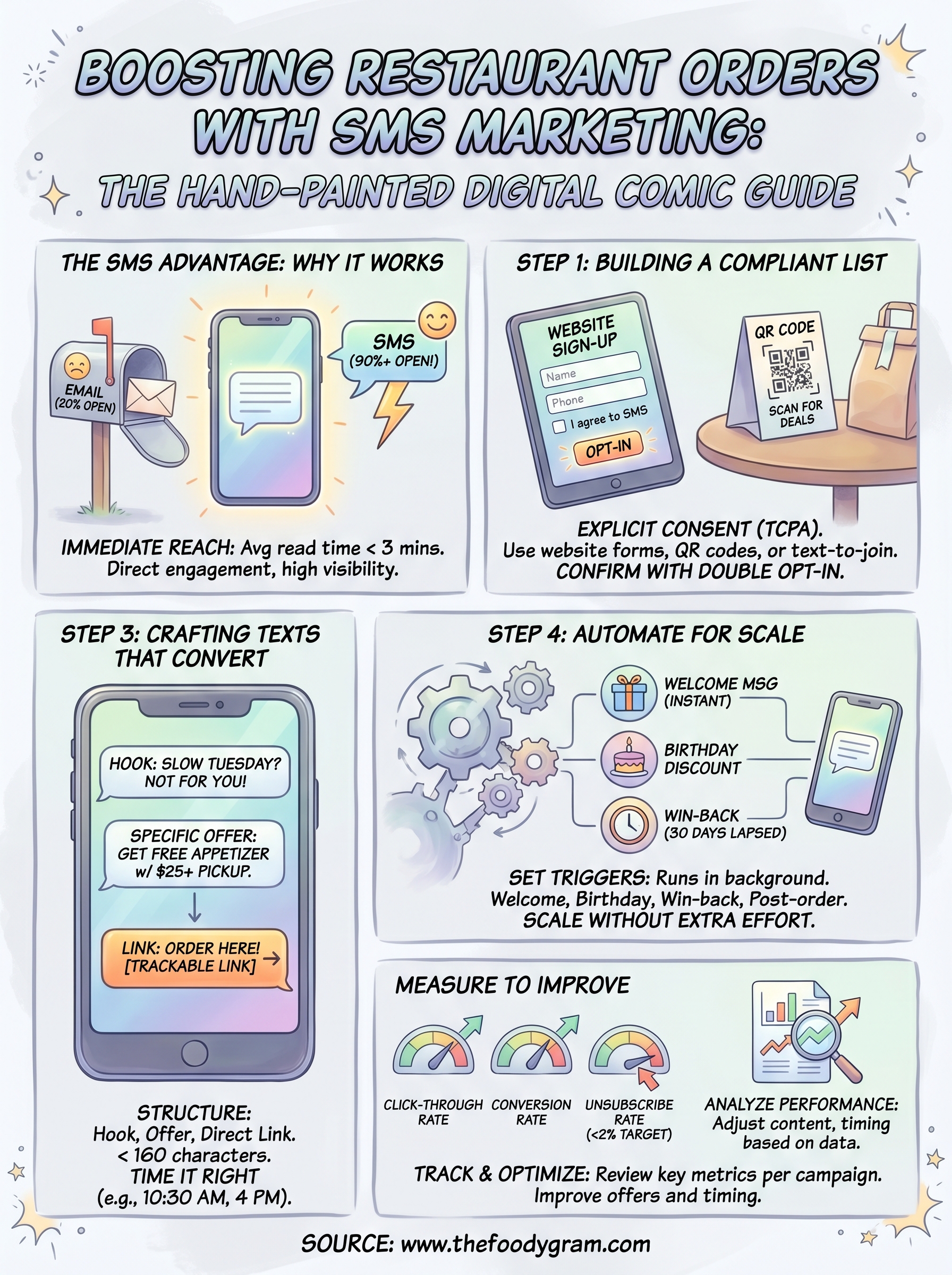
You cannot improve what you don't measure. Every campaign should be reviewed against three core numbers: click-through rate on your order link, conversion rate from click to completed order, and unsubscribe rate per message. If your unsubscribe rate climbs above 2 percent on a single campaign, the message content or timing needs adjustment before you send again.
Pull a simple performance report after each campaign and log the results. Reviewing these numbers over time shows you which offers, days, and send times drive the most orders so you can build on what actually works.
Keep it simple and consistent
SMS marketing for restaurants does not require a complex setup or a big marketing budget to produce real results. You need a clean opt-in list, a platform that handles compliance automatically, and a consistent habit of sending relevant, well-timed messages that link directly to your own ordering page. Start with one or two automated triggers and one campaign per week, then expand as you learn what your customers respond to.
Consistency is the variable most restaurants overlook. A single strong campaign will not move the needle long term, but showing up reliably in your customers' inboxes every week keeps your restaurant top of mind when they decide where to order. Every text you send to your own ordering page is a sale that stays entirely in your pocket, with no commission taken by a third-party platform. If you're ready to build that foundation, see what The Foody Gram's commission-free ordering plans include.