


5 Direct Mail Marketing Tips For Restaurants That Work
Most restaurants pour their marketing budgets into social media and paid ads, but direct mail marketing for restaurants remains one of the most effective ways to put your brand in front of local customers. A well-designed mailer sitting on someone's kitchen counter beats a skippable Instagram ad almost every time.
The catch? Direct mail only works when it drives customers to take action, and that means having a solid online presence ready to capture those orders. That's exactly what we help restaurants do at The Foody Gram: commission-free online ordering through your own branded website, so every customer a mailer brings in goes straight to your bottom line, not a third-party app's.
In this guide, we'll break down five proven direct mail strategies restaurants are using right now to fill seats, boost online orders, and build repeat business in their neighborhoods.
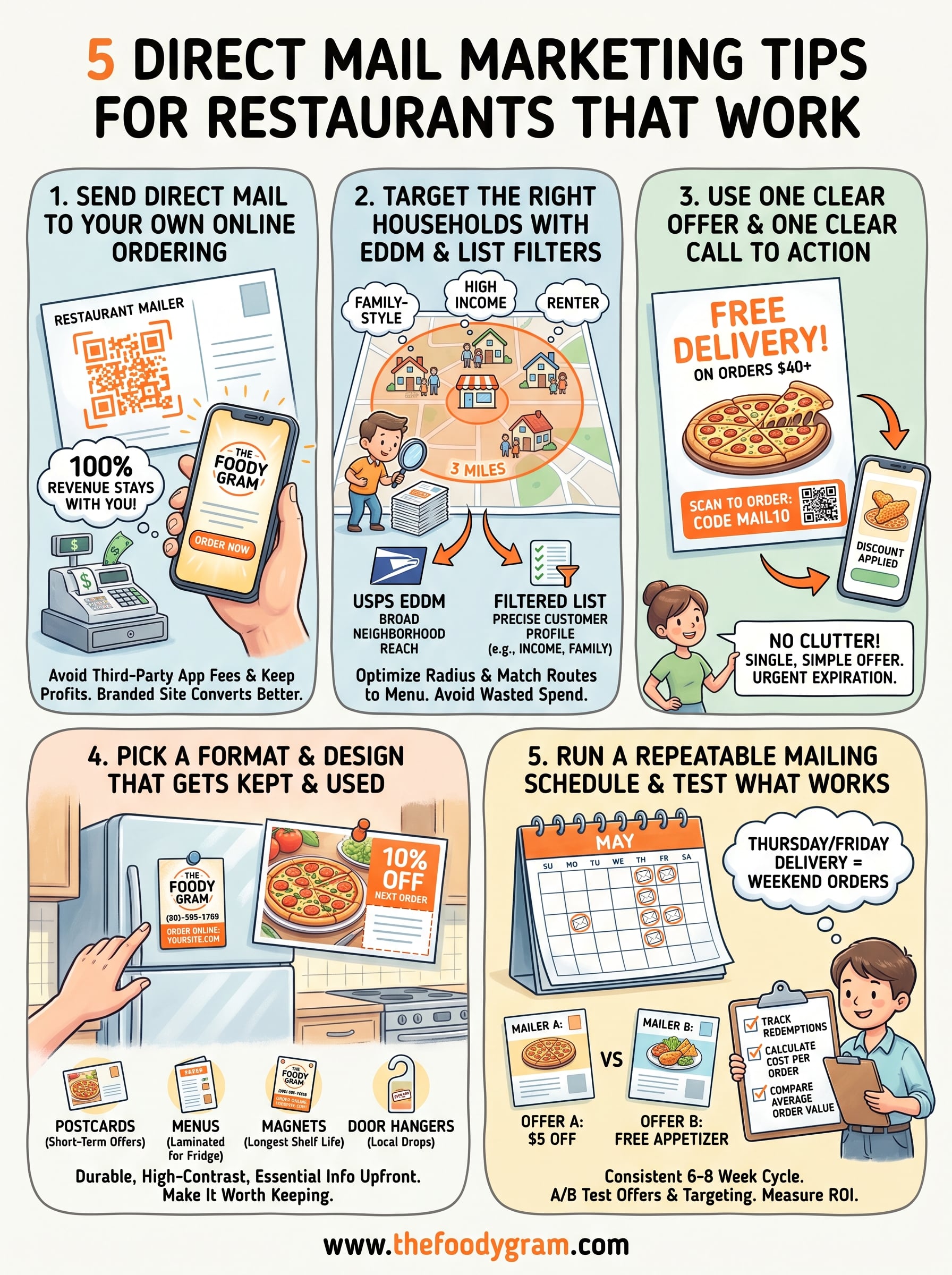
1. Send direct mail to your own online ordering
The biggest mistake restaurants make with direct mail marketing for restaurants is sending customers straight to a third-party app. When someone scans your QR code and lands on DoorDash, you lose 20-30% of that order to commission fees before you even plate the food. Every mailer you send should point directly to your own ordering page.
Why owned ordering makes direct mail more profitable
When you own your ordering channel, every dollar a mailer converts stays with your business. A $40 online order through your own website means $40 in revenue. That same order through a third-party app might net you $28 or less after fees. Multiply that across a few hundred orders per month and the math strongly favors direct ordering every time.
What to include on the mailer to drive online orders
Your mailer needs to answer three questions fast: what is the offer, how do I claim it, and where do I go. Include these essential elements on every piece you send:
- A clear, single offer (dollar off, free item, or combo deal)
- A short, branded URL that goes directly to your menu
- A QR code linked to your ordering page, not a homepage
- Your phone number for customers who prefer to call
A QR code that drops customers directly on a promo page will always convert better than one that sends them to a generic homepage to hunt for the deal.
How to set up offer-specific ordering pages on The Foody Gram
The Foody Gram lets you build custom pages tied to specific promotions, so mailer traffic lands on a page that reflects exactly what you advertised. Your team can update these pages without any technical setup, and the branded experience reinforces the mailer design, which reduces confusion and drop-off at checkout.
How to track redemptions and calculate ROI
Use a unique promo code or dedicated URL for each mail drop so you can see exactly how many orders came from that campaign. Divide your total mailing cost by the number of redemptions to get your cost per order, then compare that against your average order value to confirm the campaign returned a profit.
2. Target the right households with EDDM and list filters
Sending mailers to the wrong people wastes your budget fast. Targeting strategy separates a profitable campaign from one that fills recycling bins. Two main approaches exist for restaurants: USPS Every Door Direct Mail (EDDM) and targeted mailing lists built with demographic filters.
When to use Every Door Direct Mail versus a purchased list
EDDM works best when you want broad coverage in a specific area, like a neighborhood you're introducing yourself to for the first time. A purchased list with demographic filters gives you tighter control when you need to reach a specific customer profile rather than blanketing every address on a carrier route.
How to pick routes and set a realistic delivery radius
Most full-service restaurants see diminishing returns beyond a 5-mile radius, while fast-casual and pizza concepts can stretch to 7 miles. Use the USPS EDDM mapping tool to browse routes by household count and cost before you commit to a drop.
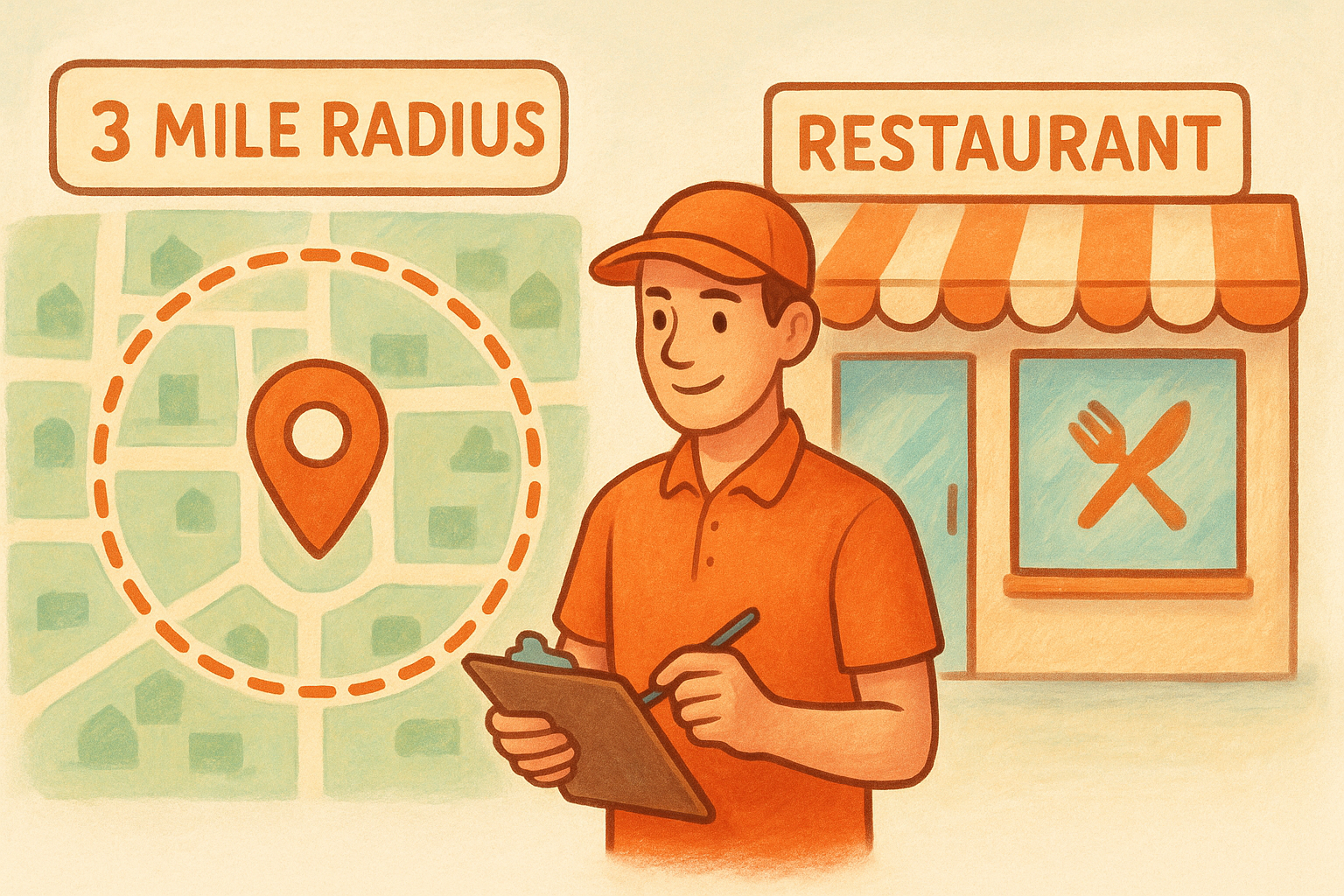
A 3-mile radius around your location will almost always outperform a wider net at half the cost per conversion.
How to layer targeting by neighborhood and customer type
Layering filters like household income, renter versus owner status, and presence of children helps you prioritize routes that match your menu and price point. A family-style restaurant benefits from targeting owner-occupied homes with children, while a higher-end concept should filter toward households in higher income brackets.
How to avoid wasted spend from bad geography
Check your existing customer order data before finalizing any routes. If your online orders cluster around specific zip codes, those areas deserve the bulk of your budget. Order history from your direct ordering platform gives you real evidence instead of guesswork when allocating your direct mail marketing for restaurants spend.
3. Use one clear offer and one clear call to action
Restaurants that try to advertise three specials and two events on a single mailer end up communicating nothing. One offer and one action is the rule that separates high-converting direct mail marketing for restaurants from expensive clutter that gets tossed.
How to choose an offer that fits your margins
Pick an offer you can sustain even if it converts well. Free delivery, a fixed dollar amount off a minimum order, or a bundled deal (like a pizza and two sides) protect your margins better than a flat percentage discount, which scales against you as order sizes grow.
How to write a CTA that tells people exactly what to do
Your call to action should tell customers exactly what to do and where to go in plain language. "Order online at [yoursite.com] with code MAIL10" works. "Visit us today!" does not.
The shorter and more specific your CTA, the fewer steps a customer has to figure out on their own, and the higher your conversion rate.
How to add urgency without looking spammy
A clear expiration date on the offer gives customers a reason to act now rather than set the mailer aside. Stick to a 3-4 week window so the sense of urgency stays credible.
How to prevent coupon abuse and discount hunters
Limit each promo code to one use per phone number or email address in your ordering platform. This keeps the offer focused on new and lapsed customers rather than regulars who would have ordered anyway.
4. Pick a format and design that gets kept and used
The format you choose determines whether your mailer lands in a drawer or a trash can. Physical format and design quality carry more weight in direct mail marketing for restaurants than most owners expect, because they directly affect how long a piece stays inside a home.
Postcards, menus, magnets, and door hangers compared
Each format serves a different purpose. Postcards work best for single offers with short deadlines, while laminated menus get pinned to refrigerators and generate repeat orders for months. Magnets cost more per piece but deliver the longest shelf life of any format. Door hangers work well for hyper-local drops without needing postage.
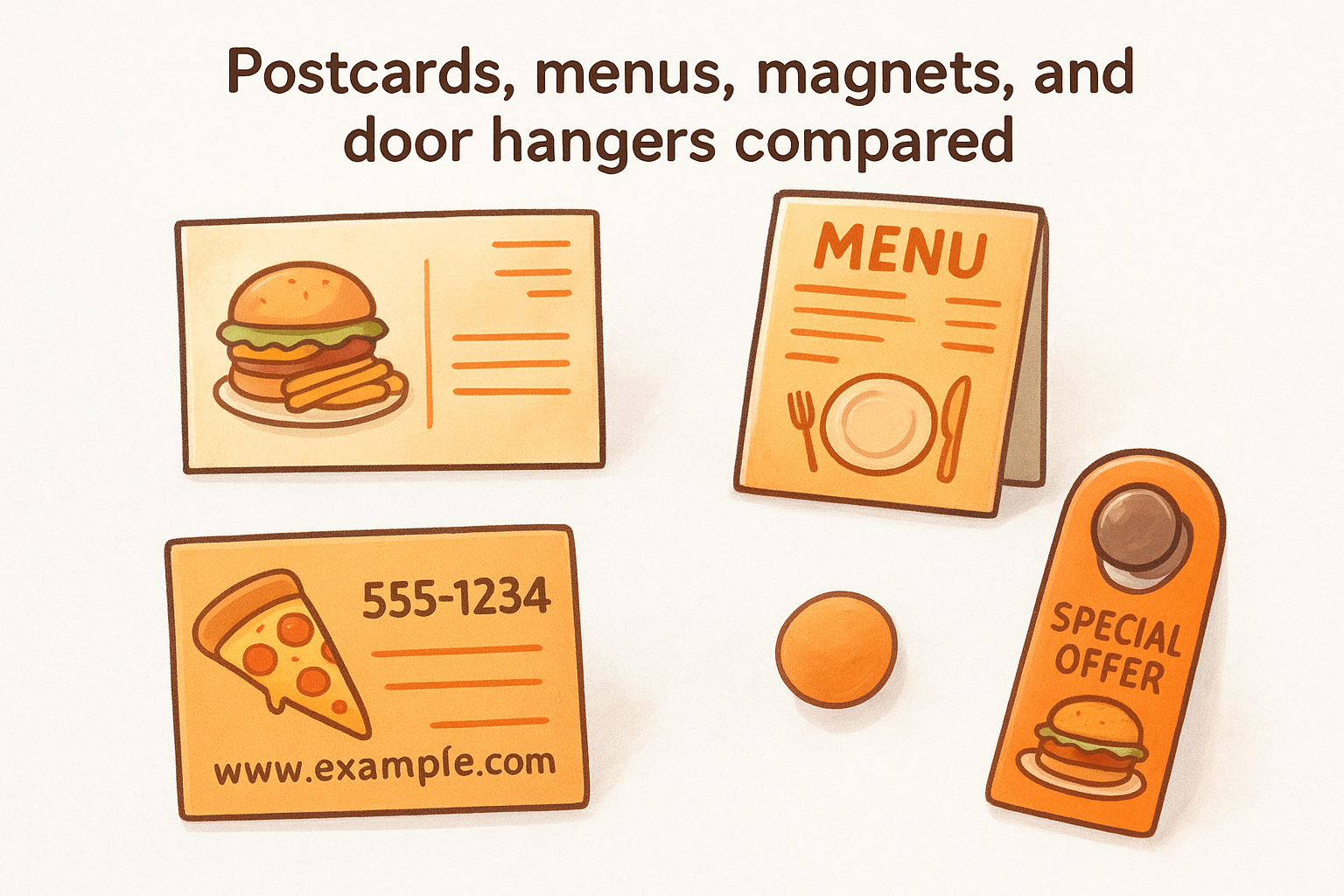
A magnet with your phone number and URL on it pays for itself the first time a customer orders instead of searching for a competitor.
Layout rules that make the offer easy to see fast
Keep your offer and call to action visible within two seconds of someone picking up the piece. Use a large headline with high-contrast colors and place your QR code in the lower right corner where eyes naturally land last.
What details matter most for restaurant mailers
Always include your restaurant name, logo, and website URL along with your phone number and hours. Missing any of these forces a customer to search for basic information you should have provided upfront.
Printing choices that improve response rates
Thick cardstock and UV coating make mailers feel substantial and survive longer in kitchens. Glossy finishes on food photography improve color accuracy and make your dishes look far more appealing than matte alternatives.
5. Run a repeatable mailing schedule and test what works
One well-timed mailer rarely moves the needle on its own. Consistency and testing are what turn direct mail marketing for restaurants from a one-off experiment into a reliable customer acquisition system.
The best cadence for new customer acquisition and retention
New customer campaigns work best on a 6-8 week cycle, giving households enough time to act before the next piece arrives. For retention, monthly drops to lapsed customers (those who haven't ordered in 60 or more days) tend to deliver strong returns without oversaturating your audience.
How to time mail drops around promos and slow days
Mail lands 2-5 days after the drop date, so plan backward from your target arrival window. Sending mailers to arrive on Thursdays or Fridays positions your offer perfectly for weekend ordering, which is typically your highest-volume period.
Timing your drop to land the week before a local event or holiday puts your restaurant in front of customers exactly when they're deciding where to eat.
How to A and B test offers, creative, and targeting
Split your list into two equal segments and change only one variable per campaign, whether that's the offer, the headline, or the route. Keeping variables isolated gives you clean data to act on rather than guessing which change drove results.
What numbers to watch after each drop
Track these three metrics after every campaign to measure overall campaign performance:
- Redemption rate: orders using your promo code divided by total pieces mailed
- Cost per order: total mailing cost divided by redemptions
- Average order value: confirms the offer attracted worthwhile customers, not just bargain hunters
Next Steps
Direct mail marketing for restaurants works best when it drives customers to an ordering channel you actually own. Every tip in this guide, from targeting the right routes to picking the right format, depends on having a reliable, branded destination ready the moment customers scan your QR code or type in your URL.
That's where The Foody Gram comes in. You get a commission-free online ordering system and a custom-branded restaurant website built within 48-72 hours, so your next mailer has somewhere worth sending people. No contracts, no setup fees, and a 45-day money-back guarantee keep the barrier to starting low.
Stop losing a third of every order to delivery app commissions. Review our commission-free restaurant ordering plans and choose the tier that fits your location count and monthly budget. Your next mail drop deserves an ordering page that captures and converts every customer you worked hard to bring in.